

The periglacial environment
167
3.5. Fluvial activity
The literature about fluvial activity in periglacial environments is very scarce.
Traditionally it was considered to be not very relevant because the water remains in the
solid state throughout most of the year. Its geomorphic effect was thought to be limited
because rivers in periglacial areas without allogenic supply only have flowing waters
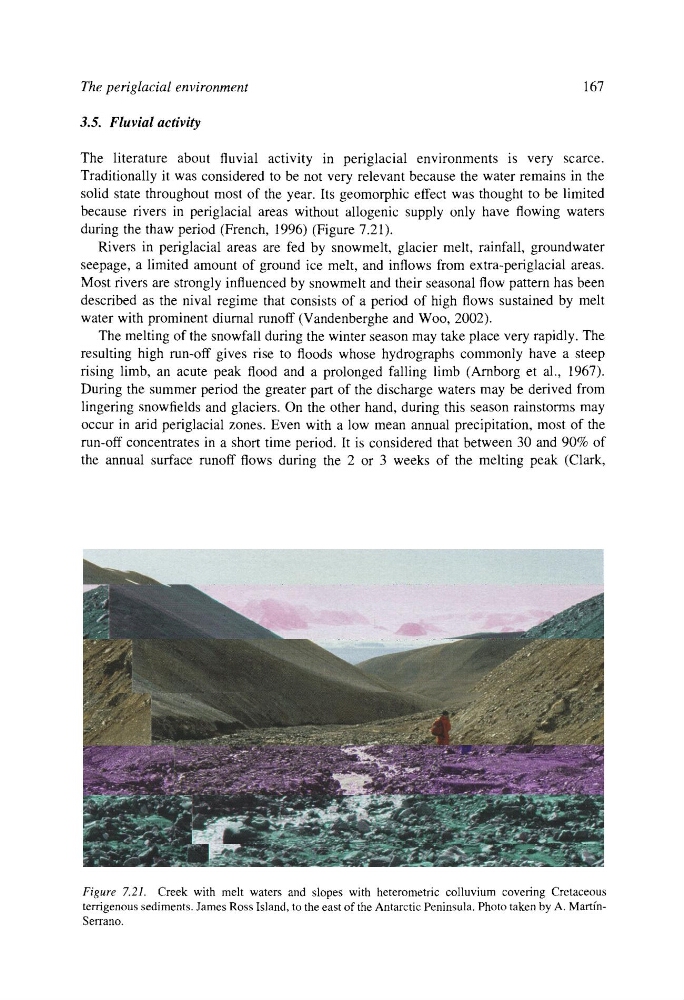
during the thaw period (French, 1996) (Figure 7.21).
Rivers in periglacial areas are fed by snowmelt, glacier melt, rainfall, groundwater
seepage, a limited amount of ground ice melt, and inflows from extra-periglacial areas.
Most rivers are strongly influenced by snowmelt and their seasonal flow pattern has been
described as the nival regime that consists of a period of high flows sustained by melt
water with prominent diurnal runoff (Vandenberghe and Woo, 2002).
The melting of the snowfall during the winter season may take place very rapidly. The
resulting high run-off gives rise to floods whose hydrographs commonly have a steep
rising limb, an acute peak flood and a prolonged falling limb (Arnborg et al., 1967).
During the summer period the greater part of the discharge waters may be derived from
lingering snowfields and glaciers. On the other hand, during this season rainstorms may
occur in arid periglacial zones. Even with a low mean annual precipitation, most of the
run-off concentrates in a short time period. It is considered that between 30 and 90% of
the annual surface runoff flows during the 2 or 3 weeks of the melting peak (Clark,
Figure 7.21. Creek with melt waters and slopes with heterometric colluvium covering Cretaceous
terrigenous sediments. James Ross Island, to the east of the Antarctic Peninsula. Photo taken by A. MartfnSerrano.
167
3.5. Fluvial activity
The literature about fluvial activity in periglacial environments is very scarce.
Traditionally it was considered to be not very relevant because the water remains in the
solid state throughout most of the year. Its geomorphic effect was thought to be limited
because rivers in periglacial areas without allogenic supply only have flowing waters
during the thaw period (French, 1996) (Figure 7.21).
Rivers in periglacial areas are fed by snowmelt, glacier melt, rainfall, groundwater
seepage, a limited amount of ground ice melt, and inflows from extra-periglacial areas.
Most rivers are strongly influenced by snowmelt and their seasonal flow pattern has been
described as the nival regime that consists of a period of high flows sustained by melt
water with prominent diurnal runoff (Vandenberghe and Woo, 2002).
The melting of the snowfall during the winter season may take place very rapidly. The
resulting high run-off gives rise to floods whose hydrographs commonly have a steep
rising limb, an acute peak flood and a prolonged falling limb (Arnborg et al., 1967).
During the summer period the greater part of the discharge waters may be derived from
lingering snowfields and glaciers. On the other hand, during this season rainstorms may
occur in arid periglacial zones. Even with a low mean annual precipitation, most of the
run-off concentrates in a short time period. It is considered that between 30 and 90% of
the annual surface runoff flows during the 2 or 3 weeks of the melting peak (Clark,
Figure 7.21. Creek with melt waters and slopes with heterometric colluvium covering Cretaceous
terrigenous sediments. James Ross Island, to the east of the Antarctic Peninsula. Photo taken by A. MartfnSerrano.