

162
Climatic Geomorphology
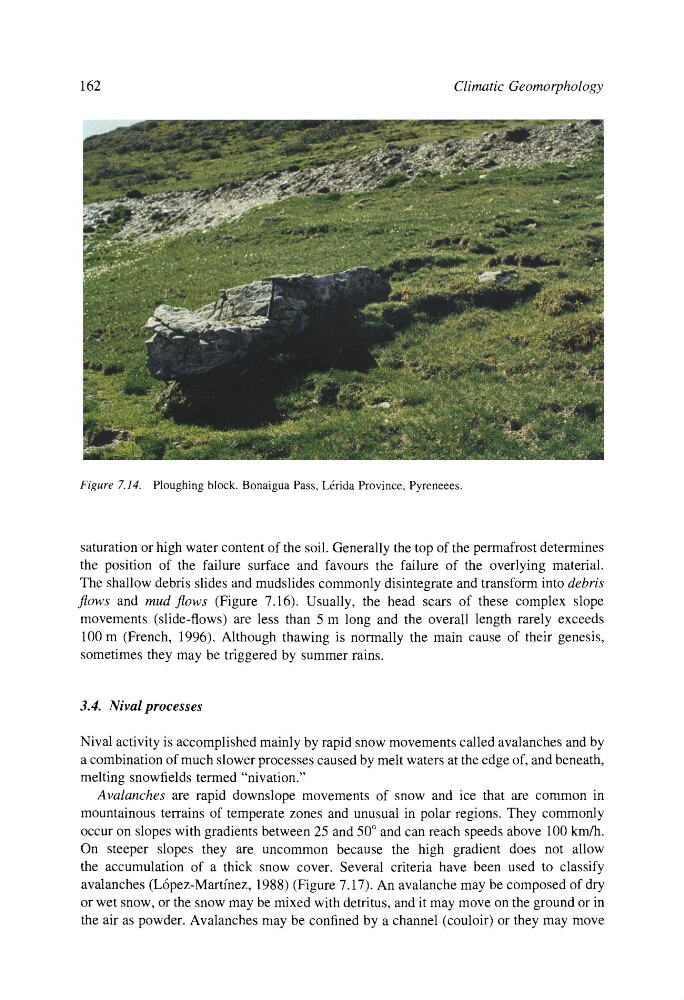
Figure 7.14. Ploughing block. Bonaigua Pass, L~rida Province, Pyreneees.
saturation or high water content of the soil. Generally the top of the permafrost determines
the position of the failure surface and favours the failure of the overlying material.
The shallow debris slides and mudslides commonly disintegrate and transform into debris
flows and mud flows (Figure 7.16). Usually, the head scars of these complex slope
movements (slide-flows) are less than 5 m long and the overall length rarely exceeds
100 m (French, 1996). Although thawing is normally the main cause of their genesis,
sometimes they may be triggered by summer rains.
3.4. Nival processes
Nival activity is accomplished mainly by rapid snow movements called avalanches and by
a combination of much slower processes caused by melt waters at the edge of, and beneath,
melting snowfields termed "nivation."
Avalanches are rapid downslope movements of snow and ice that are common in
mountainous terrains of temperate zones and unusual in polar regions. They commonly
occur on slopes with gradients between 25 and 50 ~ and can reach speeds above 100 km/h.
On steeper slopes they are uncommon because the high gradient does not allow
the accumulation of a thick snow cover. Several criteria have been used to classify
avalanches (Lrpez-Martfnez, 1988) (Figure 7.17). An avalanche may be composed of dry
or wet snow, or the snow may be mixed with detritus, and it may move on the ground or in
the air as powder. Avalanches may be confined by a channel (couloir) or they may move
Climatic Geomorphology
Figure 7.14. Ploughing block. Bonaigua Pass, L~rida Province, Pyreneees.
saturation or high water content of the soil. Generally the top of the permafrost determines
the position of the failure surface and favours the failure of the overlying material.
The shallow debris slides and mudslides commonly disintegrate and transform into debris
flows and mud flows (Figure 7.16). Usually, the head scars of these complex slope
movements (slide-flows) are less than 5 m long and the overall length rarely exceeds
100 m (French, 1996). Although thawing is normally the main cause of their genesis,
sometimes they may be triggered by summer rains.
3.4. Nival processes
Nival activity is accomplished mainly by rapid snow movements called avalanches and by
a combination of much slower processes caused by melt waters at the edge of, and beneath,
melting snowfields termed "nivation."
Avalanches are rapid downslope movements of snow and ice that are common in
mountainous terrains of temperate zones and unusual in polar regions. They commonly
occur on slopes with gradients between 25 and 50 ~ and can reach speeds above 100 km/h.
On steeper slopes they are uncommon because the high gradient does not allow
the accumulation of a thick snow cover. Several criteria have been used to classify
avalanches (Lrpez-Martfnez, 1988) (Figure 7.17). An avalanche may be composed of dry
or wet snow, or the snow may be mixed with detritus, and it may move on the ground or in
the air as powder. Avalanches may be confined by a channel (couloir) or they may move