

The periglacial environment
161
PI-~,P2
pl----* p2---* p 5
P2"~" P3
P3-~,P4
O
t~
"5
o)
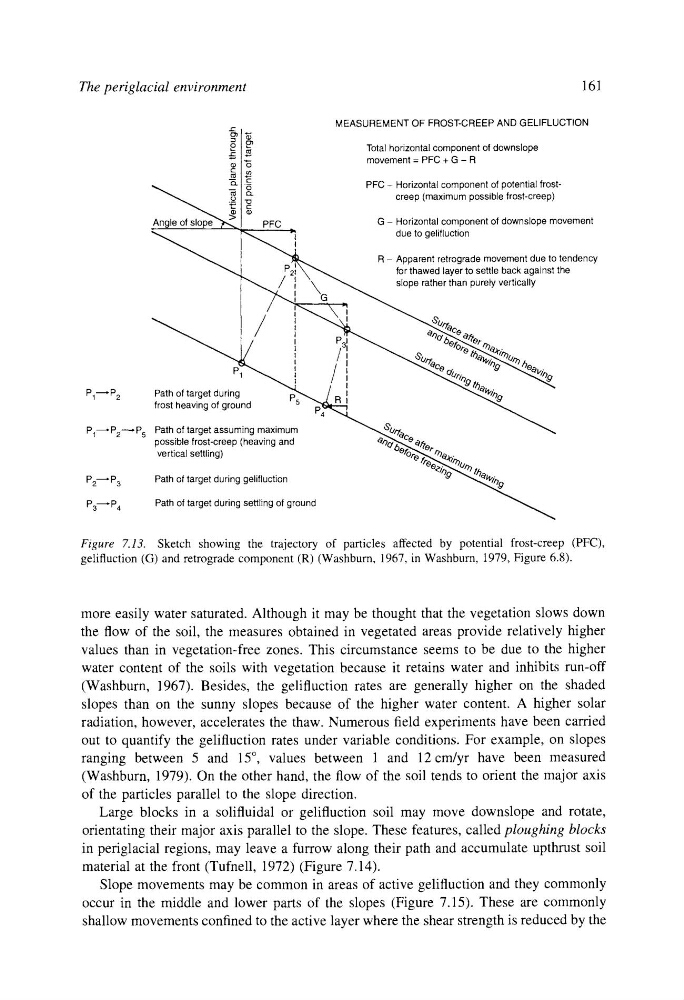
MEASUREMENT OF FROST-CREEP AND GELIFLUCTION
Total horizontal component of downslope
movement = PFC + G - R
t-~
-~
PFC - Horizontal component of potential frostcreep (maximum possible frost-creep)
._o "O
tI1)
PFC
G - Horizontal component of downslope movement
~
~.t
due to gelifluction
R - Apparent retrograde movement due to tendency
921X~
for thawed layer to settle back against the
/ I
slope rather than purely vertically
s
!os, :avn+o +,ou?0
o
Path of target assum'mg maximum
"'"~OO, ~
:::::::::::::::::::::i.eavinga+
.
,.,,
. ~
fr~/OTOrO
+oi++r,n00e +, uc, on
Path of target during settling of ground
Figure 7.13. Sketch showing the trajectory of particles affected by potential frost-creep (PFC),
gelifluction (G) and retrograde component (R) (Washburn, 1967, in Washburn, 1979, Figure 6.8).
more easily water saturated. Although it may be thought that the vegetation slows down
the flow of the soil, the measures obtained in vegetated areas provide relatively higher
values than in vegetation-free zones. This circumstance seems to be due to the higher
water content of the soils with vegetation because it retains water and inhibits run-off
(Washburn, 1967). Besides, the gelifluction rates are generally higher on the shaded
slopes than on the sunny slopes because of the higher water content. A higher solar
radiation, however, accelerates the thaw. Numerous field experiments have been carried
out to quantify the gelifluction rates under variable conditions. For example, on slopes
ranging between 5 and 15 ~ values between 1 and 12 cm/yr have been measured
(Washburn, 1979). On the other hand, the flow of the soil tends to orient the major axis
of the particles parallel to the slope direction.
Large blocks in a solifluidal or gelifluction soil may move downslope and rotate,
orientating their major axis parallel to the slope. These features, called ploughing blocks
in periglacial regions, may leave a furrow along their path and accumulate upthrust soil
material at the front (Tufnell, 1972) (Figure 7.14).
Slope movements may be common in areas of active gelifluction and they commonly
occur in the middle and lower parts of the slopes (Figure 7.15). These are commonly
shallow movements confined to the active layer where the shear strength is reduced by the
161
PI-~,P2
pl----* p2---* p 5
P2"~" P3
P3-~,P4
O
t~
"5
o)
MEASUREMENT OF FROST-CREEP AND GELIFLUCTION
Total horizontal component of downslope
movement = PFC + G - R
t-~
-~
PFC - Horizontal component of potential frostcreep (maximum possible frost-creep)
._o "O
tI1)
PFC
G - Horizontal component of downslope movement
~
~.t
due to gelifluction
R - Apparent retrograde movement due to tendency
921X~
for thawed layer to settle back against the
/ I
slope rather than purely vertically
s
!os, :avn+o +,ou?0
o
Path of target assum'mg maximum
"'"~OO, ~
:::::::::::::::::::::i.eavinga+
.
,.,,
. ~
fr~/OTOrO
+oi++r,n00e +, uc, on
Path of target during settling of ground
Figure 7.13. Sketch showing the trajectory of particles affected by potential frost-creep (PFC),
gelifluction (G) and retrograde component (R) (Washburn, 1967, in Washburn, 1979, Figure 6.8).
more easily water saturated. Although it may be thought that the vegetation slows down
the flow of the soil, the measures obtained in vegetated areas provide relatively higher
values than in vegetation-free zones. This circumstance seems to be due to the higher
water content of the soils with vegetation because it retains water and inhibits run-off
(Washburn, 1967). Besides, the gelifluction rates are generally higher on the shaded
slopes than on the sunny slopes because of the higher water content. A higher solar
radiation, however, accelerates the thaw. Numerous field experiments have been carried
out to quantify the gelifluction rates under variable conditions. For example, on slopes
ranging between 5 and 15 ~ values between 1 and 12 cm/yr have been measured
(Washburn, 1979). On the other hand, the flow of the soil tends to orient the major axis
of the particles parallel to the slope direction.
Large blocks in a solifluidal or gelifluction soil may move downslope and rotate,
orientating their major axis parallel to the slope. These features, called ploughing blocks
in periglacial regions, may leave a furrow along their path and accumulate upthrust soil
material at the front (Tufnell, 1972) (Figure 7.14).
Slope movements may be common in areas of active gelifluction and they commonly
occur in the middle and lower parts of the slopes (Figure 7.15). These are commonly
shallow movements confined to the active layer where the shear strength is reduced by the