

154
Climatic Geomorphology
100
OOC~ ~
oo!
80
-3
7O
60
o~ 50
40
30
20
10
050 100 200
500 1000 2000 500010000 20000
(a)
#m
2050 1100
1 O0 r- .......
~
820
9oF
////I
8o I
2so
70
60
,,o
10
0
50 100 200
500 1000 2000 500010000 20000
(b)
#m
E 3
o
r
~2
"0
o
' 560
16oo
1 oo
2obo
(c)
t (cycles)
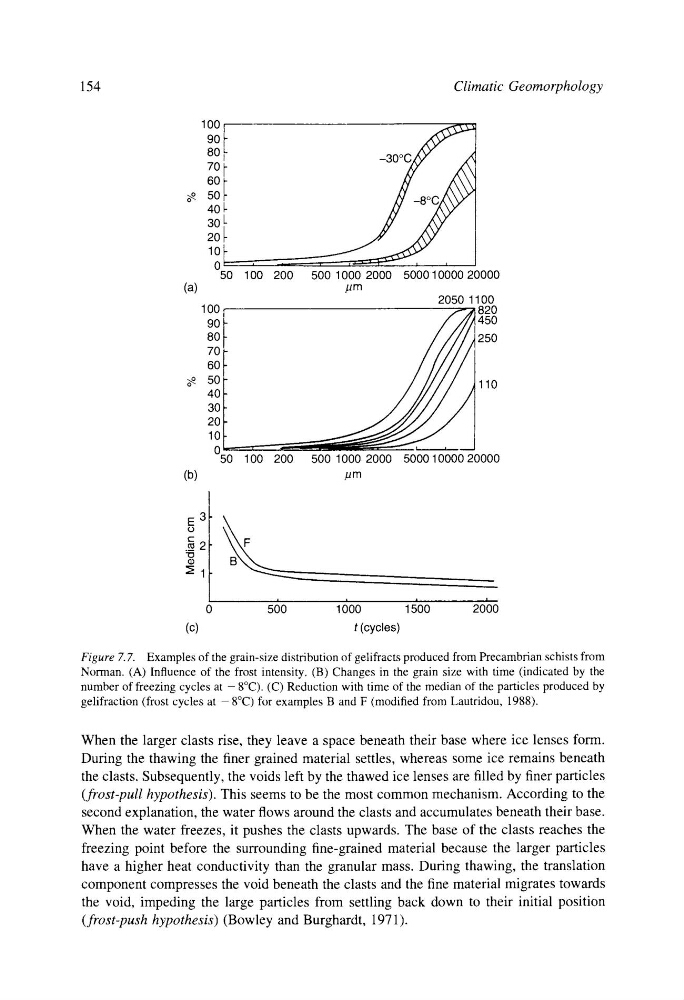
Figure 7. 7. Examples of the grain-size distribution of gelifracts produced from Precambrian schists from
Norman. (A) Influence of the frost intensity. (B) Changes in the grain size with time (indicated by the
number of freezing cycles at - 8~ (C) Reduction with time of the median of the particles produced by
gelifraction (frost cycles at - 8~ for examples B and F (modified from Lautridou, 1988).
When the larger clasts rise, they leave a space beneath their base where ice lenses form.
During the thawing the finer grained material settles, whereas some ice remains beneath
the clasts. Subsequently, the voids left by the thawed ice lenses are filled by finer particles
(frost-pull hypothesis). This seems to be the most common mechanism. According to the
second explanation, the water flows around the clasts and accumulates beneath their base.
When the water freezes, it pushes the clasts upwards. The base of the clasts reaches the
freezing point before the surrounding fine-grained material because the larger particles
have a higher heat conductivity than the granular mass. During thawing, the translation
component compresses the void beneath the clasts and the fine material migrates towards
the void, impeding the large particles from settling back down to their initial position
(frost-push hypothesis) (Bowley and Burghardt, 1971).
Climatic Geomorphology
100
OOC~ ~
oo!
80
-3
7O
60
o~ 50
40
30
20
10
050 100 200
500 1000 2000 500010000 20000
(a)
#m
2050 1100
1 O0 r- .......
~
820
9oF
////I
8o I
2so
70
60
,,o
10
0
50 100 200
500 1000 2000 500010000 20000
(b)
#m
E 3
o
r
~2
"0
o
' 560
16oo
1 oo
2obo
(c)
t (cycles)
Figure 7. 7. Examples of the grain-size distribution of gelifracts produced from Precambrian schists from
Norman. (A) Influence of the frost intensity. (B) Changes in the grain size with time (indicated by the
number of freezing cycles at - 8~ (C) Reduction with time of the median of the particles produced by
gelifraction (frost cycles at - 8~ for examples B and F (modified from Lautridou, 1988).
When the larger clasts rise, they leave a space beneath their base where ice lenses form.
During the thawing the finer grained material settles, whereas some ice remains beneath
the clasts. Subsequently, the voids left by the thawed ice lenses are filled by finer particles
(frost-pull hypothesis). This seems to be the most common mechanism. According to the
second explanation, the water flows around the clasts and accumulates beneath their base.
When the water freezes, it pushes the clasts upwards. The base of the clasts reaches the
freezing point before the surrounding fine-grained material because the larger particles
have a higher heat conductivity than the granular mass. During thawing, the translation
component compresses the void beneath the clasts and the fine material migrates towards
the void, impeding the large particles from settling back down to their initial position
(frost-push hypothesis) (Bowley and Burghardt, 1971).