

The periglacial environment
153
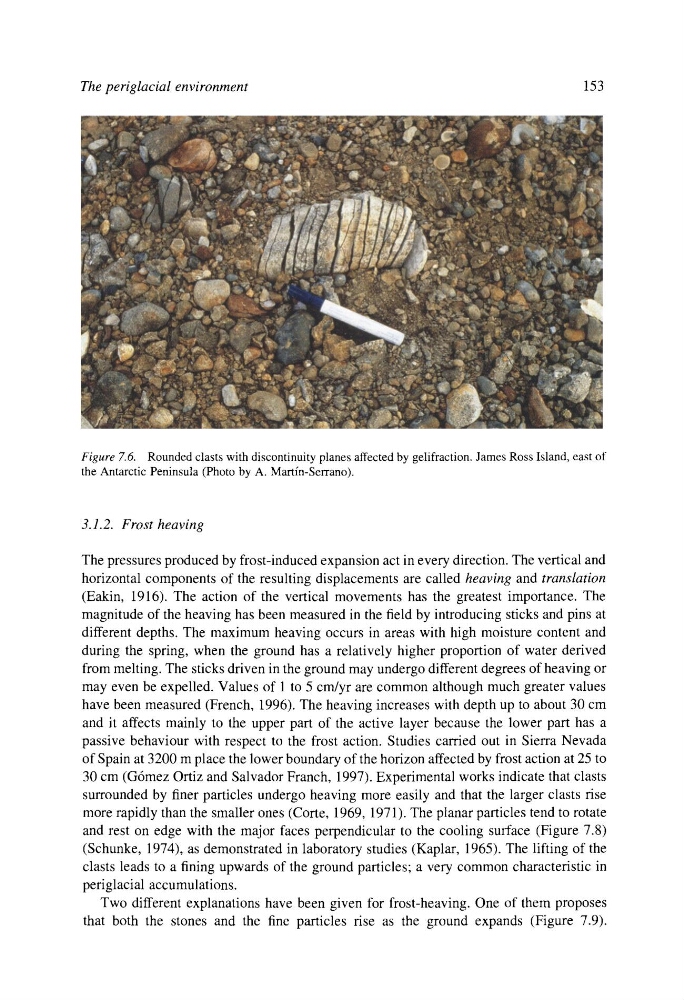
Figure 7.6. Rounded clasts with discontinuity planes affected by gelifraction. James Ross Island, east of
the Antarctic Peninsula (Photo by A. Martfn-Serrano).
3.1.2. Frost heaving
The pressures produced by frost-induced expansion act in every direction. The vertical and
horizontal components of the resulting displacements are called heaving and translation
(Eakin, 1916). The action of the vertical movements has the greatest importance. The
magnitude of the heaving has been measured in the field by introducing sticks and pins at
different depths. The maximum heaving occurs in areas with high moisture content and
during the spring, when the ground has a relatively higher proportion of water derived
from melting. The sticks driven in the ground may undergo different degrees of heaving or
may even be expelled. Values of 1 to 5 cm/yr are common although much greater values
have been measured (French, 1996). The heaving increases with depth up to about 30 cm
and it affects mainly to the upper part of the active layer because the lower part has a
passive behaviour with respect to the frost action. Studies carried out in Sierra Nevada
of Spain at 3200 m place the lower boundary of the horizon affected by frost action at 25 to
30 cm (Grmez Ortiz and Salvador Franch, 1997). Experimental works indicate that clasts
surrounded by finer particles undergo heaving more easily and that the larger clasts rise
more rapidly than the smaller ones (Corte, 1969, 1971). The planar particles tend to rotate
and rest on edge with the major faces perpendicular to the cooling surface (Figure 7.8)
(Schunke, 1974), as demonstrated in laboratory studies (Kaplar, 1965). The lifting of the
clasts leads to a fining upwards of the ground particles; a very common characteristic in
periglacial accumulations.
Two different explanations have been given for frost-heaving. One of them proposes
that both the stones and the fine particles rise as the ground expands (Figure 7.9).
153
Figure 7.6. Rounded clasts with discontinuity planes affected by gelifraction. James Ross Island, east of
the Antarctic Peninsula (Photo by A. Martfn-Serrano).
3.1.2. Frost heaving
The pressures produced by frost-induced expansion act in every direction. The vertical and
horizontal components of the resulting displacements are called heaving and translation
(Eakin, 1916). The action of the vertical movements has the greatest importance. The
magnitude of the heaving has been measured in the field by introducing sticks and pins at
different depths. The maximum heaving occurs in areas with high moisture content and
during the spring, when the ground has a relatively higher proportion of water derived
from melting. The sticks driven in the ground may undergo different degrees of heaving or
may even be expelled. Values of 1 to 5 cm/yr are common although much greater values
have been measured (French, 1996). The heaving increases with depth up to about 30 cm
and it affects mainly to the upper part of the active layer because the lower part has a
passive behaviour with respect to the frost action. Studies carried out in Sierra Nevada
of Spain at 3200 m place the lower boundary of the horizon affected by frost action at 25 to
30 cm (Grmez Ortiz and Salvador Franch, 1997). Experimental works indicate that clasts
surrounded by finer particles undergo heaving more easily and that the larger clasts rise
more rapidly than the smaller ones (Corte, 1969, 1971). The planar particles tend to rotate
and rest on edge with the major faces perpendicular to the cooling surface (Figure 7.8)
(Schunke, 1974), as demonstrated in laboratory studies (Kaplar, 1965). The lifting of the
clasts leads to a fining upwards of the ground particles; a very common characteristic in
periglacial accumulations.
Two different explanations have been given for frost-heaving. One of them proposes
that both the stones and the fine particles rise as the ground expands (Figure 7.9).