

The periglacial environment
151
tcl
Ground surface
Permafrost table
Mean annual ground
temperature
/
7../`
Minimum monthly
mean temperature
Temperature (~
-
0
+
"----~
Active layer
S
XX~X
XXK
i
I
Maximum monthly
I mean temperature
I
I
Level of zero
_.~~t~ annual amplitude
-(20-50 if)
6-16m)
i
t
I
I
I
I
Permafrost
I
I
I
I
I
I
I
I
I
I
I
I
I
I
I
I
I
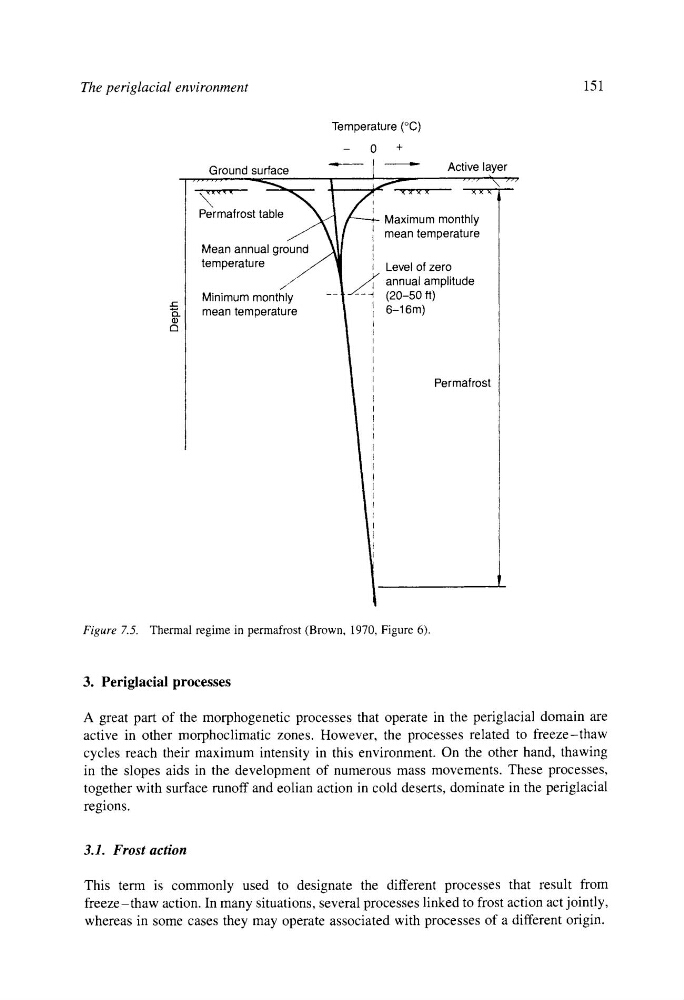
Figure 7.5. Thermal regime in permafrost (Brown, 1970, Figure 6).
3. Periglacial processes
A great part of the morphogenetic processes that operate in the periglacial domain are
active in other morphoclimatic zones. However, the processes related to freeze-thaw
cycles reach their maximum intensity in this environment. On the other hand, thawing
in the slopes aids in the development of numerous mass movements. These processes,
together with surface runoff and eolian action in cold deserts, dominate in the periglacial
regions.
3.1. Frost action
This term is commonly used to designate the different processes that result from
freeze-thaw action. In many situations, several processes linked to frost action act jointly,
whereas in some cases they may operate associated with processes of a different origin.
151
tcl
Ground surface
Permafrost table
Mean annual ground
temperature
/
7../`
Minimum monthly
mean temperature
Temperature (~
-
0
+
"----~
Active layer
S
XX~X
XXK
i
I
Maximum monthly
I mean temperature
I
I
Level of zero
_.~~t~ annual amplitude
-(20-50 if)
6-16m)
i
t
I
I
I
I
Permafrost
I
I
I
I
I
I
I
I
I
I
I
I
I
I
I
I
I
Figure 7.5. Thermal regime in permafrost (Brown, 1970, Figure 6).
3. Periglacial processes
A great part of the morphogenetic processes that operate in the periglacial domain are
active in other morphoclimatic zones. However, the processes related to freeze-thaw
cycles reach their maximum intensity in this environment. On the other hand, thawing
in the slopes aids in the development of numerous mass movements. These processes,
together with surface runoff and eolian action in cold deserts, dominate in the periglacial
regions.
3.1. Frost action
This term is commonly used to designate the different processes that result from
freeze-thaw action. In many situations, several processes linked to frost action act jointly,
whereas in some cases they may operate associated with processes of a different origin.