

150
Climatic Geomorphology
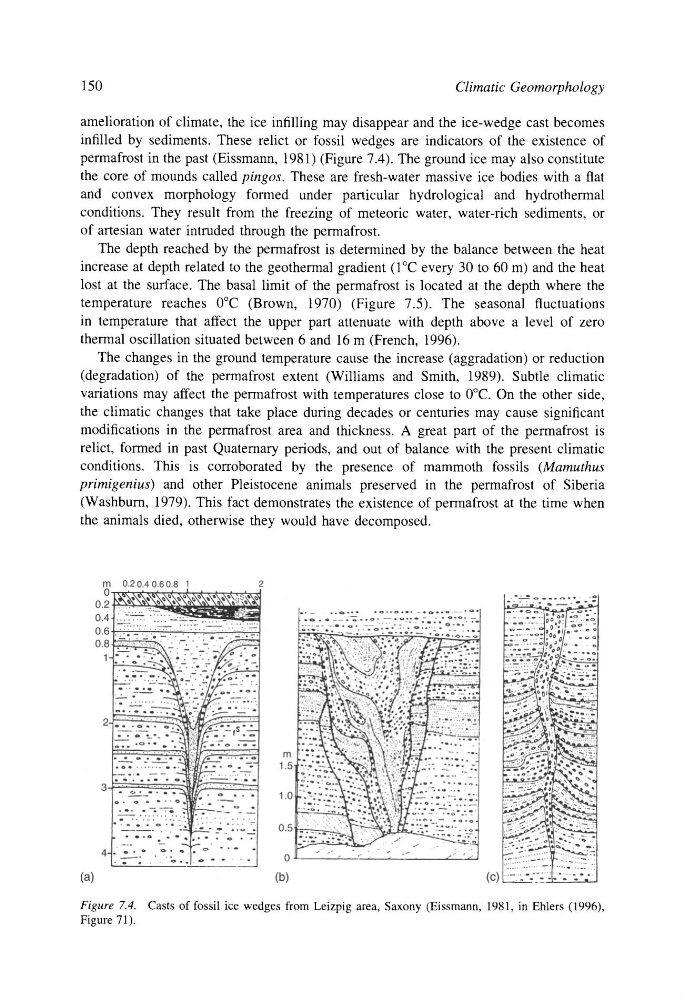
amelioration of climate, the ice infilling may disappear and the ice-wedge cast becomes
infilled by sediments. These relict or fossil wedges are indicators of the existence of
permafrost in the past (Eissmann, 1981) (Figure 7.4). The ground ice may also constitute
the core of mounds called pingos. These are fresh-water massive ice bodies with a flat
and convex morphology formed under particular hydrological and hydrothermal
conditions. They result from the freezing of meteoric water, water-rich sediments, or
of artesian water intruded through the permafrost.
The depth reached by the permafrost is determined by the balance between the heat
increase at depth related to the geothermal gradient (1 ~ every 30 to 60 m) and the heat
lost at the surface. The basal limit of the permafrost is located at the depth where the
temperature reaches 0~ (Brown, 1970) (Figure 7.5). The seasonal fluctuations
in temperature that affect the upper part attenuate with depth above a level of zero
thermal oscillation situated between 6 and 16 m (French, 1996).
The changes in the ground temperature cause the increase (aggradation) or reduction
(degradation) of the permafrost extent (Williams and Smith, 1989). Subtle climatic
variations may affect the permafrost with temperatures close to 0~ On the other side,
the climatic changes that take place during decades or centuries may cause significant
modifications in the permafrost area and thickness. A great part of the permafrost is
relict, formed in past Quaternary periods, and out of balance with the present climatic
conditions. This is corroborated by the presence of mammoth fossils (Mamuthus
primigenius) and other Pleistocene animals preserved in the permafrost of Siberia
(Washburn, 1979). This fact demonstrates the existence of permafrost at the time when
the animals died, otherwise they would have decomposed.
Figure 7.4. Casts of fossil ice wedges from Leizpig area, Saxony (Eissmann, 1981, in Ehlers (1996),
Figure 71).
Climatic Geomorphology
amelioration of climate, the ice infilling may disappear and the ice-wedge cast becomes
infilled by sediments. These relict or fossil wedges are indicators of the existence of
permafrost in the past (Eissmann, 1981) (Figure 7.4). The ground ice may also constitute
the core of mounds called pingos. These are fresh-water massive ice bodies with a flat
and convex morphology formed under particular hydrological and hydrothermal
conditions. They result from the freezing of meteoric water, water-rich sediments, or
of artesian water intruded through the permafrost.
The depth reached by the permafrost is determined by the balance between the heat
increase at depth related to the geothermal gradient (1 ~ every 30 to 60 m) and the heat
lost at the surface. The basal limit of the permafrost is located at the depth where the
temperature reaches 0~ (Brown, 1970) (Figure 7.5). The seasonal fluctuations
in temperature that affect the upper part attenuate with depth above a level of zero
thermal oscillation situated between 6 and 16 m (French, 1996).
The changes in the ground temperature cause the increase (aggradation) or reduction
(degradation) of the permafrost extent (Williams and Smith, 1989). Subtle climatic
variations may affect the permafrost with temperatures close to 0~ On the other side,
the climatic changes that take place during decades or centuries may cause significant
modifications in the permafrost area and thickness. A great part of the permafrost is
relict, formed in past Quaternary periods, and out of balance with the present climatic
conditions. This is corroborated by the presence of mammoth fossils (Mamuthus
primigenius) and other Pleistocene animals preserved in the permafrost of Siberia
(Washburn, 1979). This fact demonstrates the existence of permafrost at the time when
the animals died, otherwise they would have decomposed.
Figure 7.4. Casts of fossil ice wedges from Leizpig area, Saxony (Eissmann, 1981, in Ehlers (1996),
Figure 71).