

Geomorphology applied to glacial regions
133
200
180
160
Total discharge: 5.94 x 10⁶ m 3
140
t~
E 120
12}
I,,..
t~
tO
100
a
80
60
40
20
12
16
20
24
04
08
12
16
20
24
04
08
20 July
21 July
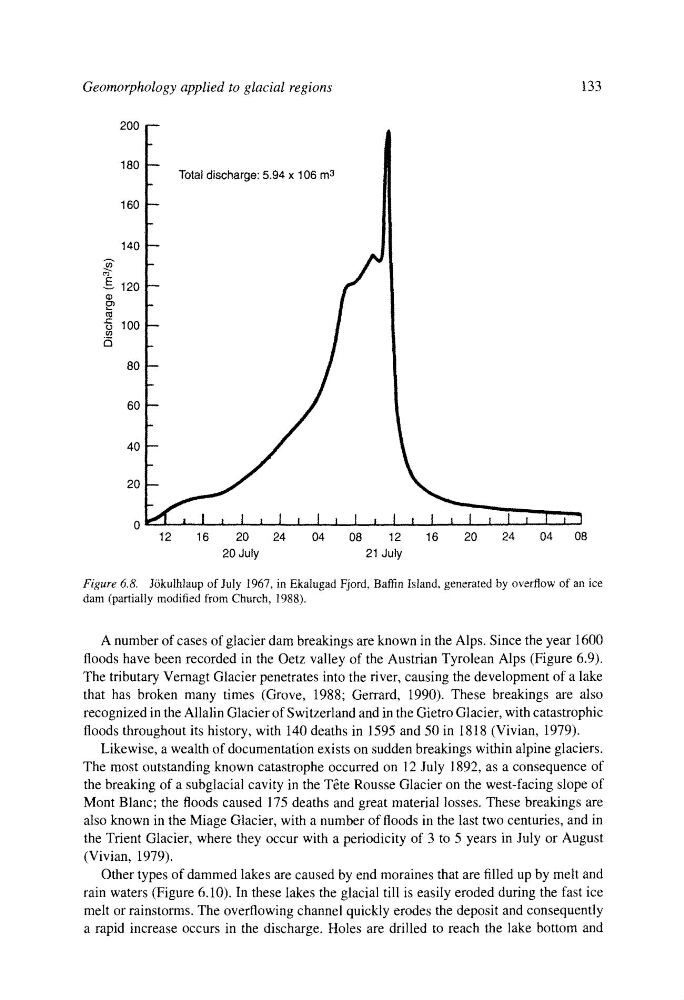
Figure 6.8. J6kulhlaup of July 1967, in Ekalugad Fjord, Baffin Island, generated by overflow of an ice
dam (partially modified from Church, 1988).
A number of cases of glacier dam breakings are known in the Alps. Since the year 1600
floods have been recorded in the Oetz valley of the Austrian Tyrolean Alps (Figure 6.9).
The tributary Vernagt Glacier penetrates into the fiver, causing the development of a lake
that has broken many times (Grove, 1988; Gerrard, 1990). These breakings are also
recognized in the Allalin Glacier of Switzerland and in the Gietro Glacier, with catastrophic
floods throughout its history, with 140 deaths in 1595 and 50 in 1818 (Vivian, 1979).
Likewise, a wealth of documentation exists on sudden breakings within alpine glaciers.
The most outstanding known catastrophe occurred on 12 July 1892, as a consequence of
the breaking of a subglacial cavity in the T~te Rousse Glacier on the west-facing slope of
Mont Blanc; the floods caused 175 deaths and great material losses. These breakings are
also known in the Miage Glacier, with a number of floods in the last two centuries, and in
the Trient Glacier, where they occur with a periodicity of 3 to 5 years in July or August
(Vivian, 1979).
Other types of dammed lakes are caused by end moraines that are filled up by melt and
rain waters (Figure 6.10). In these lakes the glacial till is easily eroded during the fast ice
melt or rainstorms. The overflowing channel quickly erodes the deposit and consequently
a rapid increase occurs in the discharge. Holes are drilled to reach the lake bottom and
133
200
180
160
Total discharge: 5.94 x 10⁶ m 3
140
t~
E 120
12}
I,,..
t~
tO
100
a
80
60
40
20
12
16
20
24
04
08
12
16
20
24
04
08
20 July
21 July
Figure 6.8. J6kulhlaup of July 1967, in Ekalugad Fjord, Baffin Island, generated by overflow of an ice
dam (partially modified from Church, 1988).
A number of cases of glacier dam breakings are known in the Alps. Since the year 1600
floods have been recorded in the Oetz valley of the Austrian Tyrolean Alps (Figure 6.9).
The tributary Vernagt Glacier penetrates into the fiver, causing the development of a lake
that has broken many times (Grove, 1988; Gerrard, 1990). These breakings are also
recognized in the Allalin Glacier of Switzerland and in the Gietro Glacier, with catastrophic
floods throughout its history, with 140 deaths in 1595 and 50 in 1818 (Vivian, 1979).
Likewise, a wealth of documentation exists on sudden breakings within alpine glaciers.
The most outstanding known catastrophe occurred on 12 July 1892, as a consequence of
the breaking of a subglacial cavity in the T~te Rousse Glacier on the west-facing slope of
Mont Blanc; the floods caused 175 deaths and great material losses. These breakings are
also known in the Miage Glacier, with a number of floods in the last two centuries, and in
the Trient Glacier, where they occur with a periodicity of 3 to 5 years in July or August
(Vivian, 1979).
Other types of dammed lakes are caused by end moraines that are filled up by melt and
rain waters (Figure 6.10). In these lakes the glacial till is easily eroded during the fast ice
melt or rainstorms. The overflowing channel quickly erodes the deposit and consequently
a rapid increase occurs in the discharge. Holes are drilled to reach the lake bottom and