

130
Climatic Geomorphology
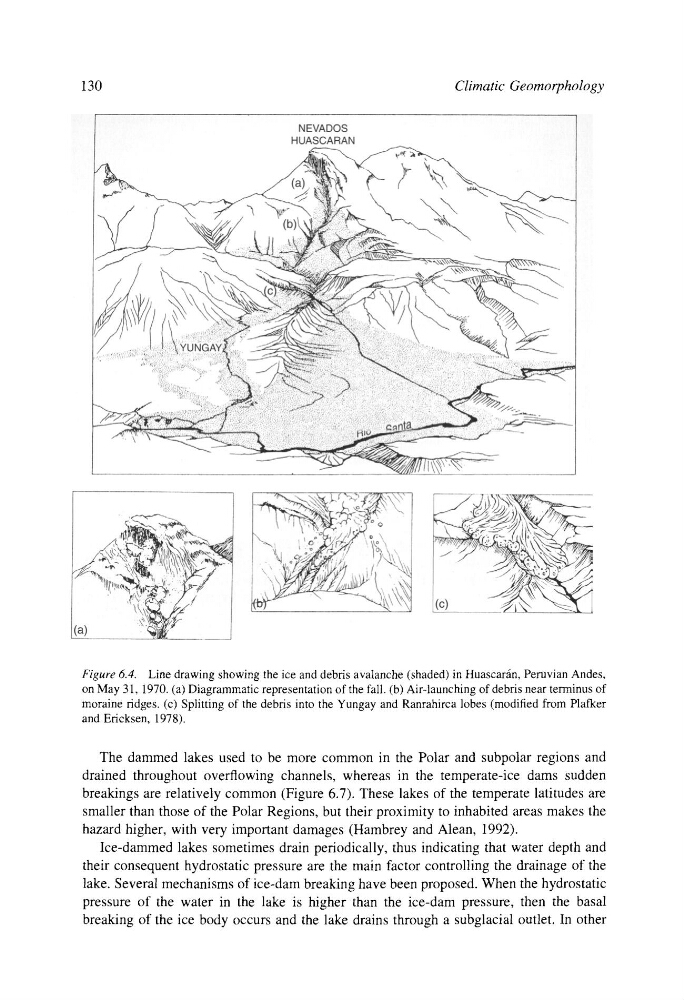
Figure 6.4. Line drawing showing the ice and debris avalanche (shaded) in Huascarfin, Peruvian Andes,
on May 31, 1970. (a) Diagrammatic representation of the fall. (b) Air-launching of debris near terminus of
moraine ridges. (c) Splitting of the debris into the Yungay and Ranrahirca lobes (modified from Plafker
and Ericksen, 1978).
The dammed lakes used to be more common in the Polar and subpolar regions and
drained throughout overflowing channels, whereas in the temperate-ice dams sudden
breakings are relatively common (Figure 6.7). These lakes of the temperate latitudes are
smaller than those of the Polar Regions, but their proximity to inhabited areas makes the
hazard higher, with very important damages (Hambrey and Alean, 1992).
Ice-dammed lakes sometimes drain periodically, thus indicating that water depth and
their consequent hydrostatic pressure are the main factor controlling the drainage of the
lake. Several mechanisms of ice-dam breaking have been proposed. When the hydrostatic
pressure of the water in the lake is higher than the ice-dam pressure, then the basal
breaking of the ice body occurs and the lake drains through a subglacial outlet. In other
Climatic Geomorphology
Figure 6.4. Line drawing showing the ice and debris avalanche (shaded) in Huascarfin, Peruvian Andes,
on May 31, 1970. (a) Diagrammatic representation of the fall. (b) Air-launching of debris near terminus of
moraine ridges. (c) Splitting of the debris into the Yungay and Ranrahirca lobes (modified from Plafker
and Ericksen, 1978).
The dammed lakes used to be more common in the Polar and subpolar regions and
drained throughout overflowing channels, whereas in the temperate-ice dams sudden
breakings are relatively common (Figure 6.7). These lakes of the temperate latitudes are
smaller than those of the Polar Regions, but their proximity to inhabited areas makes the
hazard higher, with very important damages (Hambrey and Alean, 1992).
Ice-dammed lakes sometimes drain periodically, thus indicating that water depth and
their consequent hydrostatic pressure are the main factor controlling the drainage of the
lake. Several mechanisms of ice-dam breaking have been proposed. When the hydrostatic
pressure of the water in the lake is higher than the ice-dam pressure, then the basal
breaking of the ice body occurs and the lake drains through a subglacial outlet. In other