

Geomorphology applied to glacial regions
129
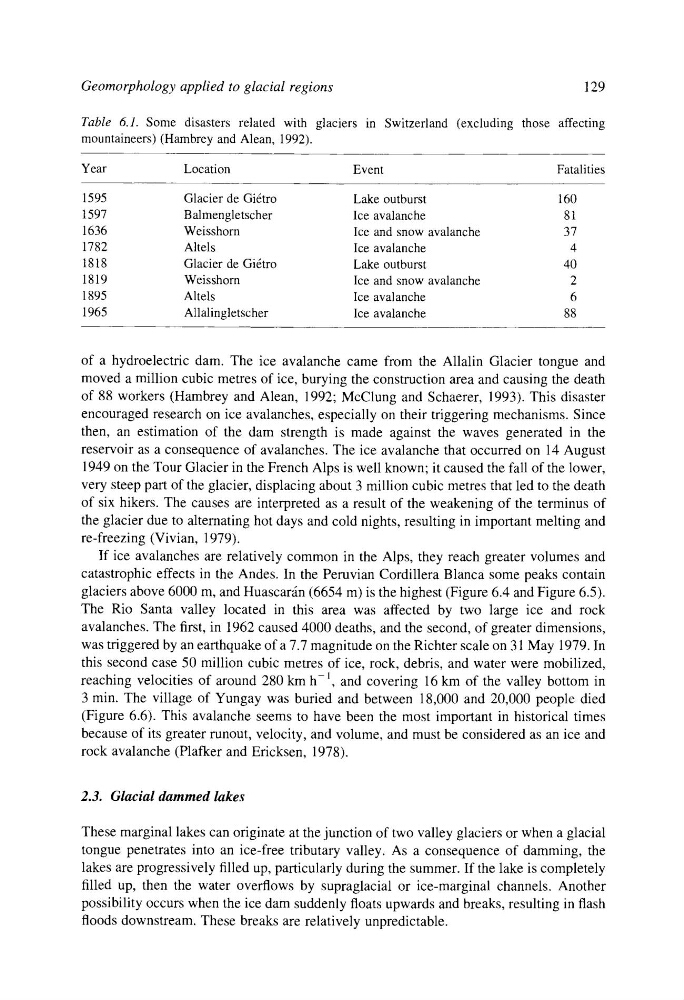
Table 6.1. Some disasters related with glaciers in Switzerland (excluding those affecting
mountaineers) (Hambrey and Alean, 1992).
Year
Location
Event
Fatalities
1595
Glacier de Gi~tro
Lake outburst
160
1597
Balmengletscher
Ice avalanche
81
1636
Weisshorn
Ice and snow avalanche
37
1782
Altels
Ice avalanche
4
1818
Glacier de Gi~tro
Lake outburst
40
1819
Weisshorn
Ice and snow avalanche
2
1895
Altels
Ice avalanche
6
1965
Allalingletscher
Ice avalanche
88
of a hydroelectric dam. The ice avalanche came from the Allalin Glacier tongue and
moved a million cubic metres of ice, burying the construction area and causing the death
of 88 workers (Hambrey and Alean, 1992; McClung and Schaerer, 1993). This disaster
encouraged research on ice avalanches, especially on their triggering mechanisms. Since
then, an estimation of the dam strength is made against the waves generated in the
reservoir as a consequence of avalanches. The ice avalanche that occurred on 14 August
1949 on the Tour Glacier in the French Alps is well known; it caused the fall of the lower,
very steep part of the glacier, displacing about 3 million cubic metres that led to the death
of six hikers. The causes are interpreted as a result of the weakening of the terminus of
the glacier due to alternating hot days and cold nights, resulting in important melting and
re-freezing (Vivian, 1979).
If ice avalanches are relatively common in the Alps, they reach greater volumes and
catastrophic effects in the Andes. In the Peruvian Cordillera Blanca some peaks contain
glaciers above 6000 m, and Huascarfin (6654 m) is the highest (Figure 6.4 and Figure 6.5).
The Rio Santa valley located in this area was affected by two large ice and rock
avalanches. The first, in 1962 caused 4000 deaths, and the second, of greater dimensions,
was triggered by an earthquake of a 7.7 magnitude on the Richter scale on 31 May 1979. In
this second case 50 million cubic metres of ice, rock, debris, and water were mobilized,
reaching velocities of around 280 km h-~, and covering 16 km of the valley bottom in
3 min. The village of Yungay was buried and between 18,000 and 20,000 people died
(Figure 6.6). This avalanche seems to have been the most important in historical times
because of its greater runout, velocity, and volume, and must be considered as an ice and
rock avalanche (Plafker and Ericksen, 1978).
2.3. Glacial dammed lakes
These marginal lakes can originate at the junction of two valley glaciers or when a glacial
tongue penetrates into an ice-free tributary valley. As a consequence of damming, the
lakes are progressively filled up, particularly during the summer. If the lake is completely
filled up, then the water overflows by supraglacial or ice-marginal channels. Another
possibility occurs when the ice dam suddenly floats upwards and breaks, resulting in flash
floods downstream. These breaks are relatively unpredictable.
129
Table 6.1. Some disasters related with glaciers in Switzerland (excluding those affecting
mountaineers) (Hambrey and Alean, 1992).
Year
Location
Event
Fatalities
1595
Glacier de Gi~tro
Lake outburst
160
1597
Balmengletscher
Ice avalanche
81
1636
Weisshorn
Ice and snow avalanche
37
1782
Altels
Ice avalanche
4
1818
Glacier de Gi~tro
Lake outburst
40
1819
Weisshorn
Ice and snow avalanche
2
1895
Altels
Ice avalanche
6
1965
Allalingletscher
Ice avalanche
88
of a hydroelectric dam. The ice avalanche came from the Allalin Glacier tongue and
moved a million cubic metres of ice, burying the construction area and causing the death
of 88 workers (Hambrey and Alean, 1992; McClung and Schaerer, 1993). This disaster
encouraged research on ice avalanches, especially on their triggering mechanisms. Since
then, an estimation of the dam strength is made against the waves generated in the
reservoir as a consequence of avalanches. The ice avalanche that occurred on 14 August
1949 on the Tour Glacier in the French Alps is well known; it caused the fall of the lower,
very steep part of the glacier, displacing about 3 million cubic metres that led to the death
of six hikers. The causes are interpreted as a result of the weakening of the terminus of
the glacier due to alternating hot days and cold nights, resulting in important melting and
re-freezing (Vivian, 1979).
If ice avalanches are relatively common in the Alps, they reach greater volumes and
catastrophic effects in the Andes. In the Peruvian Cordillera Blanca some peaks contain
glaciers above 6000 m, and Huascarfin (6654 m) is the highest (Figure 6.4 and Figure 6.5).
The Rio Santa valley located in this area was affected by two large ice and rock
avalanches. The first, in 1962 caused 4000 deaths, and the second, of greater dimensions,
was triggered by an earthquake of a 7.7 magnitude on the Richter scale on 31 May 1979. In
this second case 50 million cubic metres of ice, rock, debris, and water were mobilized,
reaching velocities of around 280 km h-~, and covering 16 km of the valley bottom in
3 min. The village of Yungay was buried and between 18,000 and 20,000 people died
(Figure 6.6). This avalanche seems to have been the most important in historical times
because of its greater runout, velocity, and volume, and must be considered as an ice and
rock avalanche (Plafker and Ericksen, 1978).
2.3. Glacial dammed lakes
These marginal lakes can originate at the junction of two valley glaciers or when a glacial
tongue penetrates into an ice-free tributary valley. As a consequence of damming, the
lakes are progressively filled up, particularly during the summer. If the lake is completely
filled up, then the water overflows by supraglacial or ice-marginal channels. Another
possibility occurs when the ice dam suddenly floats upwards and breaks, resulting in flash
floods downstream. These breaks are relatively unpredictable.