

Biochemical Systematics and Ecology 96 (2021) 104262
5
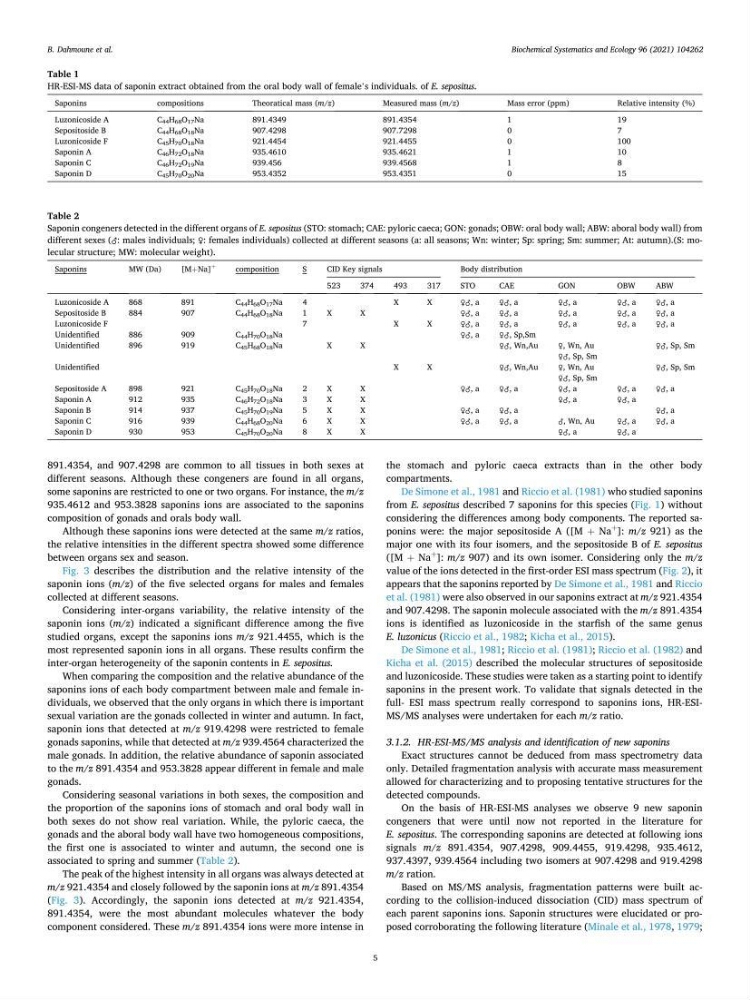
891.4354, and 907.4298 are common to all tissues in both sexes at
different seasons. Although these congeners are found in all organs,
some saponins are restricted to one or two organs. For instance, the m/z
935.4612 and 953.3828 saponins ions are associated to the saponins
composition of gonads and orals body wall.
Although these saponins ions were detected at the same m/z ratios,
the relative intensities in the different spectra showed some difference
between organs sex and season.
Fig. 3 describes the distribution and the relative intensity of the
saponin ions (m/z) of the five selected organs for males and females
collected at different seasons.
Considering inter-organs variability, the relative intensity of the
saponin ions (m/z) indicated a significant difference among the five
studied organs, except the saponins ions m/z 921.4455, which is the
most represented saponin ions in all organs. These results confirm the
inter-organ heterogeneity of the saponin contents in E. sepositus.
When comparing the composition and the relative abundance of the
saponins ions of each body compartment between male and female individuals, we observed that the only organs in which there is important
sexual variation are the gonads collected in winter and autumn. In fact,
saponin ions that detected at m/z 919.4298 were restricted to female
gonads saponins, while that detected at m/z 939.4564 characterized the
male gonads. In addition, the relative abundance of saponin associated
to the m/z 891.4354 and 953.3828 appear different in female and male
gonads.
Considering seasonal variations in both sexes, the composition and
the proportion of the saponins ions of stomach and oral body wall in
both sexes do not show real variation. While, the pyloric caeca, the
gonads and the aboral body wall have two homogeneous compositions,
the first one is associated to winter and autumn, the second one is
associated to spring and summer (Table 2).
The peak of the highest intensity in all organs was always detected at
m/z 921.4354 and closely followed by the saponin ions at m/z 891.4354
(Fig. 3). Accordingly, the saponin ions detected at m/z 921.4354,
891.4354, were the most abundant molecules whatever the body
component considered. These m/z 891.4354 ions were more intense in
the stomach and pyloric caeca extracts than in the other body
compartments.
De Simone et al., 1981 and Riccio et al. (1981) who studied saponins
from E. sepositus described 7 saponins for this species (Fig. 1) without
considering the differences among body components. The reported saponins were: the major sepositoside A ([M + Na
+
]: m/z 921) as the
major one with its four isomers, and the sepositoside B of E. sepositus
([M + Na
+
]: m/z 907) and its own isomer. Considering only the m/z
value of the ions detected in the first-order ESI mass spectrum (Fig. 2), it
appears that the saponins reported by De Simone et al., 1981 and Riccio
et al. (1981) were also observed in our saponins extract at m/z 921.4354
and 907.4298. The saponin molecule associated with the m/z 891.4354
ions is identified as luzonicoside in the starfish of the same genus
E. luzonicus (Riccio et al., 1982; Kicha et al., 2015).
De Simone et al., 1981; Riccio et al. (1981); Riccio et al. (1982) and
Kicha et al. (2015) described the molecular structures of sepositoside
and luzonicoside. These studies were taken as a starting point to identify
saponins in the present work. To validate that signals detected in the
full- ESI mass spectrum really correspond to saponins ions, HR-ESIMS/MS analyses were undertaken for each m/z ratio.
3.1.2. HR-ESI-MS/MS analysis and identification of new saponins
Exact structures cannot be deduced from mass spectrometry data
only. Detailed fragmentation analysis with accurate mass measurement
allowed for characterizing and to proposing tentative structures for the
detected compounds.
On the basis of HR-ESI-MS analyses we observe 9 new saponin
congeners that were until now not reported in the literature for
E. sepositus. The corresponding saponins are detected at following ions
signals m/z 891.4354, 907.4298, 909.4455, 919.4298, 935.4612,
937.4397, 939.4564 including two isomers at 907.4298 and 919.4298
m/z ration.
Based on MS/MS analysis, fragmentation patterns were built according to the collision-induced dissociation (CID) mass spectrum of
each parent saponins ions. Saponin structures were elucidated or proposed corroborating the following literature (Minale et al., 1978, 1979;
Table 1
HR-ESI-MS data of saponin extract obtained from the oral body wall of female’s individuals. of E. sepositus.
Saponins
compositions
Theoratical mass (m/z)
Measured mass (m/z)
Mass error (ppm)
Relative intensity (%)
Luzonicoside A
C 44 H 68 O 17 Na
891.4349
891.4354
1
19
Sepositoside B
C 44 H 68 O 18 Na
907.4298
907.7298
0
7
Luzonicoside F
C 45 H 70 O 18 Na
921.4454
921.4455
0
100
Saponin A
C 46 H 72 O 18 Na
935.4610
935.4621
1
10
Saponin C
C 46 H 72 O 19 Na
939.456
939.4568
1
8
Saponin D
C 45 H 70 O 20 Na
953.4352
953.4351
0
15
Table 2
Saponin congeners detected in the different organs of E. sepositus (STO: stomach; CAE: pyloric caeca; GON: gonads; OBW: oral body wall; ABW: aboral body wall) from
different sexes (♂: males individuals; ♀: females individuals) collected at different seasons (a: all seasons; Wn: winter; Sp: spring; Sm: summer; At: autumn).(S: molecular structure; MW: molecular weight).
Saponins
MW (Da)
[M+Na]
+
composition
S
CID Key signals
Body distribution
523
374
493
317
STO
CAE
GON
OBW
ABW
Luzonicoside A
868
891
C 44 H 68 O 17 Na
4
X
X
♀♂, a
♀♂, a
♀♂, a
♀♂, a
♀♂, a
Sepositoside B
884
907
C 44 H 68 O 18 Na
1
X
X
♀♂, a
♀♂, a
♀♂, a
♀♂, a
♀♂, a
Luzonicoside F
7
X
X
♀♂, a
♀♂, a
♀♂, a
♀♂, a
♀♂, a
Unidentified
886
909
C 44 H 70 O 18 Na
♀♂, a
♀♂, Sp,Sm
Unidentified
896
919
C 45 H 68 O 18 Na
X
X
♀♂, Wn,Au
♀, Wn, Au
♀♂, Sp, Sm
♀♂, Sp, Sm
Unidentified
X
X
♀♂, Wn,Au
♀, Wn, Au
♀♂, Sp, Sm
♀♂, Sp, Sm
Sepositoside A
898
921
C 45 H 70 O 18 Na
2
X
X
♀♂, a
♀♂, a
♀♂, a
♀♂, a
♀♂, a
Saponin A
912
935
C 46 H 72 O 18 Na
3
X
X
♀♂, a
♀♂, a
Saponin B
914
937
C 45 H 70 O 19 Na
5
X
X
♀♂, a
♀♂, a
♀♂, a
Saponin C
916
939
C 44 H 68 O 20 Na
6
X
X
♀♂, a
♀♂, a
♂, Wn, Au
♀♂, a
♀♂, a
Saponin D
930
953
C 45 H 70 O 20 Na
8
X
X
♀♂, a
♀♂, a
B. Dahmoune et al.
5
891.4354, and 907.4298 are common to all tissues in both sexes at
different seasons. Although these congeners are found in all organs,
some saponins are restricted to one or two organs. For instance, the m/z
935.4612 and 953.3828 saponins ions are associated to the saponins
composition of gonads and orals body wall.
Although these saponins ions were detected at the same m/z ratios,
the relative intensities in the different spectra showed some difference
between organs sex and season.
Fig. 3 describes the distribution and the relative intensity of the
saponin ions (m/z) of the five selected organs for males and females
collected at different seasons.
Considering inter-organs variability, the relative intensity of the
saponin ions (m/z) indicated a significant difference among the five
studied organs, except the saponins ions m/z 921.4455, which is the
most represented saponin ions in all organs. These results confirm the
inter-organ heterogeneity of the saponin contents in E. sepositus.
When comparing the composition and the relative abundance of the
saponins ions of each body compartment between male and female individuals, we observed that the only organs in which there is important
sexual variation are the gonads collected in winter and autumn. In fact,
saponin ions that detected at m/z 919.4298 were restricted to female
gonads saponins, while that detected at m/z 939.4564 characterized the
male gonads. In addition, the relative abundance of saponin associated
to the m/z 891.4354 and 953.3828 appear different in female and male
gonads.
Considering seasonal variations in both sexes, the composition and
the proportion of the saponins ions of stomach and oral body wall in
both sexes do not show real variation. While, the pyloric caeca, the
gonads and the aboral body wall have two homogeneous compositions,
the first one is associated to winter and autumn, the second one is
associated to spring and summer (Table 2).
The peak of the highest intensity in all organs was always detected at
m/z 921.4354 and closely followed by the saponin ions at m/z 891.4354
(Fig. 3). Accordingly, the saponin ions detected at m/z 921.4354,
891.4354, were the most abundant molecules whatever the body
component considered. These m/z 891.4354 ions were more intense in
the stomach and pyloric caeca extracts than in the other body
compartments.
De Simone et al., 1981 and Riccio et al. (1981) who studied saponins
from E. sepositus described 7 saponins for this species (Fig. 1) without
considering the differences among body components. The reported saponins were: the major sepositoside A ([M + Na
+
]: m/z 921) as the
major one with its four isomers, and the sepositoside B of E. sepositus
([M + Na
+
]: m/z 907) and its own isomer. Considering only the m/z
value of the ions detected in the first-order ESI mass spectrum (Fig. 2), it
appears that the saponins reported by De Simone et al., 1981 and Riccio
et al. (1981) were also observed in our saponins extract at m/z 921.4354
and 907.4298. The saponin molecule associated with the m/z 891.4354
ions is identified as luzonicoside in the starfish of the same genus
E. luzonicus (Riccio et al., 1982; Kicha et al., 2015).
De Simone et al., 1981; Riccio et al. (1981); Riccio et al. (1982) and
Kicha et al. (2015) described the molecular structures of sepositoside
and luzonicoside. These studies were taken as a starting point to identify
saponins in the present work. To validate that signals detected in the
full- ESI mass spectrum really correspond to saponins ions, HR-ESIMS/MS analyses were undertaken for each m/z ratio.
3.1.2. HR-ESI-MS/MS analysis and identification of new saponins
Exact structures cannot be deduced from mass spectrometry data
only. Detailed fragmentation analysis with accurate mass measurement
allowed for characterizing and to proposing tentative structures for the
detected compounds.
On the basis of HR-ESI-MS analyses we observe 9 new saponin
congeners that were until now not reported in the literature for
E. sepositus. The corresponding saponins are detected at following ions
signals m/z 891.4354, 907.4298, 909.4455, 919.4298, 935.4612,
937.4397, 939.4564 including two isomers at 907.4298 and 919.4298
m/z ration.
Based on MS/MS analysis, fragmentation patterns were built according to the collision-induced dissociation (CID) mass spectrum of
each parent saponins ions. Saponin structures were elucidated or proposed corroborating the following literature (Minale et al., 1978, 1979;
Table 1
HR-ESI-MS data of saponin extract obtained from the oral body wall of female’s individuals. of E. sepositus.
Saponins
compositions
Theoratical mass (m/z)
Measured mass (m/z)
Mass error (ppm)
Relative intensity (%)
Luzonicoside A
C 44 H 68 O 17 Na
891.4349
891.4354
1
19
Sepositoside B
C 44 H 68 O 18 Na
907.4298
907.7298
0
7
Luzonicoside F
C 45 H 70 O 18 Na
921.4454
921.4455
0
100
Saponin A
C 46 H 72 O 18 Na
935.4610
935.4621
1
10
Saponin C
C 46 H 72 O 19 Na
939.456
939.4568
1
8
Saponin D
C 45 H 70 O 20 Na
953.4352
953.4351
0
15
Table 2
Saponin congeners detected in the different organs of E. sepositus (STO: stomach; CAE: pyloric caeca; GON: gonads; OBW: oral body wall; ABW: aboral body wall) from
different sexes (♂: males individuals; ♀: females individuals) collected at different seasons (a: all seasons; Wn: winter; Sp: spring; Sm: summer; At: autumn).(S: molecular structure; MW: molecular weight).
Saponins
MW (Da)
[M+Na]
+
composition
S
CID Key signals
Body distribution
523
374
493
317
STO
CAE
GON
OBW
ABW
Luzonicoside A
868
891
C 44 H 68 O 17 Na
4
X
X
♀♂, a
♀♂, a
♀♂, a
♀♂, a
♀♂, a
Sepositoside B
884
907
C 44 H 68 O 18 Na
1
X
X
♀♂, a
♀♂, a
♀♂, a
♀♂, a
♀♂, a
Luzonicoside F
7
X
X
♀♂, a
♀♂, a
♀♂, a
♀♂, a
♀♂, a
Unidentified
886
909
C 44 H 70 O 18 Na
♀♂, a
♀♂, Sp,Sm
Unidentified
896
919
C 45 H 68 O 18 Na
X
X
♀♂, Wn,Au
♀, Wn, Au
♀♂, Sp, Sm
♀♂, Sp, Sm
Unidentified
X
X
♀♂, Wn,Au
♀, Wn, Au
♀♂, Sp, Sm
♀♂, Sp, Sm
Sepositoside A
898
921
C 45 H 70 O 18 Na
2
X
X
♀♂, a
♀♂, a
♀♂, a
♀♂, a
♀♂, a
Saponin A
912
935
C 46 H 72 O 18 Na
3
X
X
♀♂, a
♀♂, a
Saponin B
914
937
C 45 H 70 O 19 Na
5
X
X
♀♂, a
♀♂, a
♀♂, a
Saponin C
916
939
C 44 H 68 O 20 Na
6
X
X
♀♂, a
♀♂, a
♂, Wn, Au
♀♂, a
♀♂, a
Saponin D
930
953
C 45 H 70 O 20 Na
8
X
X
♀♂, a
♀♂, a
B. Dahmoune et al.