

Conceptual framework
A method for assessing the coastal ecosystems vulnerability to
pollution of Algiers coast was developed as shown in Fig. 2,
we considered two different parts: The environmental sensitivity index of coastal ecosystems (ISEEL) and anthropogenic
pressure intensity index (IPA).
The environmental sensitivity index of coastal ecosystems
(ISEEL) was created to classify coastal ecosystems according
to their sensitivity, if they are exposed to anthropogenic pressures. The effect of these pressures can act in a heterogeneous
way and at different intensities that are related to the intrinsic
characteristics of the environment. This index is divided into
the following four sub-indices:
– Biological sensitivity (Sb): aims to highlight a biodiversity indicator that is integrated into sustainable development projects. It is also intended to make a contribution,
in order to remedy this deficit, by proposing an overall
operational indicator to assess the biological sensitivity of
the environments along coastal shelves (Lorant-Plantier
2014). Two variables are taken into consideration for the
realization of this index, namely: the seabed quality and
the ichthyological stands.
– Geomorphological sensitivity (Sg): is a resilience factor.
Since the dispersion of pollutants in the marine environment is heterogeneous from one area to another, this heterogeneity is linked on the one hand to the confinement of
the coastal zone because a closed/confined area is more
sensitive to pollution than an exposed area. On the other
hand, it is also related to the nature of sedimentary facies,
knowing that a sandy area is more sensitive than a rocky
area where self-cleaning by waves is possible (Mauvais
and Goarnisson 1999; Le Berre et al. 2010; Thébault et al.
2011). The seabed and coast typology are the two variables used for the construction of this index.
– Hydrodynamic characteristics (Ch): are the second resilience factor that determines the ability of the environment
to withstand stress. The ability of the environments to
clean themselves is mainly determined by the exposure
mode of coasts (beaten or sheltered). The dispersion of
pollutants is directly related to exposures to swell and
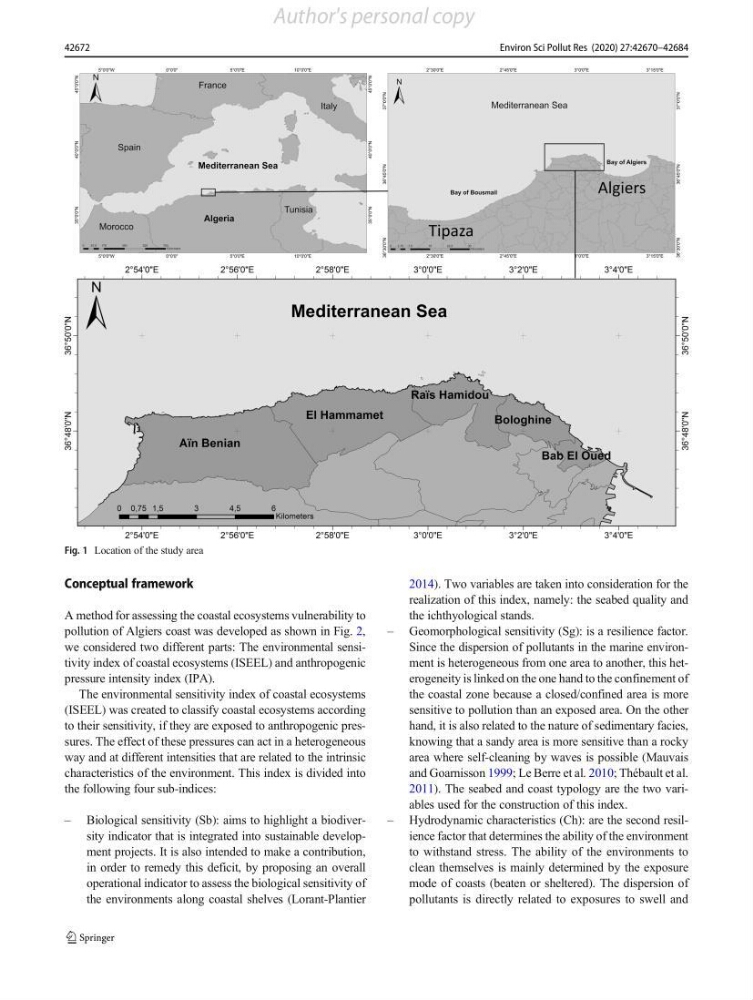
Fig. 1 Location of the study area
42672
Environ Sci Pollut Res (2020) 27:42670–42684
Author's personal copy
A method for assessing the coastal ecosystems vulnerability to
pollution of Algiers coast was developed as shown in Fig. 2,
we considered two different parts: The environmental sensitivity index of coastal ecosystems (ISEEL) and anthropogenic
pressure intensity index (IPA).
The environmental sensitivity index of coastal ecosystems
(ISEEL) was created to classify coastal ecosystems according
to their sensitivity, if they are exposed to anthropogenic pressures. The effect of these pressures can act in a heterogeneous
way and at different intensities that are related to the intrinsic
characteristics of the environment. This index is divided into
the following four sub-indices:
– Biological sensitivity (Sb): aims to highlight a biodiversity indicator that is integrated into sustainable development projects. It is also intended to make a contribution,
in order to remedy this deficit, by proposing an overall
operational indicator to assess the biological sensitivity of
the environments along coastal shelves (Lorant-Plantier
2014). Two variables are taken into consideration for the
realization of this index, namely: the seabed quality and
the ichthyological stands.
– Geomorphological sensitivity (Sg): is a resilience factor.
Since the dispersion of pollutants in the marine environment is heterogeneous from one area to another, this heterogeneity is linked on the one hand to the confinement of
the coastal zone because a closed/confined area is more
sensitive to pollution than an exposed area. On the other
hand, it is also related to the nature of sedimentary facies,
knowing that a sandy area is more sensitive than a rocky
area where self-cleaning by waves is possible (Mauvais
and Goarnisson 1999; Le Berre et al. 2010; Thébault et al.
2011). The seabed and coast typology are the two variables used for the construction of this index.
– Hydrodynamic characteristics (Ch): are the second resilience factor that determines the ability of the environment
to withstand stress. The ability of the environments to
clean themselves is mainly determined by the exposure
mode of coasts (beaten or sheltered). The dispersion of
pollutants is directly related to exposures to swell and
Fig. 1 Location of the study area
42672
Environ Sci Pollut Res (2020) 27:42670–42684
Author's personal copy