

Continental Shelf Research 232 (2022) 104629
13
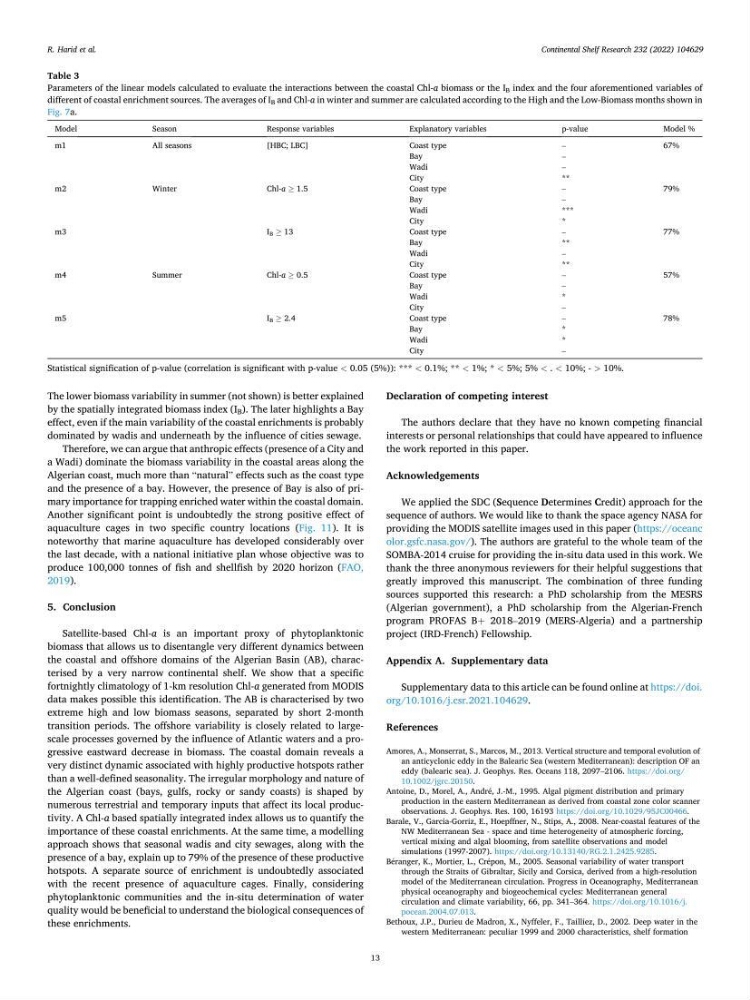
The lower biomass variability in summer (not shown) is better explained
by the spatially integrated biomass index (I B ). The later highlights a Bay
effect, even if the main variability of the coastal enrichments is probably
dominated by wadis and underneath by the influence of cities sewage.
Therefore, we can argue that anthropic effects (presence of a City and
a Wadi) dominate the biomass variability in the coastal areas along the
Algerian coast, much more than “natural” effects such as the coast type
and the presence of a bay. However, the presence of Bay is also of primary importance for trapping enriched water within the coastal domain.
Another significant point is undoubtedly the strong positive effect of
aquaculture cages in two specific country locations (Fig. 11). It is
noteworthy that marine aquaculture has developed considerably over
the last decade, with a national initiative plan whose objective was to
produce 100,000 tonnes of fish and shellfish by 2020 horizon (FAO,
2019).
5. Conclusion
Satellite-based Chl-a is an important proxy of phytoplanktonic
biomass that allows us to disentangle very different dynamics between
the coastal and offshore domains of the Algerian Basin (AB), characterised by a very narrow continental shelf. We show that a specific
fortnightly climatology of 1-km resolution Chl-a generated from MODIS
data makes possible this identification. The AB is characterised by two
extreme high and low biomass seasons, separated by short 2-month
transition periods. The offshore variability is closely related to largescale processes governed by the influence of Atlantic waters and a progressive eastward decrease in biomass. The coastal domain reveals a
very distinct dynamic associated with highly productive hotspots rather
than a well-defined seasonality. The irregular morphology and nature of
the Algerian coast (bays, gulfs, rocky or sandy coasts) is shaped by
numerous terrestrial and temporary inputs that affect its local productivity. A Chl-a based spatially integrated index allows us to quantify the
importance of these coastal enrichments. At the same time, a modelling
approach shows that seasonal wadis and city sewages, along with the
presence of a bay, explain up to 79% of the presence of these productive
hotspots. A separate source of enrichment is undoubtedly associated
with the recent presence of aquaculture cages. Finally, considering
phytoplanktonic communities and the in-situ determination of water
quality would be beneficial to understand the biological consequences of
these enrichments.
Declaration of competing interest
The authors declare that they have no known competing financial
interests or personal relationships that could have appeared to influence
the work reported in this paper.
Acknowledgements
We applied the SDC (Sequence Determines Credit) approach for the
sequence of authors. We would like to thank the space agency NASA for
providing the MODIS satellite images used in this paper (https://oceanc
olor.gsfc.nasa.gov/). The authors are grateful to the whole team of the
SOMBA-2014 cruise for providing the in-situ data used in this work. We
thank the three anonymous reviewers for their helpful suggestions that
greatly improved this manuscript. The combination of three funding
sources supported this research: a PhD scholarship from the MESRS
(Algerian government), a PhD scholarship from the Algerian-French
program PROFAS B+ 2018–2019 (MERS-Algeria) and a partnership
project (IRD-French) Fellowship.
Appendix A. Supplementary data
Supplementary data to this article can be found online at https://doi.
org/10.1016/j.csr.2021.104629.
References
Amores, A., Monserrat, S., Marcos, M., 2013. Vertical structure and temporal evolution of
an anticyclonic eddy in the Balearic Sea (western Mediterranean): description OF an
eddy (balearic sea). J. Geophys. Res. Oceans 118, 2097–2106. https://doi.org/
10.1002/jgrc.20150.
Antoine, D., Morel, A., Andr´ e, J.-M., 1995. Algal pigment distribution and primary
production in the eastern Mediterranean as derived from coastal zone color scanner
observations. J. Geophys. Res. 100, 16193 https://doi.org/10.1029/95JC00466.
Barale, V., Garcia-Gorriz, E., Hoepffner, N., Stips, A., 2008. Near-coastal features of the
NW Mediterranean Sea - space and time heterogeneity of atmospheric forcing,
vertical mixing and algal blooming, from satellite observations and model
simulations (1997-2007). https://doi.org/10.13140/RG.2.1.2425.9285.
B´ eranger, K., Mortier, L., Cr´ epon, M., 2005. Seasonal variability of water transport
through the Straits of Gibraltar, Sicily and Corsica, derived from a high-resolution
model of the Mediterranean circulation. Progress in Oceanography, Mediterranean
physical oceanography and biogeochemical cycles: Mediterranean general
circulation and climate variability, 66, pp. 341–364. https://doi.org/10.1016/j.
pocean.2004.07.013.
Bethoux, J.P., Durieu de Madron, X., Nyffeler, F., Tailliez, D., 2002. Deep water in the
western Mediterranean: peculiar 1999 and 2000 characteristics, shelf formation
Table 3
Parameters of the linear models calculated to evaluate the interactions between the coastal Chl-a biomass or the I B index and the four aforementioned variables of
different of coastal enrichment sources. The averages of I B and Chl-a in winter and summer are calculated according to the High and the Low-Biomass months shown in
Fig. 7a.
Model
Season
Response variables
Explanatory variables
p-value
Model %
m1
All seasons
[HBC; LBC]
Coast type
–
67%
Bay
–
Wadi
–
City
**
m2
Winter
Chl-a ≥ 1.5
Coast type
–
79%
Bay
–
Wadi
***
City
*
m3
I B ≥ 13
Coast type
–
77%
Bay
**
Wadi
–
City
**
m4
Summer
Chl-a ≥ 0.5
Coast type
–
57%
Bay
–
Wadi
*
City
–
m5
I B ≥ 2.4
Coast type
–
78%
Bay
*
Wadi
*
City
–
Statistical signification of p-value (correlation is significant with p-value < 0.05 (5%)): *** < 0.1%; ** < 1%; * < 5%; 5% < . < 10%; - > 10%.
R. Harid et al.
13
The lower biomass variability in summer (not shown) is better explained
by the spatially integrated biomass index (I B ). The later highlights a Bay
effect, even if the main variability of the coastal enrichments is probably
dominated by wadis and underneath by the influence of cities sewage.
Therefore, we can argue that anthropic effects (presence of a City and
a Wadi) dominate the biomass variability in the coastal areas along the
Algerian coast, much more than “natural” effects such as the coast type
and the presence of a bay. However, the presence of Bay is also of primary importance for trapping enriched water within the coastal domain.
Another significant point is undoubtedly the strong positive effect of
aquaculture cages in two specific country locations (Fig. 11). It is
noteworthy that marine aquaculture has developed considerably over
the last decade, with a national initiative plan whose objective was to
produce 100,000 tonnes of fish and shellfish by 2020 horizon (FAO,
2019).
5. Conclusion
Satellite-based Chl-a is an important proxy of phytoplanktonic
biomass that allows us to disentangle very different dynamics between
the coastal and offshore domains of the Algerian Basin (AB), characterised by a very narrow continental shelf. We show that a specific
fortnightly climatology of 1-km resolution Chl-a generated from MODIS
data makes possible this identification. The AB is characterised by two
extreme high and low biomass seasons, separated by short 2-month
transition periods. The offshore variability is closely related to largescale processes governed by the influence of Atlantic waters and a progressive eastward decrease in biomass. The coastal domain reveals a
very distinct dynamic associated with highly productive hotspots rather
than a well-defined seasonality. The irregular morphology and nature of
the Algerian coast (bays, gulfs, rocky or sandy coasts) is shaped by
numerous terrestrial and temporary inputs that affect its local productivity. A Chl-a based spatially integrated index allows us to quantify the
importance of these coastal enrichments. At the same time, a modelling
approach shows that seasonal wadis and city sewages, along with the
presence of a bay, explain up to 79% of the presence of these productive
hotspots. A separate source of enrichment is undoubtedly associated
with the recent presence of aquaculture cages. Finally, considering
phytoplanktonic communities and the in-situ determination of water
quality would be beneficial to understand the biological consequences of
these enrichments.
Declaration of competing interest
The authors declare that they have no known competing financial
interests or personal relationships that could have appeared to influence
the work reported in this paper.
Acknowledgements
We applied the SDC (Sequence Determines Credit) approach for the
sequence of authors. We would like to thank the space agency NASA for
providing the MODIS satellite images used in this paper (https://oceanc
olor.gsfc.nasa.gov/). The authors are grateful to the whole team of the
SOMBA-2014 cruise for providing the in-situ data used in this work. We
thank the three anonymous reviewers for their helpful suggestions that
greatly improved this manuscript. The combination of three funding
sources supported this research: a PhD scholarship from the MESRS
(Algerian government), a PhD scholarship from the Algerian-French
program PROFAS B+ 2018–2019 (MERS-Algeria) and a partnership
project (IRD-French) Fellowship.
Appendix A. Supplementary data
Supplementary data to this article can be found online at https://doi.
org/10.1016/j.csr.2021.104629.
References
Amores, A., Monserrat, S., Marcos, M., 2013. Vertical structure and temporal evolution of
an anticyclonic eddy in the Balearic Sea (western Mediterranean): description OF an
eddy (balearic sea). J. Geophys. Res. Oceans 118, 2097–2106. https://doi.org/
10.1002/jgrc.20150.
Antoine, D., Morel, A., Andr´ e, J.-M., 1995. Algal pigment distribution and primary
production in the eastern Mediterranean as derived from coastal zone color scanner
observations. J. Geophys. Res. 100, 16193 https://doi.org/10.1029/95JC00466.
Barale, V., Garcia-Gorriz, E., Hoepffner, N., Stips, A., 2008. Near-coastal features of the
NW Mediterranean Sea - space and time heterogeneity of atmospheric forcing,
vertical mixing and algal blooming, from satellite observations and model
simulations (1997-2007). https://doi.org/10.13140/RG.2.1.2425.9285.
B´ eranger, K., Mortier, L., Cr´ epon, M., 2005. Seasonal variability of water transport
through the Straits of Gibraltar, Sicily and Corsica, derived from a high-resolution
model of the Mediterranean circulation. Progress in Oceanography, Mediterranean
physical oceanography and biogeochemical cycles: Mediterranean general
circulation and climate variability, 66, pp. 341–364. https://doi.org/10.1016/j.
pocean.2004.07.013.
Bethoux, J.P., Durieu de Madron, X., Nyffeler, F., Tailliez, D., 2002. Deep water in the
western Mediterranean: peculiar 1999 and 2000 characteristics, shelf formation
Table 3
Parameters of the linear models calculated to evaluate the interactions between the coastal Chl-a biomass or the I B index and the four aforementioned variables of
different of coastal enrichment sources. The averages of I B and Chl-a in winter and summer are calculated according to the High and the Low-Biomass months shown in
Fig. 7a.
Model
Season
Response variables
Explanatory variables
p-value
Model %
m1
All seasons
[HBC; LBC]
Coast type
–
67%
Bay
–
Wadi
–
City
**
m2
Winter
Chl-a ≥ 1.5
Coast type
–
79%
Bay
–
Wadi
***
City
*
m3
I B ≥ 13
Coast type
–
77%
Bay
**
Wadi
–
City
**
m4
Summer
Chl-a ≥ 0.5
Coast type
–
57%
Bay
–
Wadi
*
City
–
m5
I B ≥ 2.4
Coast type
–
78%
Bay
*
Wadi
*
City
–
Statistical signification of p-value (correlation is significant with p-value < 0.05 (5%)): *** < 0.1%; ** < 1%; * < 5%; 5% < . < 10%; - > 10%.
R. Harid et al.