

Biological Origins
283
suggests that structures similar to these are present. However, this does not necessarily
imply that lignin is the sole source of this fluorescence. A fluorescence signal similar to
ferulic acid was originally labeled as marine humic-like material (M-peak) in early studies (e.g., Coble, 1996; Coble et al., 1998). Since then it has become increasingly clear
that this signal is a product of both marine and terrestrially derived DOM (Stedmon et al.,
2003; Murphy et al., 2006, 2008). Similarly, components strongly correlated with soilderived organic matter in most freshwater environments have been observed in FDOM
from Antarctic lakes (Fulton et al., 2004; Cory and McKnight, 2005), despite the fact that
the watersheds draining these lakes are devoid of lignin (Spencer, unpublished data).
8.2.3 Aquatic Organic Matter
As with their soil counterparts, aquatic microbes process organic carbon continually
modifying its characteristics. DOM is produced at all levels of the aquatic food web
(Figure 8.5). Bacteria have been shown to be capable of rapidly releasing complex DOM
400
250 300
Excitation (nm)
350 400 450
250 300
Excitation (nm)
350 400 450
450
350
300
250
Excitation (nm)
300
400
500
400
450
350
300
250
300
400
500
Emission (nm)
Excitation (nm)
Emission (nm)
0
10
5
0
2
Molar fluorescence (nm
–1
M
–1
C)
Molar fluorescence (nm
–1
M
–1
C)
4
300
400
Emission (nm)
500
300
400
Emission (nm)
500
H 3 C
CH 3
CH 3
O
O
O
O
OH
OH
OH
OH
O
Syringic Acid
Vanillic Acid
5
× 10
4
4
3
2
1
0
10
× 10
4
8
6
4
12
0
× 10
4
× 10
4
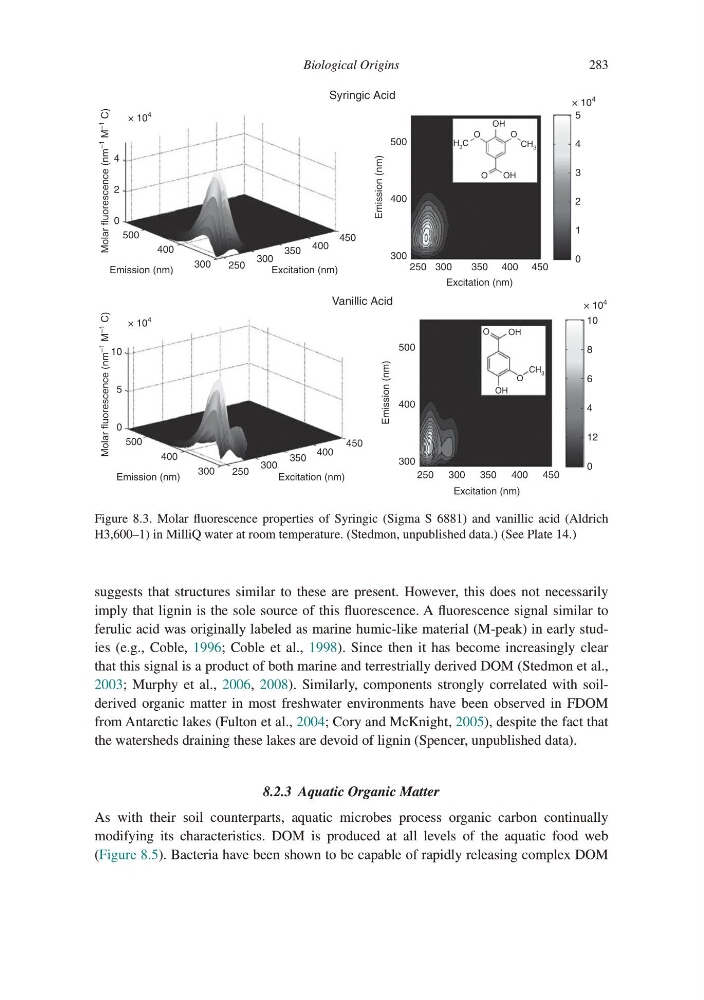
Figure 8.3. Molar fluorescence properties of Syringic (Sigma S 6881) and vanillic acid (Aldrich
H3,600–1) in MilliQ water at room temperature. (Stedmon, unpublished data.) (See Plate 14.)
283
suggests that structures similar to these are present. However, this does not necessarily
imply that lignin is the sole source of this fluorescence. A fluorescence signal similar to
ferulic acid was originally labeled as marine humic-like material (M-peak) in early studies (e.g., Coble, 1996; Coble et al., 1998). Since then it has become increasingly clear
that this signal is a product of both marine and terrestrially derived DOM (Stedmon et al.,
2003; Murphy et al., 2006, 2008). Similarly, components strongly correlated with soilderived organic matter in most freshwater environments have been observed in FDOM
from Antarctic lakes (Fulton et al., 2004; Cory and McKnight, 2005), despite the fact that
the watersheds draining these lakes are devoid of lignin (Spencer, unpublished data).
8.2.3 Aquatic Organic Matter
As with their soil counterparts, aquatic microbes process organic carbon continually
modifying its characteristics. DOM is produced at all levels of the aquatic food web
(Figure 8.5). Bacteria have been shown to be capable of rapidly releasing complex DOM
400
250 300
Excitation (nm)
350 400 450
250 300
Excitation (nm)
350 400 450
450
350
300
250
Excitation (nm)
300
400
500
400
450
350
300
250
300
400
500
Emission (nm)
Excitation (nm)
Emission (nm)
0
10
5
0
2
Molar fluorescence (nm
–1
M
–1
C)
Molar fluorescence (nm
–1
M
–1
C)
4
300
400
Emission (nm)
500
300
400
Emission (nm)
500
H 3 C
CH 3
CH 3
O
O
O
O
OH
OH
OH
OH
O
Syringic Acid
Vanillic Acid
5
× 10
4
4
3
2
1
0
10
× 10
4
8
6
4
12
0
× 10
4
× 10
4
Figure 8.3. Molar fluorescence properties of Syringic (Sigma S 6881) and vanillic acid (Aldrich
H3,600–1) in MilliQ water at room temperature. (Stedmon, unpublished data.) (See Plate 14.)