

Conmy, Del Castillo, Downing, and Chen
198
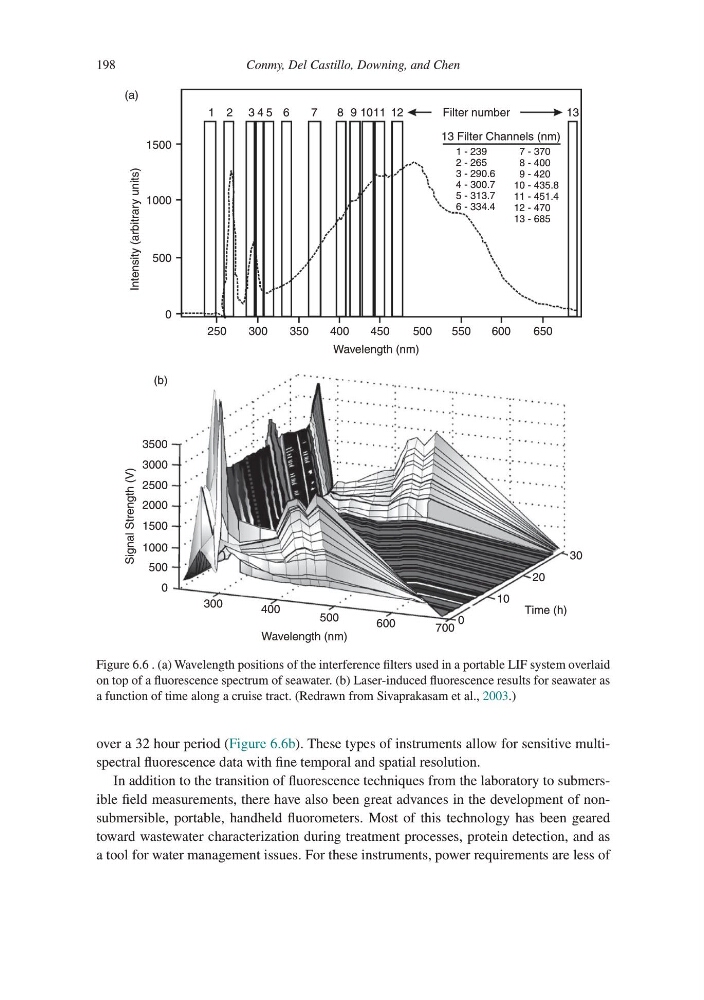
over a 32 hour period (Figure 6.6b). These types of instruments allow for sensitive multispectral fluorescence data with fine temporal and spatial resolution.
In addition to the transition of fluorescence techniques from the laboratory to submersible field measurements, there have also been great advances in the development of nonsubmersible, portable, handheld fluorometers. Most of this technology has been geared
toward wastewater characterization during treatment processes, protein detection, and as
a tool for water management issues. For these instruments, power requirements are less of
450
400
350
Wavelength (nm)
300
500
550
600
650
250
1500
(a)
Intensity (arbitrary units)
1 2 3 4 5 6
7
1 - 239
2 - 265
3 - 290.6
4 - 300.7
5 - 313.7
6 - 334.4
7 - 370
8 - 400
9 - 420
10 - 435.8
11 - 451.4
12 - 470
13 - 685
8 9 1011 12
13
Filter number
13 Filter Channels (nm)
1000
500
0
Wavelength (nm)
Time (h)
Signal Strength (V)
3500
(b)
3000
2000
2500
1500
1000
0
0
20
10
30
500
300
400
500
600
700
Figure 6.6 . (a) Wavelength positions of the interference filters used in a portable LIF system overlaid
on top of a fluorescence spectrum of seawater. (b) Laser-induced fluorescence results for seawater as
a function of time along a cruise tract. (Redrawn from Sivaprakasam et al., 2003.)
198
over a 32 hour period (Figure 6.6b). These types of instruments allow for sensitive multispectral fluorescence data with fine temporal and spatial resolution.
In addition to the transition of fluorescence techniques from the laboratory to submersible field measurements, there have also been great advances in the development of nonsubmersible, portable, handheld fluorometers. Most of this technology has been geared
toward wastewater characterization during treatment processes, protein detection, and as
a tool for water management issues. For these instruments, power requirements are less of
450
400
350
Wavelength (nm)
300
500
550
600
650
250
1500
(a)
Intensity (arbitrary units)
1 2 3 4 5 6
7
1 - 239
2 - 265
3 - 290.6
4 - 300.7
5 - 313.7
6 - 334.4
7 - 370
8 - 400
9 - 420
10 - 435.8
11 - 451.4
12 - 470
13 - 685
8 9 1011 12
13
Filter number
13 Filter Channels (nm)
1000
500
0
Wavelength (nm)
Time (h)
Signal Strength (V)
3500
(b)
3000
2000
2500
1500
1000
0
0
20
10
30
500
300
400
500
600
700
Figure 6.6 . (a) Wavelength positions of the interference filters used in a portable LIF system overlaid
on top of a fluorescence spectrum of seawater. (b) Laser-induced fluorescence results for seawater as
a function of time along a cruise tract. (Redrawn from Sivaprakasam et al., 2003.)