

Gilchrist and Reynolds
170
photodiodes is often much less than that of photomultipliers because they have no internal
gain. However, single-photon avalanche diode (SPAD) identifies a class of solid-state photodetectors based on a reverse biased P–N junction in which a photogenerated carrier can
trigger an avalanche current owing to the impact ionization mechanism. This device is able
to detect low-intensity signals (down to the single photon) and to signal the arrival times of
the photons with a jitter of a few tens of picoseconds (Niclass et al., 2005). Even so, silicon
photodiodes are rugged, exhibit excellent linearity over seven decades of incident radiant
power, and can be small in size with excellent time responses. As a result they are ideal
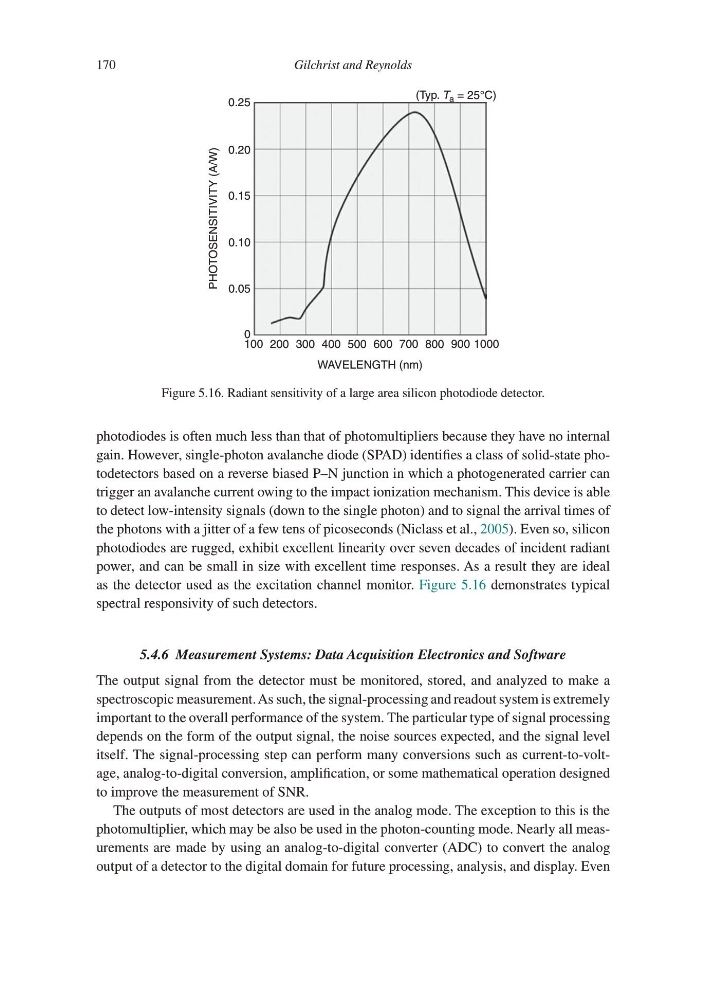
as the detector used as the excitation channel monitor. Figure 5.16 demonstrates typical
spectral responsivity of such detectors.
5.4.6 Measurement Systems: Data Acquisition Electronics and Software
The output signal from the detector must be monitored, stored, and analyzed to make a
spectroscopic measurement. As such, the signal-processing and readout system is extremely
important to the overall performance of the system. The particular type of signal processing
depends on the form of the output signal, the noise sources expected, and the signal level
itself. The signal-processing step can perform many conversions such as current-to-voltage, analog-to-digital conversion, amplification, or some mathematical operation designed
to improve the measurement of SNR.
The outputs of most detectors are used in the analog mode. The exception to this is the
photomultiplier, which may be also be used in the photon-counting mode. Nearly all measurements are made by using an analog-to-digital converter (ADC) to convert the analog
output of a detector to the digital domain for future processing, analysis, and display. Even
100
0.25
0.20
0.15
PHOTOSENSITIVITY (A/W)
0.10
0.05
0
900
700
WAVELENGTH (nm)
1000
(Typ. T a = 25°C)
800
600
500
400
300
200
Figure 5.16. Radiant sensitivity of a large area silicon photodiode detector.
170
photodiodes is often much less than that of photomultipliers because they have no internal
gain. However, single-photon avalanche diode (SPAD) identifies a class of solid-state photodetectors based on a reverse biased P–N junction in which a photogenerated carrier can
trigger an avalanche current owing to the impact ionization mechanism. This device is able
to detect low-intensity signals (down to the single photon) and to signal the arrival times of
the photons with a jitter of a few tens of picoseconds (Niclass et al., 2005). Even so, silicon
photodiodes are rugged, exhibit excellent linearity over seven decades of incident radiant
power, and can be small in size with excellent time responses. As a result they are ideal
as the detector used as the excitation channel monitor. Figure 5.16 demonstrates typical
spectral responsivity of such detectors.
5.4.6 Measurement Systems: Data Acquisition Electronics and Software
The output signal from the detector must be monitored, stored, and analyzed to make a
spectroscopic measurement. As such, the signal-processing and readout system is extremely
important to the overall performance of the system. The particular type of signal processing
depends on the form of the output signal, the noise sources expected, and the signal level
itself. The signal-processing step can perform many conversions such as current-to-voltage, analog-to-digital conversion, amplification, or some mathematical operation designed
to improve the measurement of SNR.
The outputs of most detectors are used in the analog mode. The exception to this is the
photomultiplier, which may be also be used in the photon-counting mode. Nearly all measurements are made by using an analog-to-digital converter (ADC) to convert the analog
output of a detector to the digital domain for future processing, analysis, and display. Even
100
0.25
0.20
0.15
PHOTOSENSITIVITY (A/W)
0.10
0.05
0
900
700
WAVELENGTH (nm)
1000
(Typ. T a = 25°C)
800
600
500
400
300
200
Figure 5.16. Radiant sensitivity of a large area silicon photodiode detector.