

Optical Spectroscopy Instrumentation Design
169
photocathode that converts an absorbed photon to an emitted electron. This electron is
drawn toward an electron multiplier stage. The multiplier gain is dependent on the number
of stages in the photomultiplier (dynode stages) where secondary electrons are released.
The signal is collected at the anode and output as a current pulse lasting a few nanoseconds.
Typical photomultiplier gains are in the range 10
4
–10
7
, where single-photon sensitivity is
possible. For photon counting the dynode chain is designed to give isolated short pulses
for each photon.
The absorbing surface of the photomultiplier, its photocathode material, defines the
spectral range and quantum efficiency of the detector. Photocathodes that respond to
longer wavelengths have lower work functions and are therefore more susceptible to noise
signals from thermally generated electrons. Thus, if working above 650 nm in photoncounting mode, it may be necessary to cool the detector to –20°C or less in a suitable
housing.
Photomultiplier tube detectors are still the detector of choice for fluorimeter application
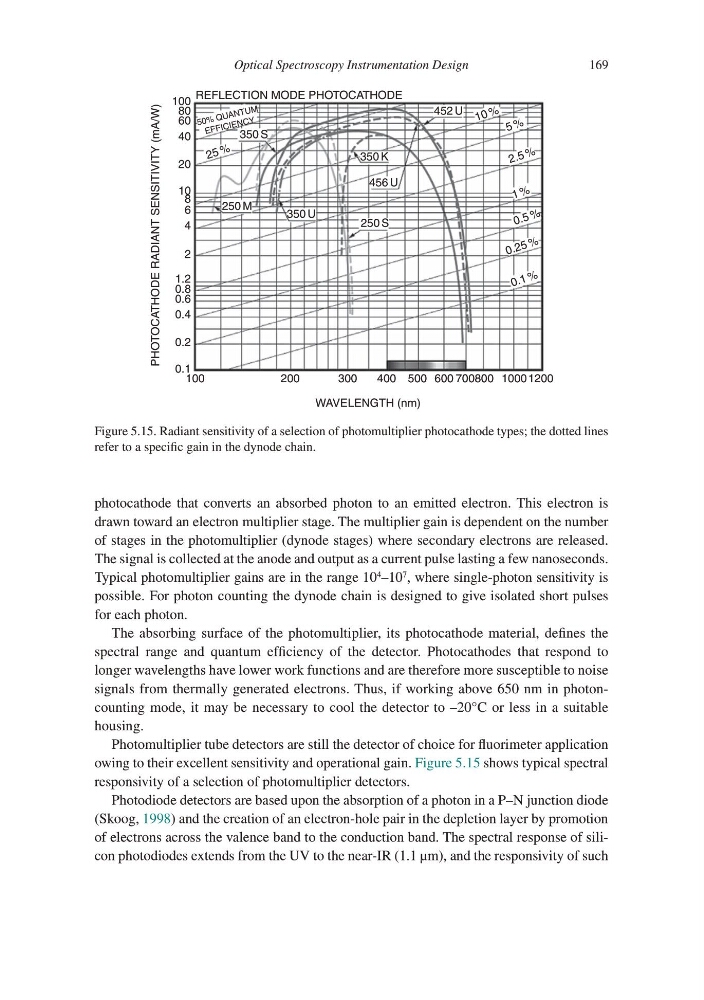
owing to their excellent sensitivity and operational gain. Figure 5.15 shows typical spectral
responsivity of a selection of photomultiplier detectors.
Photodiode detectors are based upon the absorption of a photon in a P–N junction diode
(Skoog, 1998) and the creation of an electron-hole pair in the depletion layer by promotion
of electrons across the valence band to the conduction band. The spectral response of silicon photodiodes extends from the UV to the near-IR (1.1 μm), and the responsivity of such
100
100
80
60
40
20
10
8
6
4
2
1.2
0.8
0.6
0.4
0.2
0.1
700
WAVELENGTH (nm)
REFLECTION MODE PHOTOCATHODE
350 S
2 5 %
0 .1 %
0 .2 5 %
5 %
1 0 %
2 .5 %
0 .5 %
1 %
50 % Q UA NT UM
EF FI CI EN CY
250 M
350 K
456 U
452 U
250 S
350 U
PHOTOCATHODE RADIANT SENSITIVITY (mA/W)
1200
1000
800
600
500
400
300
200
Figure 5.15. Radiant sensitivity of a selection of photomultiplier photocathode types; the dotted lines
refer to a specific gain in the dynode chain.
169
photocathode that converts an absorbed photon to an emitted electron. This electron is
drawn toward an electron multiplier stage. The multiplier gain is dependent on the number
of stages in the photomultiplier (dynode stages) where secondary electrons are released.
The signal is collected at the anode and output as a current pulse lasting a few nanoseconds.
Typical photomultiplier gains are in the range 10
4
–10
7
, where single-photon sensitivity is
possible. For photon counting the dynode chain is designed to give isolated short pulses
for each photon.
The absorbing surface of the photomultiplier, its photocathode material, defines the
spectral range and quantum efficiency of the detector. Photocathodes that respond to
longer wavelengths have lower work functions and are therefore more susceptible to noise
signals from thermally generated electrons. Thus, if working above 650 nm in photoncounting mode, it may be necessary to cool the detector to –20°C or less in a suitable
housing.
Photomultiplier tube detectors are still the detector of choice for fluorimeter application
owing to their excellent sensitivity and operational gain. Figure 5.15 shows typical spectral
responsivity of a selection of photomultiplier detectors.
Photodiode detectors are based upon the absorption of a photon in a P–N junction diode
(Skoog, 1998) and the creation of an electron-hole pair in the depletion layer by promotion
of electrons across the valence band to the conduction band. The spectral response of silicon photodiodes extends from the UV to the near-IR (1.1 μm), and the responsivity of such
100
100
80
60
40
20
10
8
6
4
2
1.2
0.8
0.6
0.4
0.2
0.1
700
WAVELENGTH (nm)
REFLECTION MODE PHOTOCATHODE
350 S
2 5 %
0 .1 %
0 .2 5 %
5 %
1 0 %
2 .5 %
0 .5 %
1 %
50 % Q UA NT UM
EF FI CI EN CY
250 M
350 K
456 U
452 U
250 S
350 U
PHOTOCATHODE RADIANT SENSITIVITY (mA/W)
1200
1000
800
600
500
400
300
200
Figure 5.15. Radiant sensitivity of a selection of photomultiplier photocathode types; the dotted lines
refer to a specific gain in the dynode chain.