

Optical Spectroscopy Instrumentation Design
161
these lamps require a complex power supply with an ignition circuit to strike the arc and a
well-designed lamp housing to provide proper lamp cooling. In addition lamps that exhibit
intense UV characteristics require additional attention given their possible effects on eyes
and skin in particular.
The spectral profile of the lamp is dependent on the operating conditions and the age of
the lamp (number of hours used). At the same time the design of the power supply should
be such as to ensure stability in the light output. Typically, the short- and long-term drifts in
xenon lamp outputs are on the order 0.2–5% depending on manufacturers and the exact use
of the lamp. For fluorimeter measurements 5% light stability is useless, as the fluorescence
signal will shift in synchronization with the lamp fluctuations by at least this value in routine measurements, making quantitative spectroscopy difficult. A high-quality fluorimeter
should demonstrate at least <0.5% lamp fluctuations and even at this level the reference
photodiode is still a very useful and necessary monitor of performance. Typical spectral
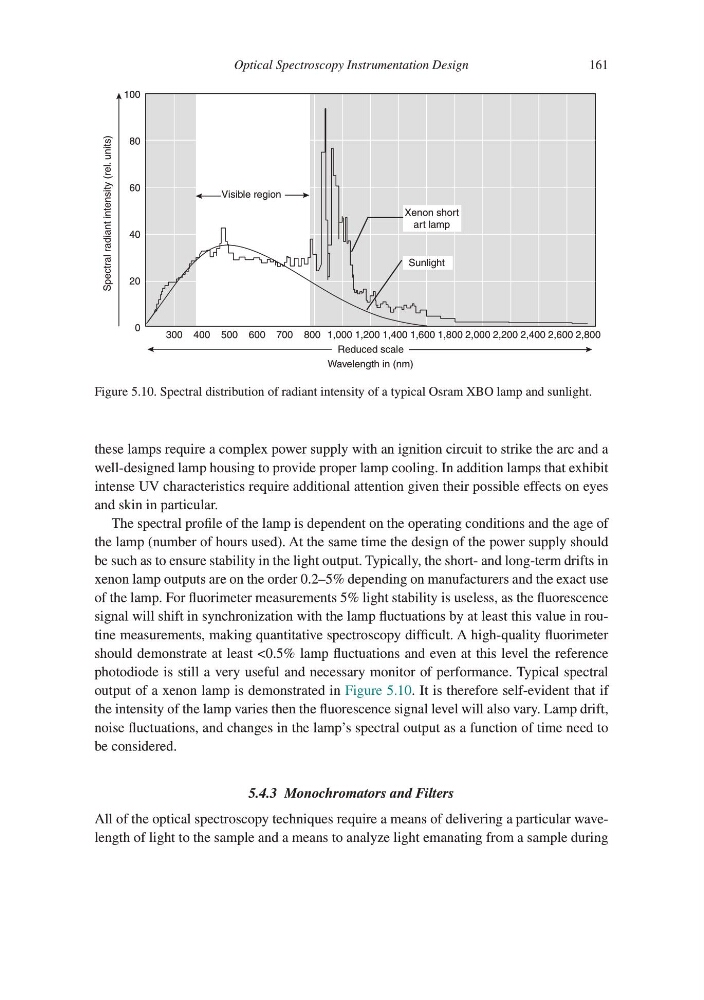
output of a xenon lamp is demonstrated in Figure 5.10. It is therefore self-evident that if
the intensity of the lamp varies then the fluorescence signal level will also vary. Lamp drift,
noise fluctuations, and changes in the lamp’s spectral output as a function of time need to
be considered.
5.4.3 Monochromators and Filters
All of the optical spectroscopy techniques require a means of delivering a particular wavelength of light to the sample and a means to analyze light emanating from a sample during
100
80
60
40
20
0
Visible region
Sunlight
Xenon short
art lamp
300
Spectral radiant intensity (rel. units)
400 500 600 700 800 1,000 1,200 1,400 1,600 1,800 2,000 2,200 2,400
Reduced scale
Wavelength in (nm)
2,600 2,800
Figure 5.10. Spectral distribution of radiant intensity of a typical Osram XBO lamp and sunlight.
161
these lamps require a complex power supply with an ignition circuit to strike the arc and a
well-designed lamp housing to provide proper lamp cooling. In addition lamps that exhibit
intense UV characteristics require additional attention given their possible effects on eyes
and skin in particular.
The spectral profile of the lamp is dependent on the operating conditions and the age of
the lamp (number of hours used). At the same time the design of the power supply should
be such as to ensure stability in the light output. Typically, the short- and long-term drifts in
xenon lamp outputs are on the order 0.2–5% depending on manufacturers and the exact use
of the lamp. For fluorimeter measurements 5% light stability is useless, as the fluorescence
signal will shift in synchronization with the lamp fluctuations by at least this value in routine measurements, making quantitative spectroscopy difficult. A high-quality fluorimeter
should demonstrate at least <0.5% lamp fluctuations and even at this level the reference
photodiode is still a very useful and necessary monitor of performance. Typical spectral
output of a xenon lamp is demonstrated in Figure 5.10. It is therefore self-evident that if
the intensity of the lamp varies then the fluorescence signal level will also vary. Lamp drift,
noise fluctuations, and changes in the lamp’s spectral output as a function of time need to
be considered.
5.4.3 Monochromators and Filters
All of the optical spectroscopy techniques require a means of delivering a particular wavelength of light to the sample and a means to analyze light emanating from a sample during
100
80
60
40
20
0
Visible region
Sunlight
Xenon short
art lamp
300
Spectral radiant intensity (rel. units)
400 500 600 700 800 1,000 1,200 1,400 1,600 1,800 2,000 2,200 2,400
Reduced scale
Wavelength in (nm)
2,600 2,800
Figure 5.10. Spectral distribution of radiant intensity of a typical Osram XBO lamp and sunlight.