

Gilchrist and Reynolds
160
5.4.2 Continuum Light Sources
Most photoluminescence instruments employ the use of high-intensity continuum sources
with UV and visible output. Continuum light sources have wavelength-dependent intensity profiles and may also change in both intensity and spectral output as a function of
time. For this reason many fluorimeter systems are now equipped with a reference silicon
photodiode detector that monitors a portion of the excitation light that is incident upon
the sample. The most common light source that is used in bench-top fluorimeter systems
is the xenon short arc lamp. This has an intense, almost continuous spectral output from
the UV (220 nm) to the near-IR (800 nm) with some fine structure superimposed. Line
spectra are prominent in the 800- to 1000-nm range, and optical output can be observed
well into the IR (2.6 μm). Xenon lamps have a small arc length (0.5–2.7 mm for 75- to
450-W lamps) and a high flux density. They are available in a variety of envelope materials allowing output from 185 nm and have relatively long operating lifetimes of up to
2000 hours.
Typically, xenon lamps are operated with DC power supplies, but pulsed versions are
available with 1- to 10-μs pulse widths for use in time-resolved measurements such as
phosphorescence studies. Xenon lamps offer the highest spectral flux density short of a
laser. Their spectral output is close to that of the sun at 6000°C, and they make ideal solar
simulators in many experiments. Special considerations when using an arc lamp include
envelope materials (materials that allow the transmission of light within a given or defined
spectral range); ozone dissipation; and convection current effects on noise, cooling, arc
gap, and lamp life. Although they are the lamp of choice for most fluorescence instruments,
0.8
1.0
0.6
0.4
0.2
0
Detection
volume
“Low concentration”
“High concentration”
0
2
4
6
8
1 0
Distance inside cuvette / mm
Excitation light intensity / Arb
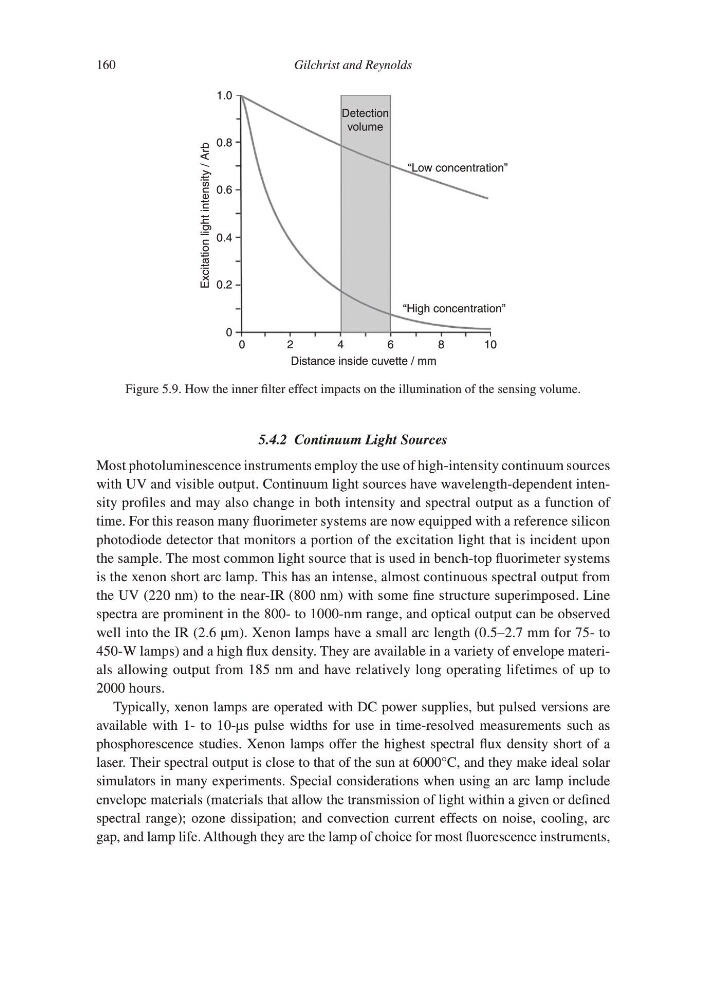
Figure 5.9. How the inner filter effect impacts on the illumination of the sensing volume.
160
5.4.2 Continuum Light Sources
Most photoluminescence instruments employ the use of high-intensity continuum sources
with UV and visible output. Continuum light sources have wavelength-dependent intensity profiles and may also change in both intensity and spectral output as a function of
time. For this reason many fluorimeter systems are now equipped with a reference silicon
photodiode detector that monitors a portion of the excitation light that is incident upon
the sample. The most common light source that is used in bench-top fluorimeter systems
is the xenon short arc lamp. This has an intense, almost continuous spectral output from
the UV (220 nm) to the near-IR (800 nm) with some fine structure superimposed. Line
spectra are prominent in the 800- to 1000-nm range, and optical output can be observed
well into the IR (2.6 μm). Xenon lamps have a small arc length (0.5–2.7 mm for 75- to
450-W lamps) and a high flux density. They are available in a variety of envelope materials allowing output from 185 nm and have relatively long operating lifetimes of up to
2000 hours.
Typically, xenon lamps are operated with DC power supplies, but pulsed versions are
available with 1- to 10-μs pulse widths for use in time-resolved measurements such as
phosphorescence studies. Xenon lamps offer the highest spectral flux density short of a
laser. Their spectral output is close to that of the sun at 6000°C, and they make ideal solar
simulators in many experiments. Special considerations when using an arc lamp include
envelope materials (materials that allow the transmission of light within a given or defined
spectral range); ozone dissipation; and convection current effects on noise, cooling, arc
gap, and lamp life. Although they are the lamp of choice for most fluorescence instruments,
0.8
1.0
0.6
0.4
0.2
0
Detection
volume
“Low concentration”
“High concentration”
0
2
4
6
8
1 0
Distance inside cuvette / mm
Excitation light intensity / Arb
Figure 5.9. How the inner filter effect impacts on the illumination of the sensing volume.