

Coble, Spencer, Baker, and Reynolds
94
be utilized to provide information about environmental conditions and the biogeochemical
transformations that are taking place, which is very informative in studies examining nutrient cycling in hyporheic and riparian ecosystems (Fellman et al., 2010).
Protein-like fluorescence has been linked to biologically labile DOM in a range of freshwater ecosystems. For example, a study in Lakes of Southern Quebec by Cammack et al.
(2004) correlated protein-like fluorescence with bacterial production, bacterial respiration,
and community respiration. Laboratory incubation experiments from a diverse range of
freshwater DOM sources have also found strong relationships between protein-like fluorescence and biodegradable DOM (Fellman et al., 2009b; Hood et al., 2009). Protein-like
fluorescence can also be used with respect to examining in stream uptake of DOM as
Fellman et al. (2009c) demonstrated that protein-like fluorescence decreased downstream
during soil leachate addition experiments in forested headwater streams in Alaska (USA).
In this leachate addition experiment, humic-like fluorescence did not change and protein0
y = 0.0031x + 1.24
r 2 = 0.81
p < 0.001
1.21
Continuous cropland in riparian zone (%)
Fluorescence index
5
1.26
1.31
1.36
1.41
10 15 20 25 30 35 40 45
0
y = –0.0132x + 1.36
1.21
Wetland in riparian zone SQRT %)
Fluorescence index
1
1.26
1.31
1.36
1.41
2
3
4
5
6
7
8
r
2 = 0.69
p < 0.001
(a)
(b)
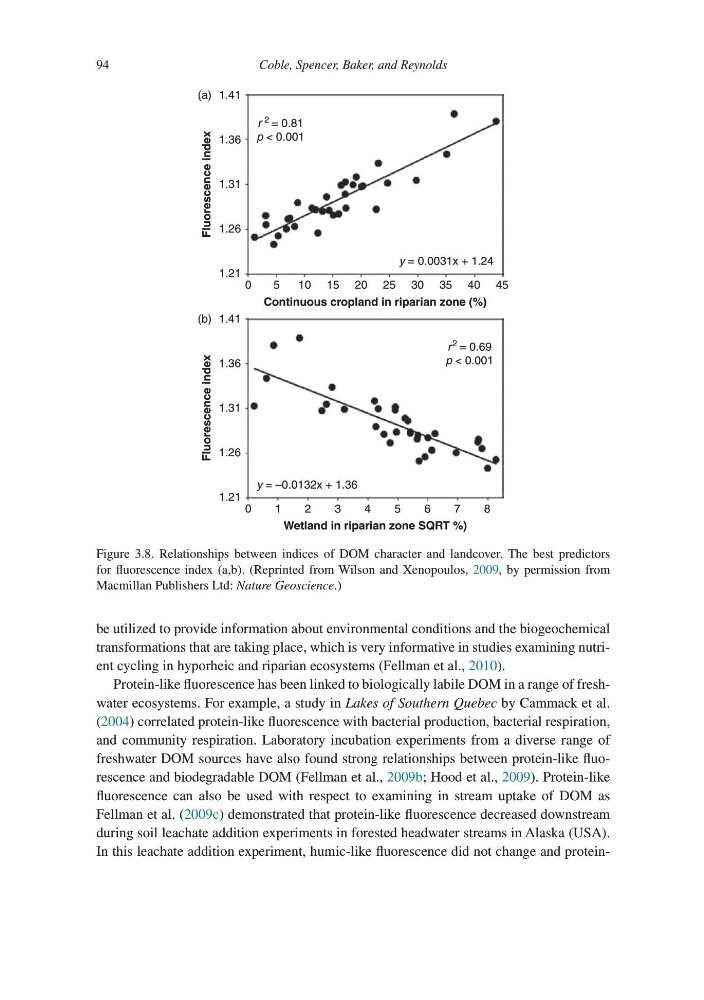
Figure 3.8. Relationships between indices of DOM character and landcover. The best predictors
for fluorescence index (a,b). (Reprinted from Wilson and Xenopoulos, 2009, by permission from
Macmillan Publishers Ltd: Nature Geoscience.)
94
be utilized to provide information about environmental conditions and the biogeochemical
transformations that are taking place, which is very informative in studies examining nutrient cycling in hyporheic and riparian ecosystems (Fellman et al., 2010).
Protein-like fluorescence has been linked to biologically labile DOM in a range of freshwater ecosystems. For example, a study in Lakes of Southern Quebec by Cammack et al.
(2004) correlated protein-like fluorescence with bacterial production, bacterial respiration,
and community respiration. Laboratory incubation experiments from a diverse range of
freshwater DOM sources have also found strong relationships between protein-like fluorescence and biodegradable DOM (Fellman et al., 2009b; Hood et al., 2009). Protein-like
fluorescence can also be used with respect to examining in stream uptake of DOM as
Fellman et al. (2009c) demonstrated that protein-like fluorescence decreased downstream
during soil leachate addition experiments in forested headwater streams in Alaska (USA).
In this leachate addition experiment, humic-like fluorescence did not change and protein0
y = 0.0031x + 1.24
r 2 = 0.81
p < 0.001
1.21
Continuous cropland in riparian zone (%)
Fluorescence index
5
1.26
1.31
1.36
1.41
10 15 20 25 30 35 40 45
0
y = –0.0132x + 1.36
1.21
Wetland in riparian zone SQRT %)
Fluorescence index
1
1.26
1.31
1.36
1.41
2
3
4
5
6
7
8
r
2 = 0.69
p < 0.001
(a)
(b)
Figure 3.8. Relationships between indices of DOM character and landcover. The best predictors
for fluorescence index (a,b). (Reprinted from Wilson and Xenopoulos, 2009, by permission from
Macmillan Publishers Ltd: Nature Geoscience.)