

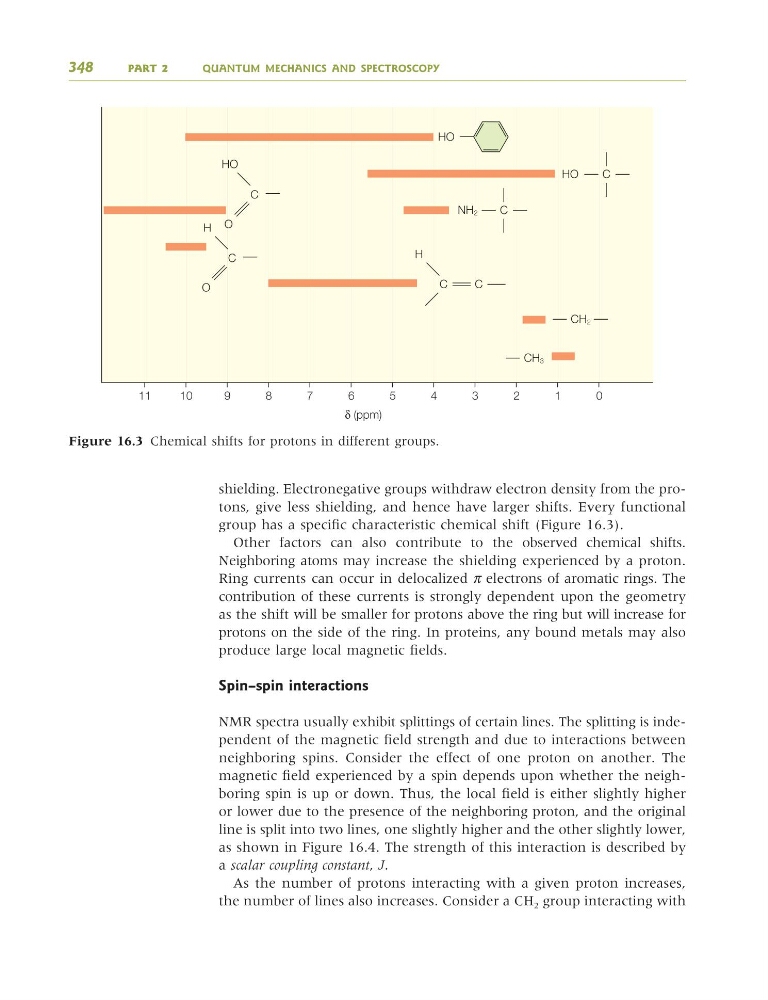
shielding. Electronegative groups withdraw electron density from the protons, give less shielding, and hence have larger shifts. Every functional
group has a specific characteristic chemical shift (Figure 16.3).
Other factors can also contribute to the observed chemical shifts.
Neighboring atoms may increase the shielding experienced by a proton.
Ring currents can occur in delocalized π electrons of aromatic rings. The
contribution of these currents is strongly dependent upon the geometry
as the shift will be smaller for protons above the ring but will increase for
protons on the side of the ring. In proteins, any bound metals may also
produce large local magnetic fields.
Spin–spin interactions
NMR spectra usually exhibit splittings of certain lines. The splitting is independent of the magnetic field strength and due to interactions between
neighboring spins. Consider the effect of one proton on another. The
magnetic field experienced by a spin depends upon whether the neighboring spin is up or down. Thus, the local field is either slightly higher
or lower due to the presence of the neighboring proton, and the original
line is split into two lines, one slightly higher and the other slightly lower,
as shown in Figure 16.4. The strength of this interaction is described by
a scalar coupling constant, J.
As the number of protons interacting with a given proton increases,
the number of lines also increases. Consider a CH 2 group interacting with
348
PART 2
QUANTUM MECHANICS AND SPECTROSCOPY
1 1
1 0
9
8
7
6
5
4
3
2
1
0
δ (ppm)
HO
C
NH2
C
CH 2
CH3
C
C
H
C
O
HO
C
O
H
HO
Figure 16.3 Chemical shifts for protons in different groups.
9781405124362_4_016.qxd 4/29/08 10:45 Page 348
group has a specific characteristic chemical shift (Figure 16.3).
Other factors can also contribute to the observed chemical shifts.
Neighboring atoms may increase the shielding experienced by a proton.
Ring currents can occur in delocalized π electrons of aromatic rings. The
contribution of these currents is strongly dependent upon the geometry
as the shift will be smaller for protons above the ring but will increase for
protons on the side of the ring. In proteins, any bound metals may also
produce large local magnetic fields.
Spin–spin interactions
NMR spectra usually exhibit splittings of certain lines. The splitting is independent of the magnetic field strength and due to interactions between
neighboring spins. Consider the effect of one proton on another. The
magnetic field experienced by a spin depends upon whether the neighboring spin is up or down. Thus, the local field is either slightly higher
or lower due to the presence of the neighboring proton, and the original
line is split into two lines, one slightly higher and the other slightly lower,
as shown in Figure 16.4. The strength of this interaction is described by
a scalar coupling constant, J.
As the number of protons interacting with a given proton increases,
the number of lines also increases. Consider a CH 2 group interacting with
348
PART 2
QUANTUM MECHANICS AND SPECTROSCOPY
1 1
1 0
9
8
7
6
5
4
3
2
1
0
δ (ppm)
HO
C
NH2
C
CH 2
CH3
C
C
H
C
O
HO
C
O
H
HO
Figure 16.3 Chemical shifts for protons in different groups.
9781405124362_4_016.qxd 4/29/08 10:45 Page 348