

Chemical shifts
Every dipole of a protein will interact with the external magnetic field.
The magnetic field experienced by each dipole will be slightly different
than the applied field due to the contributions of these dipoles. The
additional contribution is proportional to the applied field and is usually
written as:
δB = −σB
(16.6)
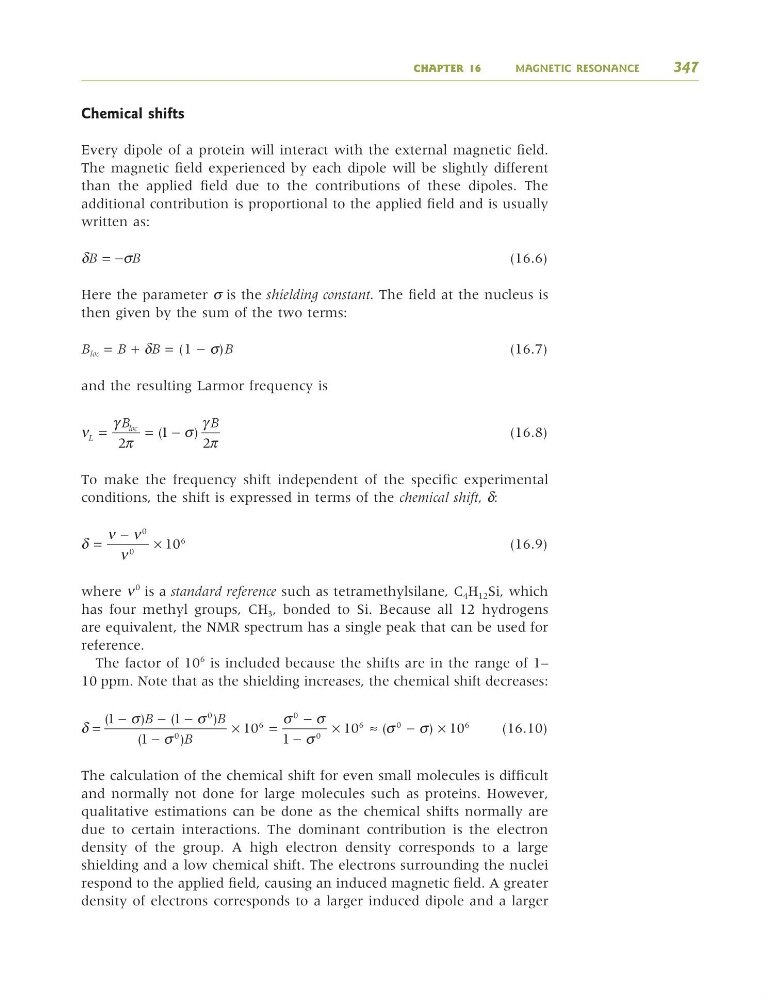
Here the parameter σ is the shielding constant. The field at the nucleus is
then given by the sum of the two terms:
B loc = B + δB = (1 − σ)B
(16.7)
and the resulting Larmor frequency is
(16.8)
To make the frequency shift independent of the specific experimental
conditions, the shift is expressed in terms of the chemical shift, δ:
(16.9)
where ν
0 is a standard reference such as tetramethylsilane, C 4 H 12 Si, which
has four methyl groups, CH 3 , bonded to Si. Because all 12 hydrogens
are equivalent, the NMR spectrum has a single peak that can be used for
reference.
The factor of 10
6 is included because the shifts are in the range of 1–
10 ppm. Note that as the shielding increases, the chemical shift decreases:
(16.10)
The calculation of the chemical shift for even small molecules is difficult
and normally not done for large molecules such as proteins. However,
qualitative estimations can be done as the chemical shifts normally are
due to certain interactions. The dominant contribution is the electron
density of the group. A high electron density corresponds to a large
shielding and a low chemical shift. The electrons surrounding the nuclei
respond to the applied field, causing an induced magnetic field. A greater
density of electrons corresponds to a larger induced dipole and a larger
δ
σ
σ
σ
σ
=
−
− −
−
×
=
(
)
(
)
(
)
1
1
1
10
0
0
6
0
B
B
B
− −
−
×
≈
−
×
(
)
σ
σ
σ
σ
1
10
10
0
6
0
6
δ
ν ν
ν
=
−
×
0
0
6
10
ν
γ
π
σ
γ
π
L
loc
B
B
(
)
=
= −
2
1
2
CHAPTER 16
MAGNETIC RESONANCE
347
9781405124362_4_016.qxd 4/29/08 10:45 Page 347
Every dipole of a protein will interact with the external magnetic field.
The magnetic field experienced by each dipole will be slightly different
than the applied field due to the contributions of these dipoles. The
additional contribution is proportional to the applied field and is usually
written as:
δB = −σB
(16.6)
Here the parameter σ is the shielding constant. The field at the nucleus is
then given by the sum of the two terms:
B loc = B + δB = (1 − σ)B
(16.7)
and the resulting Larmor frequency is
(16.8)
To make the frequency shift independent of the specific experimental
conditions, the shift is expressed in terms of the chemical shift, δ:
(16.9)
where ν
0 is a standard reference such as tetramethylsilane, C 4 H 12 Si, which
has four methyl groups, CH 3 , bonded to Si. Because all 12 hydrogens
are equivalent, the NMR spectrum has a single peak that can be used for
reference.
The factor of 10
6 is included because the shifts are in the range of 1–
10 ppm. Note that as the shielding increases, the chemical shift decreases:
(16.10)
The calculation of the chemical shift for even small molecules is difficult
and normally not done for large molecules such as proteins. However,
qualitative estimations can be done as the chemical shifts normally are
due to certain interactions. The dominant contribution is the electron
density of the group. A high electron density corresponds to a large
shielding and a low chemical shift. The electrons surrounding the nuclei
respond to the applied field, causing an induced magnetic field. A greater
density of electrons corresponds to a larger induced dipole and a larger
δ
σ
σ
σ
σ
=
−
− −
−
×
=
(
)
(
)
(
)
1
1
1
10
0
0
6
0
B
B
B
− −
−
×
≈
−
×
(
)
σ
σ
σ
σ
1
10
10
0
6
0
6
δ
ν ν
ν
=
−
×
0
0
6
10
ν
γ
π
σ
γ
π
L
loc
B
B
(
)
=
= −
2
1
2
CHAPTER 16
MAGNETIC RESONANCE
347
9781405124362_4_016.qxd 4/29/08 10:45 Page 347