

CHAPTER 15
X-RAY DIFFRACTION AND EXAFS
327
according to its atomic scattering factor, f i (hkl ), which has both an amplitude f i (hkl ) and a
phase ϕ ι (hkl ):
(db15.6)
The amplitude f i (hkl ) depends upon the type of atom (Figure 15.10) and the phase ϕ ι (hkl )
depends upon the position of the atom in the unit cell. Notice that ϕ ι (hkl ) is the phase for
the scattering of the ith atom and is distinct from α(hkl), which is the phase of the hkl reflection
(Figure 15.12).
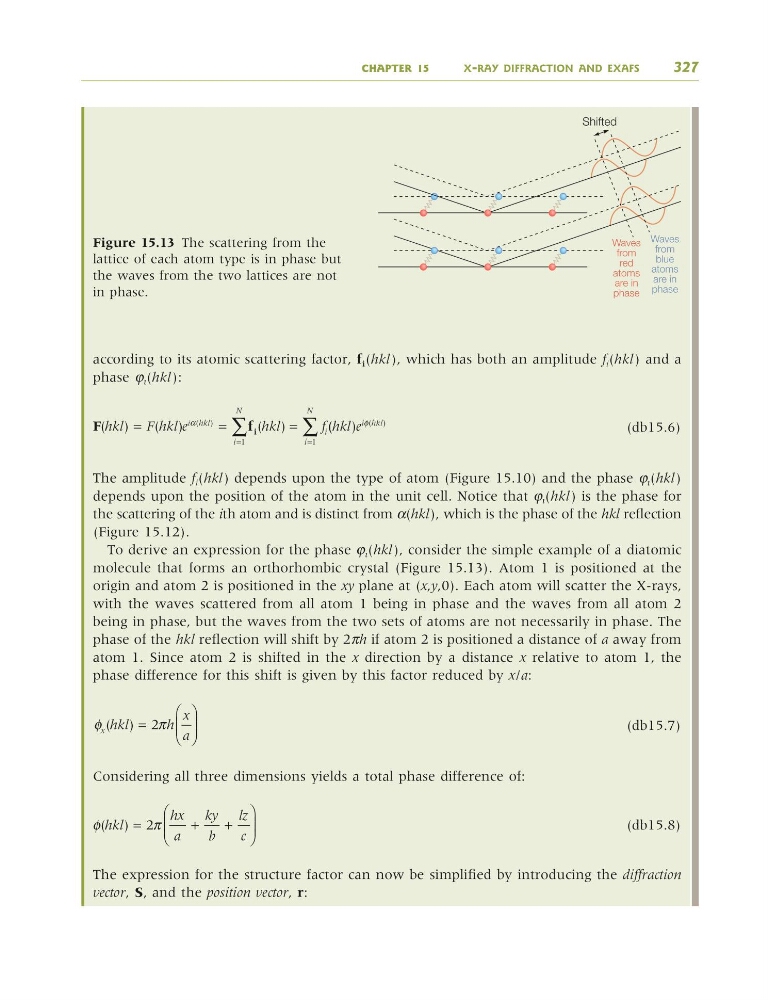
To derive an expression for the phase ϕ ι (hkl ), consider the simple example of a diatomic
molecule that forms an orthorhombic crystal (Figure 15.13). Atom 1 is positioned at the
origin and atom 2 is positioned in the xy plane at (x,y,0). Each atom will scatter the X-rays,
with the waves scattered from all atom 1 being in phase and the waves from all atom 2
being in phase, but the waves from the two sets of atoms are not necessarily in phase. The
phase of the hkl reflection will shift by 2πh if atom 2 is positioned a distance of a away from
atom 1. Since atom 2 is shifted in the x direction by a distance x relative to atom 1, the
phase difference for this shift is given by this factor reduced by x/a:
(db15.7)
Considering all three dimensions yields a total phase difference of:
(db15.8)
The expression for the structure factor can now be simplified by introducing the diffraction
9ector, S, and the position 9ector, r:
φ
π
( )
hkl
hx
a
ky
b
lz
c
=
+
+
⎛
⎝
⎜ ⎜
⎞
⎠
⎟ ⎟
2
φ
π
x hkl
h
x
a
( ) =
⎛
⎝
⎜ ⎜
⎞
⎠
⎟ ⎟
2
F
f i
( )
( )
( )
( )
hkl
F hkl e
hkl
f
i hkl
i
N
i
=
=
=
=
∑
α
1
( ( )
( )
hkl e
i
N
i hkl
=
∑
1
φ
Shifted
Waves
from
red
atoms
are in
phase
Waves
from
blue
atoms
are in
phase
Figure 15.13 The scattering from the
lattice of each atom type is in phase but
the waves from the two lattices are not
in phase.
9781405124362_4_015.qxd 4/30/08 20:27 Page 327
X-RAY DIFFRACTION AND EXAFS
327
according to its atomic scattering factor, f i (hkl ), which has both an amplitude f i (hkl ) and a
phase ϕ ι (hkl ):
(db15.6)
The amplitude f i (hkl ) depends upon the type of atom (Figure 15.10) and the phase ϕ ι (hkl )
depends upon the position of the atom in the unit cell. Notice that ϕ ι (hkl ) is the phase for
the scattering of the ith atom and is distinct from α(hkl), which is the phase of the hkl reflection
(Figure 15.12).
To derive an expression for the phase ϕ ι (hkl ), consider the simple example of a diatomic
molecule that forms an orthorhombic crystal (Figure 15.13). Atom 1 is positioned at the
origin and atom 2 is positioned in the xy plane at (x,y,0). Each atom will scatter the X-rays,
with the waves scattered from all atom 1 being in phase and the waves from all atom 2
being in phase, but the waves from the two sets of atoms are not necessarily in phase. The
phase of the hkl reflection will shift by 2πh if atom 2 is positioned a distance of a away from
atom 1. Since atom 2 is shifted in the x direction by a distance x relative to atom 1, the
phase difference for this shift is given by this factor reduced by x/a:
(db15.7)
Considering all three dimensions yields a total phase difference of:
(db15.8)
The expression for the structure factor can now be simplified by introducing the diffraction
9ector, S, and the position 9ector, r:
φ
π
( )
hkl
hx
a
ky
b
lz
c
=
+
+
⎛
⎝
⎜ ⎜
⎞
⎠
⎟ ⎟
2
φ
π
x hkl
h
x
a
( ) =
⎛
⎝
⎜ ⎜
⎞
⎠
⎟ ⎟
2
F
f i
( )
( )
( )
( )
hkl
F hkl e
hkl
f
i hkl
i
N
i
=
=
=
=
∑
α
1
( ( )
( )
hkl e
i
N
i hkl
=
∑
1
φ
Shifted
Waves
from
red
atoms
are in
phase
Waves
from
blue
atoms
are in
phase
Figure 15.13 The scattering from the
lattice of each atom type is in phase but
the waves from the two lattices are not
in phase.
9781405124362_4_015.qxd 4/30/08 20:27 Page 327