

326
PART 2
QUANTUM MECHANICS AND SPECTROSCOPY
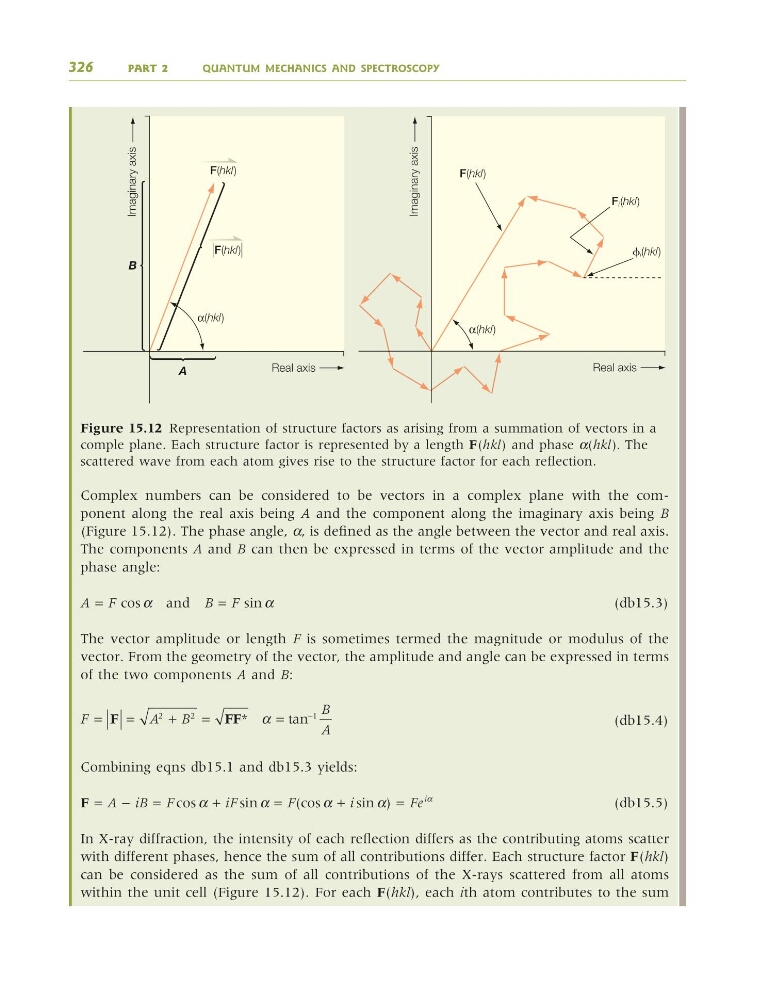
Complex numbers can be considered to be vectors in a complex plane with the component along the real axis being A and the component along the imaginary axis being B
(Figure 15.12). The phase angle, α, is defined as the angle between the vector and real axis.
The components A and B can then be expressed in terms of the vector amplitude and the
phase angle:
A = F cos α and B = F sin α
(db15.3)
The vector amplitude or length F is sometimes termed the magnitude or modulus of the
vector. From the geometry of the vector, the amplitude and angle can be expressed in terms
of the two components A and B:
(db15.4)
Combining eqns db15.1 and db15.3 yields:
F = A − iB = F cos α + iF sin α = F(cos α + i sin α) = Fe
iα
(db15.5)
In X-ray diffraction, the intensity of each reflection differs as the contributing atoms scatter
with different phases, hence the sum of all contributions differ. Each structure factor F(hkl)
can be considered as the sum of all contributions of the X-rays scattered from all atoms
within the unit cell (Figure 15.12). For each F(hkl), each ith atom contributes to the sum
F
A
B
B
A
tan
=
=
+
=
=
−
F
F F
2
2
1
* α
F(hkl)
α(hkl)
α(hkl)
F(hkl)
F(hkl)
F i(hkl)
ı(hkl)
Imaginary axis
B
A
Real axis
Imaginary axis
Real axis
Figure 15.12 Representation of structure factors as arising from a summation of vectors in a
comple plane. Each structure factor is represented by a length F(hkl) and phase α(hkl). The
scattered wave from each atom gives rise to the structure factor for each reflection.
9781405124362_4_015.qxd 4/30/08 20:27 Page 326
PART 2
QUANTUM MECHANICS AND SPECTROSCOPY
Complex numbers can be considered to be vectors in a complex plane with the component along the real axis being A and the component along the imaginary axis being B
(Figure 15.12). The phase angle, α, is defined as the angle between the vector and real axis.
The components A and B can then be expressed in terms of the vector amplitude and the
phase angle:
A = F cos α and B = F sin α
(db15.3)
The vector amplitude or length F is sometimes termed the magnitude or modulus of the
vector. From the geometry of the vector, the amplitude and angle can be expressed in terms
of the two components A and B:
(db15.4)
Combining eqns db15.1 and db15.3 yields:
F = A − iB = F cos α + iF sin α = F(cos α + i sin α) = Fe
iα
(db15.5)
In X-ray diffraction, the intensity of each reflection differs as the contributing atoms scatter
with different phases, hence the sum of all contributions differ. Each structure factor F(hkl)
can be considered as the sum of all contributions of the X-rays scattered from all atoms
within the unit cell (Figure 15.12). For each F(hkl), each ith atom contributes to the sum
F
A
B
B
A
tan
=
=
+
=
=
−
F
F F
2
2
1
* α
F(hkl)
α(hkl)
α(hkl)
F(hkl)
F(hkl)
F i(hkl)
ı(hkl)
Imaginary axis
B
A
Real axis
Imaginary axis
Real axis
Figure 15.12 Representation of structure factors as arising from a summation of vectors in a
comple plane. Each structure factor is represented by a length F(hkl) and phase α(hkl). The
scattered wave from each atom gives rise to the structure factor for each reflection.
9781405124362_4_015.qxd 4/30/08 20:27 Page 326