

bonds. Bond rotation through an angle ϕ is modeled as having a periodic
dependence on the angle that corresponds to the different orientations
of the substitutents. For example, the dependence for two tetrahedral
carbons will show three minima corresponding to the substitutents being
trans (ϕ = 180°), gauche
+ (ϕ = 60°), or gauche
− (ϕ = −60°), when modeled
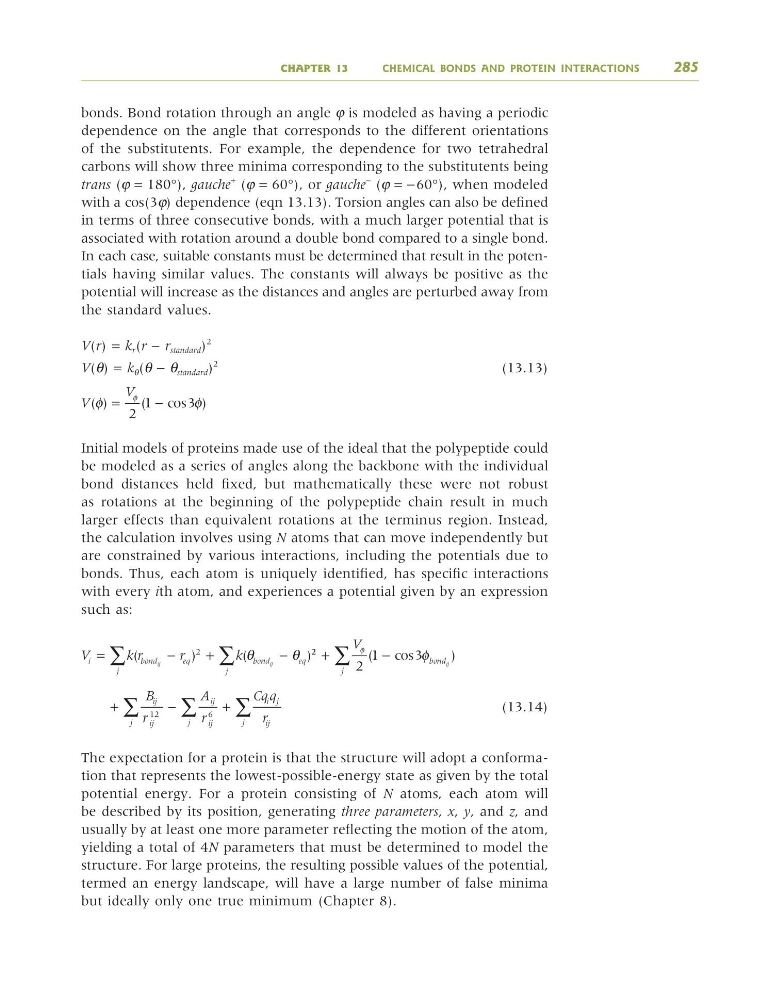
with a cos(3ϕ) dependence (eqn 13.13). Torsion angles can also be defined
in terms of three consecutive bonds, with a much larger potential that is
associated with rotation around a double bond compared to a single bond.
In each case, suitable constants must be determined that result in the potentials having similar values. The constants will always be positive as the
potential will increase as the distances and angles are perturbed away from
the standard values.
V(r) = k r (r − r standard )
2
V(θ) = k θ (θ − θ standard )
2
(13.13)
Initial models of proteins made use of the ideal that the polypeptide could
be modeled as a series of angles along the backbone with the individual
bond distances held fixed, but mathematically these were not robust
as rotations at the beginning of the polypeptide chain result in much
larger effects than equivalent rotations at the terminus region. Instead,
the calculation involves using N atoms that can move independently but
are constrained by various interactions, including the potentials due to
bonds. Thus, each atom is uniquely identified, has specific interactions
with every ith atom, and experiences a potential given by an expression
such as:
(13.14)
The expectation for a protein is that the structure will adopt a conformation that represents the lowest-possible-energy state as given by the total
potential energy. For a protein consisting of N atoms, each atom will
be described by its position, generating three parameters, x, y, and z, and
usually by at least one more parameter reflecting the motion of the atom,
yielding a total of 4N parameters that must be determined to model the
structure. For large proteins, the resulting possible values of the potential,
termed an energy landscape, will have a large number of false minima
but ideally only one true minimum (Chapter 8).
+
−
+
∑
∑
∑
B
r
A
r
Cqq
r
ij
ij
j
ij
ij
j
i j
ij
j
12
6
V
kr
r
k
i
b o n d
e q
j
bond
eq
ij
ij
(
)
(
)
=
−
+
−
∑
2
θ
θ
2 2
2
1
3
j
bond
j
V
ij
∑
∑
+
−
( cos
)
φ
φ
V
V
( )
( cos )
φ
φ
φ
=
−
2
1
3
CHAPTER 13
CHEMICAL BONDS AND PROTEIN INTERACTIONS
285
9781405124362_4_013.qxd 4/29/08 9:12 Page 285
dependence on the angle that corresponds to the different orientations
of the substitutents. For example, the dependence for two tetrahedral
carbons will show three minima corresponding to the substitutents being
trans (ϕ = 180°), gauche
+ (ϕ = 60°), or gauche
− (ϕ = −60°), when modeled
with a cos(3ϕ) dependence (eqn 13.13). Torsion angles can also be defined
in terms of three consecutive bonds, with a much larger potential that is
associated with rotation around a double bond compared to a single bond.
In each case, suitable constants must be determined that result in the potentials having similar values. The constants will always be positive as the
potential will increase as the distances and angles are perturbed away from
the standard values.
V(r) = k r (r − r standard )
2
V(θ) = k θ (θ − θ standard )
2
(13.13)
Initial models of proteins made use of the ideal that the polypeptide could
be modeled as a series of angles along the backbone with the individual
bond distances held fixed, but mathematically these were not robust
as rotations at the beginning of the polypeptide chain result in much
larger effects than equivalent rotations at the terminus region. Instead,
the calculation involves using N atoms that can move independently but
are constrained by various interactions, including the potentials due to
bonds. Thus, each atom is uniquely identified, has specific interactions
with every ith atom, and experiences a potential given by an expression
such as:
(13.14)
The expectation for a protein is that the structure will adopt a conformation that represents the lowest-possible-energy state as given by the total
potential energy. For a protein consisting of N atoms, each atom will
be described by its position, generating three parameters, x, y, and z, and
usually by at least one more parameter reflecting the motion of the atom,
yielding a total of 4N parameters that must be determined to model the
structure. For large proteins, the resulting possible values of the potential,
termed an energy landscape, will have a large number of false minima
but ideally only one true minimum (Chapter 8).
+
−
+
∑
∑
∑
B
r
A
r
Cqq
r
ij
ij
j
ij
ij
j
i j
ij
j
12
6
V
kr
r
k
i
b o n d
e q
j
bond
eq
ij
ij
(
)
(
)
=
−
+
−
∑
2
θ
θ
2 2
2
1
3
j
bond
j
V
ij
∑
∑
+
−
( cos
)
φ
φ
V
V
( )
( cos )
φ
φ
φ
=
−
2
1
3
CHAPTER 13
CHEMICAL BONDS AND PROTEIN INTERACTIONS
285
9781405124362_4_013.qxd 4/29/08 9:12 Page 285