

VALENCE BONDS
In valence bond theory, a bond is formed when an electron in one of
the atomic orbitals pairs its spin with the spin of an electron associated
with another nucleus. Since the two electrons are identical, the overall
wavefunction is written as a linear combination of individual wavefunctions (eqn 13.8). Since the molecular wavefunctions are written in terms
of the atomic orbitals, the resulting molecular orbitals will also reflect the
atomic orbitals. The lowest-energy solution of the hydrogen atom was
the 1s orbital. The lowest-energy molecular orbital will be formed by a
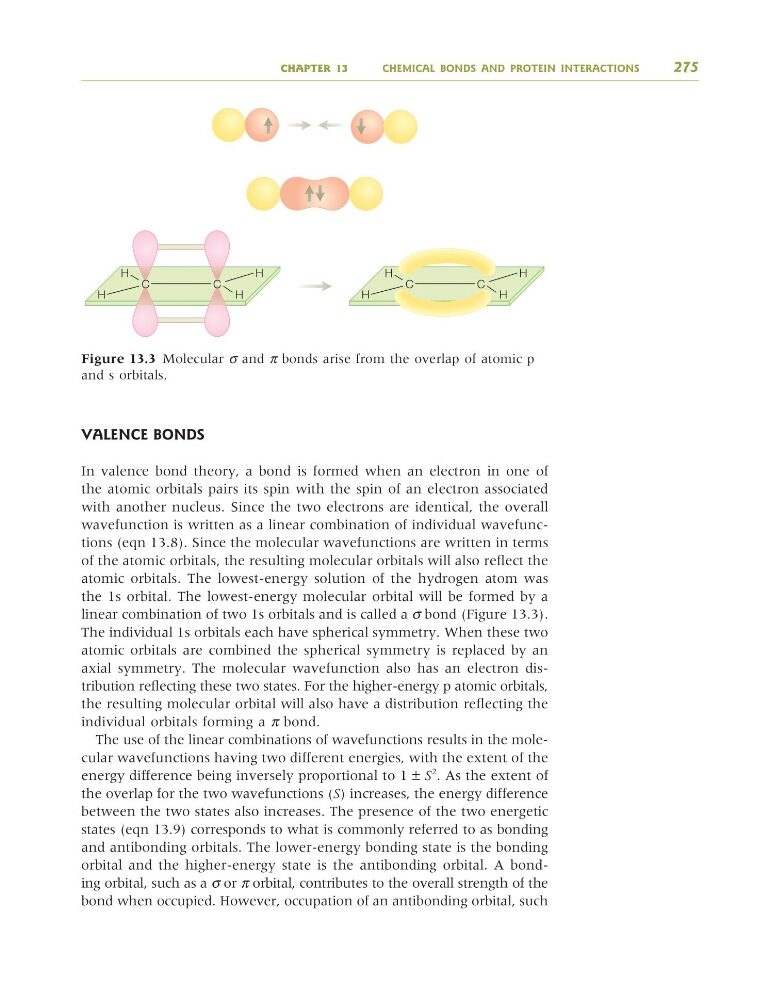
linear combination of two 1s orbitals and is called a σ bond (Figure 13.3).
The individual 1s orbitals each have spherical symmetry. When these two
atomic orbitals are combined the spherical symmetry is replaced by an
axial symmetry. The molecular wavefunction also has an electron distribution reflecting these two states. For the higher-energy p atomic orbitals,
the resulting molecular orbital will also have a distribution reflecting the
individual orbitals forming a π bond.
The use of the linear combinations of wavefunctions results in the molecular wavefunctions having two different energies, with the extent of the
energy difference being inversely proportional to 1 ± S
2
. As the extent of
the overlap for the two wavefunctions (S) increases, the energy difference
between the two states also increases. The presence of the two energetic
states (eqn 13.9) corresponds to what is commonly referred to as bonding
and antibonding orbitals. The lower-energy bonding state is the bonding
orbital and the higher-energy state is the antibonding orbital. A bonding orbital, such as a σ or π orbital, contributes to the overall strength of the
bond when occupied. However, occupation of an antibonding orbital, such
Figure 13.3 Molecular σ and π bonds arise from the overlap of atomic p
and s orbitals.
CHAPTER 13
CHEMICAL BONDS AND PROTEIN INTERACTIONS
275
H
H
H
H
H
H
H
H
C
C
C
C
9781405124362_4_013.qxd 4/29/08 9:12 Page 275
In valence bond theory, a bond is formed when an electron in one of
the atomic orbitals pairs its spin with the spin of an electron associated
with another nucleus. Since the two electrons are identical, the overall
wavefunction is written as a linear combination of individual wavefunctions (eqn 13.8). Since the molecular wavefunctions are written in terms
of the atomic orbitals, the resulting molecular orbitals will also reflect the
atomic orbitals. The lowest-energy solution of the hydrogen atom was
the 1s orbital. The lowest-energy molecular orbital will be formed by a
linear combination of two 1s orbitals and is called a σ bond (Figure 13.3).
The individual 1s orbitals each have spherical symmetry. When these two
atomic orbitals are combined the spherical symmetry is replaced by an
axial symmetry. The molecular wavefunction also has an electron distribution reflecting these two states. For the higher-energy p atomic orbitals,
the resulting molecular orbital will also have a distribution reflecting the
individual orbitals forming a π bond.
The use of the linear combinations of wavefunctions results in the molecular wavefunctions having two different energies, with the extent of the
energy difference being inversely proportional to 1 ± S
2
. As the extent of
the overlap for the two wavefunctions (S) increases, the energy difference
between the two states also increases. The presence of the two energetic
states (eqn 13.9) corresponds to what is commonly referred to as bonding
and antibonding orbitals. The lower-energy bonding state is the bonding
orbital and the higher-energy state is the antibonding orbital. A bonding orbital, such as a σ or π orbital, contributes to the overall strength of the
bond when occupied. However, occupation of an antibonding orbital, such
Figure 13.3 Molecular σ and π bonds arise from the overlap of atomic p
and s orbitals.
CHAPTER 13
CHEMICAL BONDS AND PROTEIN INTERACTIONS
275
H
H
H
H
H
H
H
H
C
C
C
C
9781405124362_4_013.qxd 4/29/08 9:12 Page 275