

The second contribution is due to the repulsion between atoms at
very short distances. The repulsion can be calculated using quantum
mechanics as arising from trying to insert more than two electrons into
one orbital. For the purpose of such calculations, simple models of
electron-overlap repulsion are used. At long distances, the interactions
are very weak and so the energy is considered to be zero. As the two
atoms move closer together, the bonding interaction is favorable and
the energy of the system decreases. When the two atoms are too close
together, the electrostatic interaction becomes large and the overall
energy becomes positive with a dependence of 1/r
12 . The use of these
two potentials to describe the interactions between atoms is often termed
the Lennard-Jones potential after Sir John Edward Lennard-Jones who
first proposed its use. The combination of the attractive and repulsive
effects results in an optimal separation distance between any two atoms
and represents the ideal distance for a bond between the atoms. This net
interaction has a minimum energy value at the equilibrium distance for
the bond length.
Although this form of Schrödinger’s equation can be solved, we have
already been able to argue what the features of these wavefunctions should
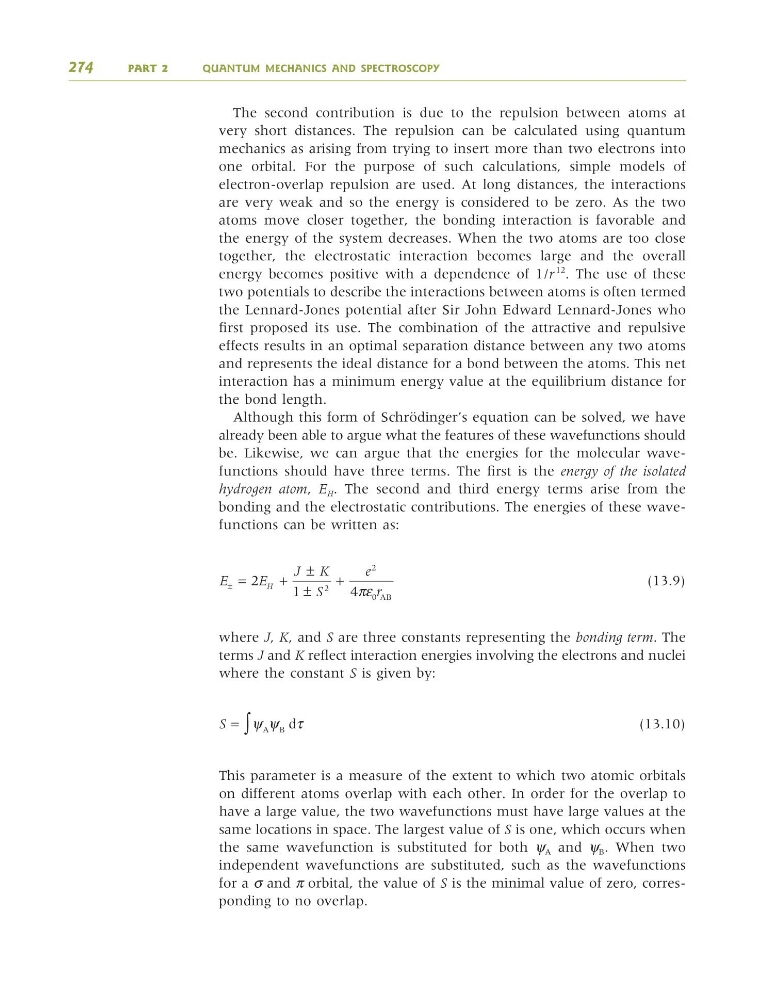
be. Likewise, we can argue that the energies for the molecular wavefunctions should have three terms. The first is the energy of the isolated
hydrogen atom, E H . The second and third energy terms arise from the
bonding and the electrostatic contributions. The energies of these wavefunctions can be written as:
(13.9)
where J, K, and S are three constants representing the bonding term. The
terms J and K reflect interaction energies involving the electrons and nuclei
where the constant S is given by:
(13.10)
This parameter is a measure of the extent to which two atomic orbitals
on different atoms overlap with each other. In order for the overlap to
have a large value, the two wavefunctions must have large values at the
same locations in space. The largest value of S is one, which occurs when
the same wavefunction is substituted for both ψ A and ψ B . When two
independent wavefunctions are substituted, such as the wavefunctions
for a σ and π orbital, the value of S is the minimal value of zero, corresponding to no overlap.
S = ∫ ψ ψ τ
A B d
E
E
J K
S
e
r
H
± =
+
±
±
+
2
1
4
2
2
0
πε AB
274
PART 2
QUANTUM MECHANICS AND SPECTROSCOPY
9781405124362_4_013.qxd 4/29/08 9:12 Page 274
very short distances. The repulsion can be calculated using quantum
mechanics as arising from trying to insert more than two electrons into
one orbital. For the purpose of such calculations, simple models of
electron-overlap repulsion are used. At long distances, the interactions
are very weak and so the energy is considered to be zero. As the two
atoms move closer together, the bonding interaction is favorable and
the energy of the system decreases. When the two atoms are too close
together, the electrostatic interaction becomes large and the overall
energy becomes positive with a dependence of 1/r
12 . The use of these
two potentials to describe the interactions between atoms is often termed
the Lennard-Jones potential after Sir John Edward Lennard-Jones who
first proposed its use. The combination of the attractive and repulsive
effects results in an optimal separation distance between any two atoms
and represents the ideal distance for a bond between the atoms. This net
interaction has a minimum energy value at the equilibrium distance for
the bond length.
Although this form of Schrödinger’s equation can be solved, we have
already been able to argue what the features of these wavefunctions should
be. Likewise, we can argue that the energies for the molecular wavefunctions should have three terms. The first is the energy of the isolated
hydrogen atom, E H . The second and third energy terms arise from the
bonding and the electrostatic contributions. The energies of these wavefunctions can be written as:
(13.9)
where J, K, and S are three constants representing the bonding term. The
terms J and K reflect interaction energies involving the electrons and nuclei
where the constant S is given by:
(13.10)
This parameter is a measure of the extent to which two atomic orbitals
on different atoms overlap with each other. In order for the overlap to
have a large value, the two wavefunctions must have large values at the
same locations in space. The largest value of S is one, which occurs when
the same wavefunction is substituted for both ψ A and ψ B . When two
independent wavefunctions are substituted, such as the wavefunctions
for a σ and π orbital, the value of S is the minimal value of zero, corresponding to no overlap.
S = ∫ ψ ψ τ
A B d
E
E
J K
S
e
r
H
± =
+
±
±
+
2
1
4
2
2
0
πε AB
274
PART 2
QUANTUM MECHANICS AND SPECTROSCOPY
9781405124362_4_013.qxd 4/29/08 9:12 Page 274