

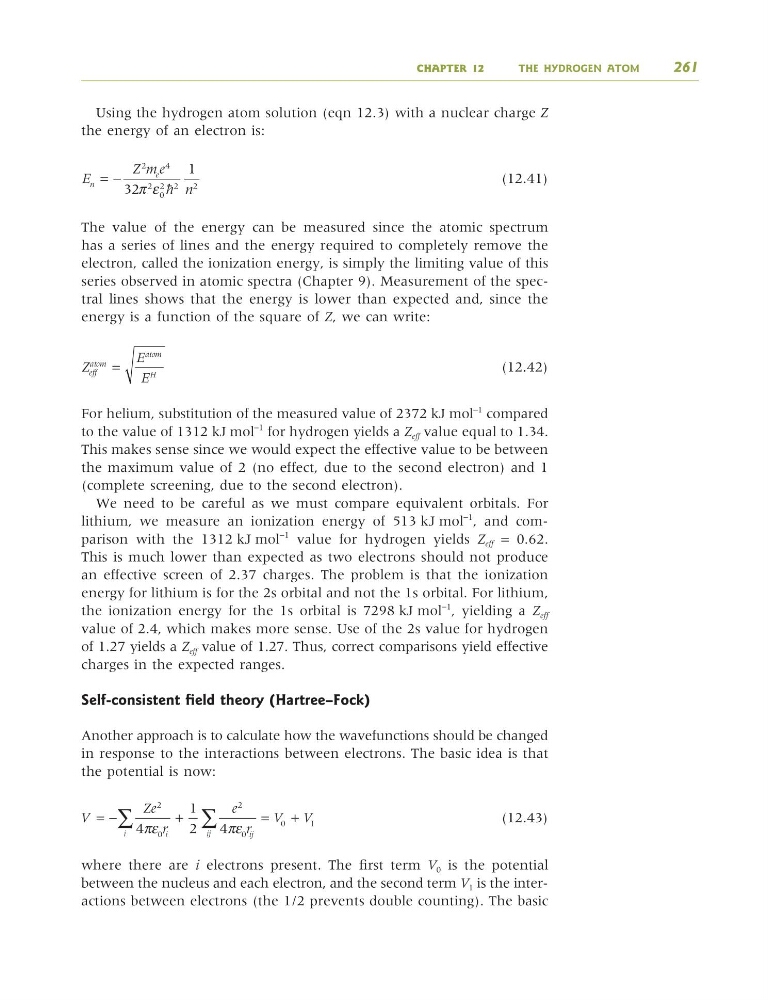
Using the hydrogen atom solution (eqn 12.3) with a nuclear charge Z
the energy of an electron is:
(12.41)
The value of the energy can be measured since the atomic spectrum
has a series of lines and the energy required to completely remove the
electron, called the ionization energy, is simply the limiting value of this
series observed in atomic spectra (Chapter 9). Measurement of the spectral lines shows that the energy is lower than expected and, since the
energy is a function of the square of Z, we can write:
(12.42)
For helium, substitution of the measured value of 2372 kJ mol
−1 compared
to the value of 1312 kJ mol
−1 for hydrogen yields a Z eff value equal to 1.34.
This makes sense since we would expect the effective value to be between
the maximum value of 2 (no effect, due to the second electron) and 1
(complete screening, due to the second electron).
We need to be careful as we must compare equivalent orbitals. For
lithium, we measure an ionization energy of 513 kJ mol
−1
, and comparison with the 1312 kJ mol
−1 value for hydrogen yields Z eff = 0.62.
This is much lower than expected as two electrons should not produce
an effective screen of 2.37 charges. The problem is that the ionization
energy for lithium is for the 2s orbital and not the 1s orbital. For lithium,
the ionization energy for the 1s orbital is 7298 kJ mol
−1
, yielding a Z eff
value of 2.4, which makes more sense. Use of the 2s value for hydrogen
of 1.27 yields a Z eff value of 1.27. Thus, correct comparisons yield effective
charges in the expected ranges.
Self-consistent field theory (Hartree–Fock)
Another approach is to calculate how the wavefunctions should be changed
in response to the interactions between electrons. The basic idea is that
the potential is now:
(12.43)
where there are i electrons present. The first term V 0 is the potential
between the nucleus and each electron, and the second term V 1 is the interactions between electrons (the 1/2 prevents double counting). The basic
V
Ze
r
e
r
V V
i
i
ij
ij
= −
+
=
+
∑
∑
2
0
2
0
0
1
4
1
2
4
πε
πε
Z
E
E
eff
atom
atom
H
=
E
Z m e
n
n
e
= −
2
4
2
0
2 2
2
32
1
π ε Z
CHAPTER 12
THE HYDROGEN ATOM
261
9781405124362_4_012.qxd 4/29/08 9:11 Page 261
the energy of an electron is:
(12.41)
The value of the energy can be measured since the atomic spectrum
has a series of lines and the energy required to completely remove the
electron, called the ionization energy, is simply the limiting value of this
series observed in atomic spectra (Chapter 9). Measurement of the spectral lines shows that the energy is lower than expected and, since the
energy is a function of the square of Z, we can write:
(12.42)
For helium, substitution of the measured value of 2372 kJ mol
−1 compared
to the value of 1312 kJ mol
−1 for hydrogen yields a Z eff value equal to 1.34.
This makes sense since we would expect the effective value to be between
the maximum value of 2 (no effect, due to the second electron) and 1
(complete screening, due to the second electron).
We need to be careful as we must compare equivalent orbitals. For
lithium, we measure an ionization energy of 513 kJ mol
−1
, and comparison with the 1312 kJ mol
−1 value for hydrogen yields Z eff = 0.62.
This is much lower than expected as two electrons should not produce
an effective screen of 2.37 charges. The problem is that the ionization
energy for lithium is for the 2s orbital and not the 1s orbital. For lithium,
the ionization energy for the 1s orbital is 7298 kJ mol
−1
, yielding a Z eff
value of 2.4, which makes more sense. Use of the 2s value for hydrogen
of 1.27 yields a Z eff value of 1.27. Thus, correct comparisons yield effective
charges in the expected ranges.
Self-consistent field theory (Hartree–Fock)
Another approach is to calculate how the wavefunctions should be changed
in response to the interactions between electrons. The basic idea is that
the potential is now:
(12.43)
where there are i electrons present. The first term V 0 is the potential
between the nucleus and each electron, and the second term V 1 is the interactions between electrons (the 1/2 prevents double counting). The basic
V
Ze
r
e
r
V V
i
i
ij
ij
= −
+
=
+
∑
∑
2
0
2
0
0
1
4
1
2
4
πε
πε
Z
E
E
eff
atom
atom
H
=
E
Z m e
n
n
e
= −
2
4
2
0
2 2
2
32
1
π ε Z
CHAPTER 12
THE HYDROGEN ATOM
261
9781405124362_4_012.qxd 4/29/08 9:11 Page 261