

260
PART 2
QUANTUM MECHANICS AND SPECTROSCOPY
the energy of each particle corresponding to their masses (technically the rest mass as the
mass is dependent upon the motion in relativity). Electrons and positrons have the same
mass, m e , corresponding to energies of m e c
2
. Thus, a total energy of at least 2m e c
2 is needed
to create an electron–positron pair at a synchrotron. Once created, the positron will rapidly
recombine with an electron, releasing an energy of 2m e c
2
, which is equal to 1022 keV, and
it is this release of energy that is often discussed in literature. To conserve momentum, the
energy will be released as two photons emitted at a relative angle of 180° (assuming that
the particles are at rest). For example, in the book Angels and Demons by Dan Brown, scientists
make use of the Conseil Europeen pour la Recherche Nucleaire, denoted by the acronym
CERN, a center for particle physics that straddles the French–Swiss border. In that story,
scientists at CERN generated 0.25 g of positrons that are trapped in a special container
(a plot device that has never been accomplished). This mass corresponds to 0.25 g m e
−1 , or
2.7 × 10
26 positrons, and hence each recombination of every positron with an equivalent
amount of electrons will release an energy of 1.4 × 10
29 keV or equivalently 5.3 kt, an amount
comparable to that of the first atomic bombs.
m e = 9.1 × 10
−31 kg
m e c
2
= (9.1 × 10
−31 kg)(3 × 10
8 m s
−1
)
2
= 511 keV
1 eV = 3.8 × 10
−32 kt (kilotonnes)
MULTI-ELECTRON ATOMS
The solution of Schrödinger’s equation when more than one
electron is present is usually solved by use of approximations to incorporate the interactions between the electrons.
There are two basic approaches that can be used. Both rely
on the idea that the wavefunctions derived for the hydrogen
atom are basically correct and simply need minor corrections
in order to be used for many electron atoms.
Empirical constants
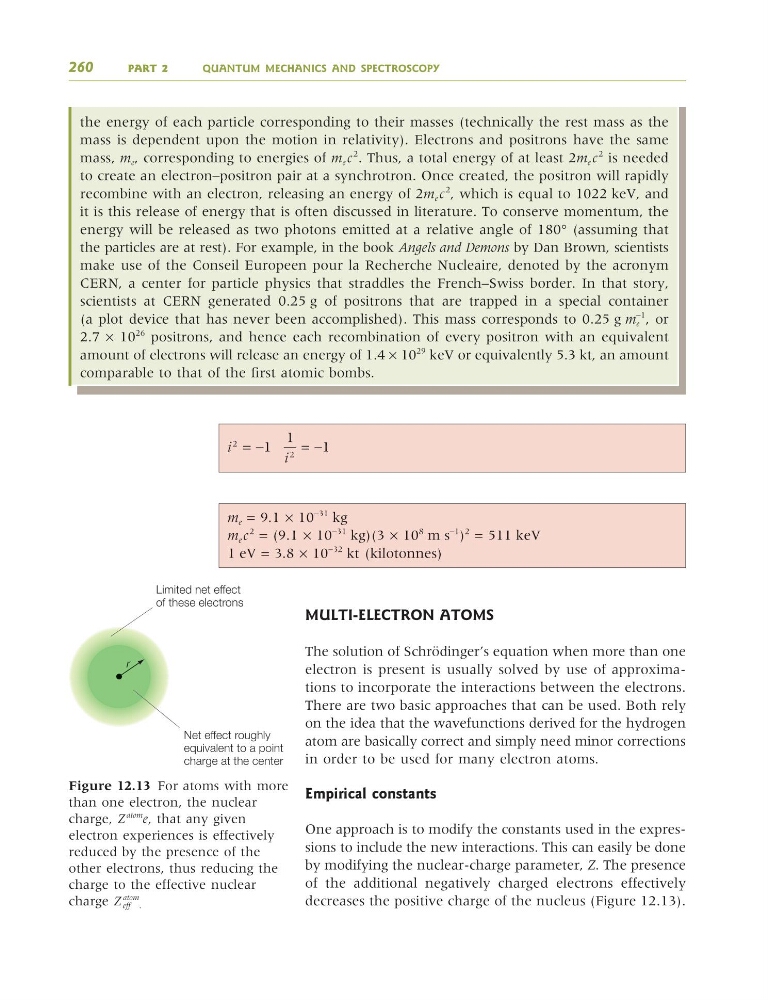
One approach is to modify the constants used in the expressions to include the new interactions. This can easily be done
by modifying the nuclear-charge parameter, Z. The presence
of the additional negatively charged electrons effectively
decreases the positive charge of the nucleus (Figure 12.13).
i
i
2
2
1
1
1
= −
= −
Limited net effect
of these electrons
Net effect roughly
equivalent to a point
charge at the center
r
Figure 12.13 For atoms with more
than one electron, the nuclear
charge, Z
atom e, that any given
electron experiences is effectively
reduced by the presence of the
other electrons, thus reducing the
charge to the effective nuclear
charge Z eff
atom
.
9781405124362_4_012.qxd 4/30/08 20:25 Page 260
PART 2
QUANTUM MECHANICS AND SPECTROSCOPY
the energy of each particle corresponding to their masses (technically the rest mass as the
mass is dependent upon the motion in relativity). Electrons and positrons have the same
mass, m e , corresponding to energies of m e c
2
. Thus, a total energy of at least 2m e c
2 is needed
to create an electron–positron pair at a synchrotron. Once created, the positron will rapidly
recombine with an electron, releasing an energy of 2m e c
2
, which is equal to 1022 keV, and
it is this release of energy that is often discussed in literature. To conserve momentum, the
energy will be released as two photons emitted at a relative angle of 180° (assuming that
the particles are at rest). For example, in the book Angels and Demons by Dan Brown, scientists
make use of the Conseil Europeen pour la Recherche Nucleaire, denoted by the acronym
CERN, a center for particle physics that straddles the French–Swiss border. In that story,
scientists at CERN generated 0.25 g of positrons that are trapped in a special container
(a plot device that has never been accomplished). This mass corresponds to 0.25 g m e
−1 , or
2.7 × 10
26 positrons, and hence each recombination of every positron with an equivalent
amount of electrons will release an energy of 1.4 × 10
29 keV or equivalently 5.3 kt, an amount
comparable to that of the first atomic bombs.
m e = 9.1 × 10
−31 kg
m e c
2
= (9.1 × 10
−31 kg)(3 × 10
8 m s
−1
)
2
= 511 keV
1 eV = 3.8 × 10
−32 kt (kilotonnes)
MULTI-ELECTRON ATOMS
The solution of Schrödinger’s equation when more than one
electron is present is usually solved by use of approximations to incorporate the interactions between the electrons.
There are two basic approaches that can be used. Both rely
on the idea that the wavefunctions derived for the hydrogen
atom are basically correct and simply need minor corrections
in order to be used for many electron atoms.
Empirical constants
One approach is to modify the constants used in the expressions to include the new interactions. This can easily be done
by modifying the nuclear-charge parameter, Z. The presence
of the additional negatively charged electrons effectively
decreases the positive charge of the nucleus (Figure 12.13).
i
i
2
2
1
1
1
= −
= −
Limited net effect
of these electrons
Net effect roughly
equivalent to a point
charge at the center
r
Figure 12.13 For atoms with more
than one electron, the nuclear
charge, Z
atom e, that any given
electron experiences is effectively
reduced by the presence of the
other electrons, thus reducing the
charge to the effective nuclear
charge Z eff
atom
.
9781405124362_4_012.qxd 4/30/08 20:25 Page 260