

TRANSITIONS
For the hydrogen atom, the electron will reside in the 1s
orbital. As was true for the other applications, the electron
can make a transition to a higher-energy orbital after it
absorbs a photon whose energy matches the energy difference of the orbitals. Transitions between the orbitals are
responsible for the presence of discrete lines in the atomic
spectrum of hydrogen as well as other atoms (Figure 12.9).
In addition to satisfying the requirement of energy conservation, for the transition to be allowed it also must obey
the conservation of momentum. Photons have an intrinsic
spin of 1 (see below). According to the conservation of
momentum, the change in the angular momentum of the
electron, due to the transition, must exactly compensate
for the loss of the spin due to the photon absorption. Thus
an electron in the 1s orbital, with an angular momentum
of l = 0, can only make a transition to a p orbital with
l = 1 but not to another s orbital or d orbital.
CHAPTER 12
THE HYDROGEN ATOM
253
dz2
dx2Ϫy2
dxy
dzx
dyz
Energy
Emission
Absorption
E2
E1
E2 Ϫ E1 ϭ hν ϭ
hc
λ
Figure 12.9 The spectral lines of
atomic hydrogen arise from
transitions between wavefunctions.
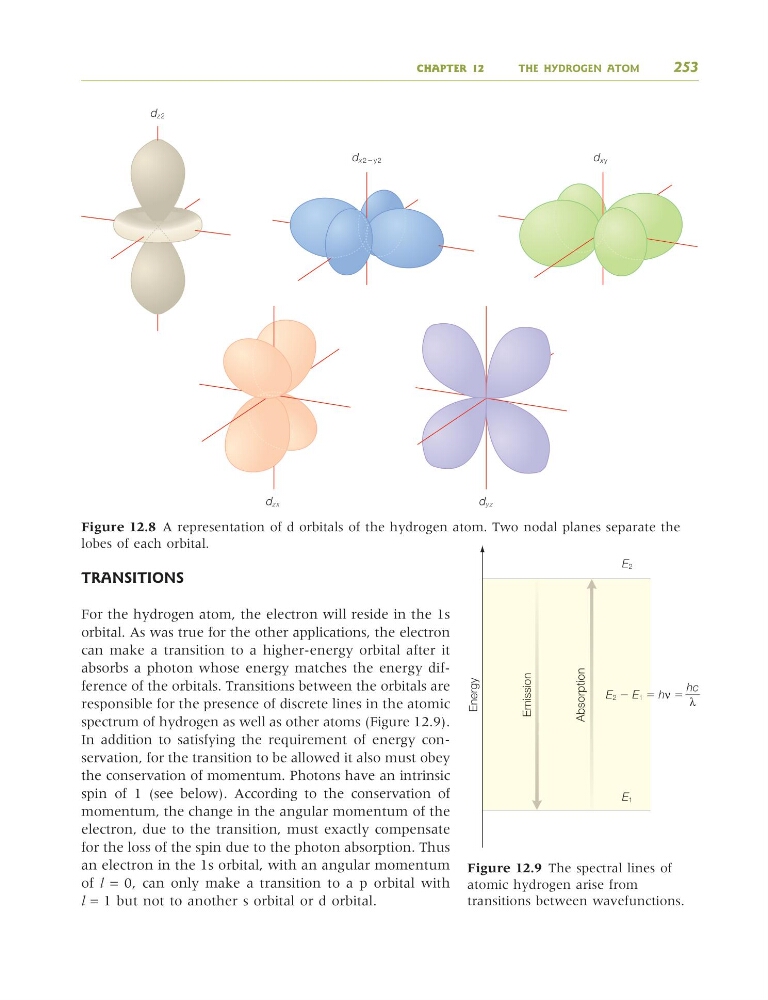
Figure 12.8 A representation of d orbitals of the hydrogen atom. Two nodal planes separate the
lobes of each orbital.
9781405124362_4_012.qxd 4/29/08 9:11 Page 253
For the hydrogen atom, the electron will reside in the 1s
orbital. As was true for the other applications, the electron
can make a transition to a higher-energy orbital after it
absorbs a photon whose energy matches the energy difference of the orbitals. Transitions between the orbitals are
responsible for the presence of discrete lines in the atomic
spectrum of hydrogen as well as other atoms (Figure 12.9).
In addition to satisfying the requirement of energy conservation, for the transition to be allowed it also must obey
the conservation of momentum. Photons have an intrinsic
spin of 1 (see below). According to the conservation of
momentum, the change in the angular momentum of the
electron, due to the transition, must exactly compensate
for the loss of the spin due to the photon absorption. Thus
an electron in the 1s orbital, with an angular momentum
of l = 0, can only make a transition to a p orbital with
l = 1 but not to another s orbital or d orbital.
CHAPTER 12
THE HYDROGEN ATOM
253
dz2
dx2Ϫy2
dxy
dzx
dyz
Energy
Emission
Absorption
E2
E1
E2 Ϫ E1 ϭ hν ϭ
hc
λ
Figure 12.9 The spectral lines of
atomic hydrogen arise from
transitions between wavefunctions.
Figure 12.8 A representation of d orbitals of the hydrogen atom. Two nodal planes separate the
lobes of each orbital.
9781405124362_4_012.qxd 4/29/08 9:11 Page 253