

This reduces to:
(12.32)
Using the relationships
x = r sin θ cos φ
y = r sin θ sin φ
(12.33)
e
±iφ
= cos φ ± i sin φ
it is easy to show that the p orbitals can be rewritten as
(12.34)
(12.35)
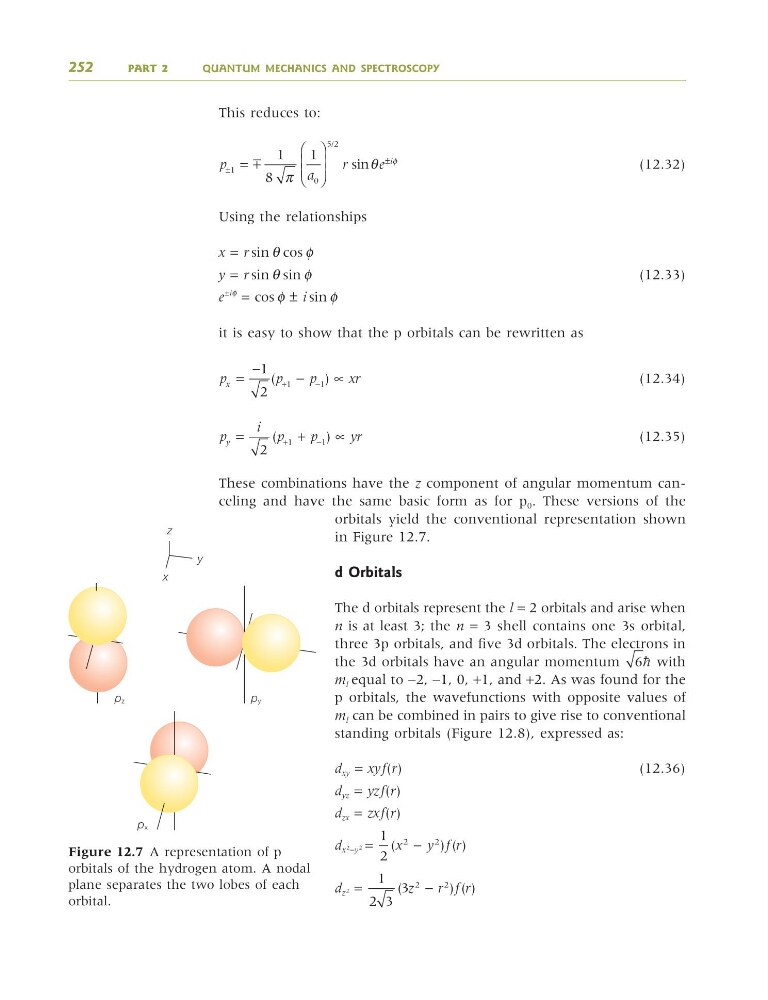
These combinations have the z component of angular momentum canceling and have the same basic form as for p 0 . These versions of the
orbitals yield the conventional representation shown
in Figure 12.7.
d Orbitals
The d orbitals represent the l = 2 orbitals and arise when
n is at least 3; the n = 3 shell contains one 3s orbital,
three 3p orbitals, and five 3d orbitals. The electrons in
the 3d orbitals have an angular momentum
with
m l equal to −2, −1, 0, +1, and +2. As was found for the
p orbitals, the wavefunctions with opposite values of
m l can be combined in pairs to give rise to conventional
standing orbitals (Figure 12.8), expressed as:
d xy = xyf(r)
(12.36)
d yz = yzf(r)
d zx = zxf(r)
d x 2 −y 2 =
d z 2 =
1
2 3
3
2
2
(
)()
z
r f r
−
1
2
2
2
(
) ()
x
y f r
−
6Z
p
i p
p
yr
y
(
)
=
+
∝
+
−
2
1
1
p
p
p
x r
x
(
)
=
−
−
∝
+
−
1
2
1
1
p
a
r
e
i
±
±
=
⎛
⎝
⎜
⎜
⎞
⎠
⎟
⎟
1
0
5 2
1
8
1
sin
/
5
π
θ
φ
252
PART 2
QUANTUM MECHANICS AND SPECTROSCOPY
z
pz
py
px
y
x
Figure 12.7 A representation of p
orbitals of the hydrogen atom. A nodal
plane separates the two lobes of each
orbital.
9781405124362_4_012.qxd 4/29/08 9:11 Page 252
(12.32)
Using the relationships
x = r sin θ cos φ
y = r sin θ sin φ
(12.33)
e
±iφ
= cos φ ± i sin φ
it is easy to show that the p orbitals can be rewritten as
(12.34)
(12.35)
These combinations have the z component of angular momentum canceling and have the same basic form as for p 0 . These versions of the
orbitals yield the conventional representation shown
in Figure 12.7.
d Orbitals
The d orbitals represent the l = 2 orbitals and arise when
n is at least 3; the n = 3 shell contains one 3s orbital,
three 3p orbitals, and five 3d orbitals. The electrons in
the 3d orbitals have an angular momentum
with
m l equal to −2, −1, 0, +1, and +2. As was found for the
p orbitals, the wavefunctions with opposite values of
m l can be combined in pairs to give rise to conventional
standing orbitals (Figure 12.8), expressed as:
d xy = xyf(r)
(12.36)
d yz = yzf(r)
d zx = zxf(r)
d x 2 −y 2 =
d z 2 =
1
2 3
3
2
2
(
)()
z
r f r
−
1
2
2
2
(
) ()
x
y f r
−
6Z
p
i p
p
yr
y
(
)
=
+
∝
+
−
2
1
1
p
p
p
x r
x
(
)
=
−
−
∝
+
−
1
2
1
1
p
a
r
e
i
±
±
=
⎛
⎝
⎜
⎜
⎞
⎠
⎟
⎟
1
0
5 2
1
8
1
sin
/
5
π
θ
φ
252
PART 2
QUANTUM MECHANICS AND SPECTROSCOPY
z
pz
py
px
y
x
Figure 12.7 A representation of p
orbitals of the hydrogen atom. A nodal
plane separates the two lobes of each
orbital.
9781405124362_4_012.qxd 4/29/08 9:11 Page 252