

So, the total angular momentum is quantized by l and the projection of
the angular momentum along the z direction is quantized by m l .
Orbitals
The solutions to Schrödinger’s equation consist of the product of a radial
term and an angular term:
ψ n,l,m l (r,θ,φ) = R n,l (r)Y l
m l (θ,φ)
(12.11)
where each solution is uniquely defined by the three indices, n, l, m l , that
are restricted to be n = 1, 2, 3, . . . , l = 0, 1, 2, . . . , n − 1, and m l = l,
l − 1, l − 2, . . . , −l, where n is the principal quantum number arising
from the quantization of energy as:
(12.12)
l is the angular-momentum quantum number arising from quantization
of the angular momentum with magnitude
, and m l arises from
the quantization of the z component of angular momentum m l Z. These
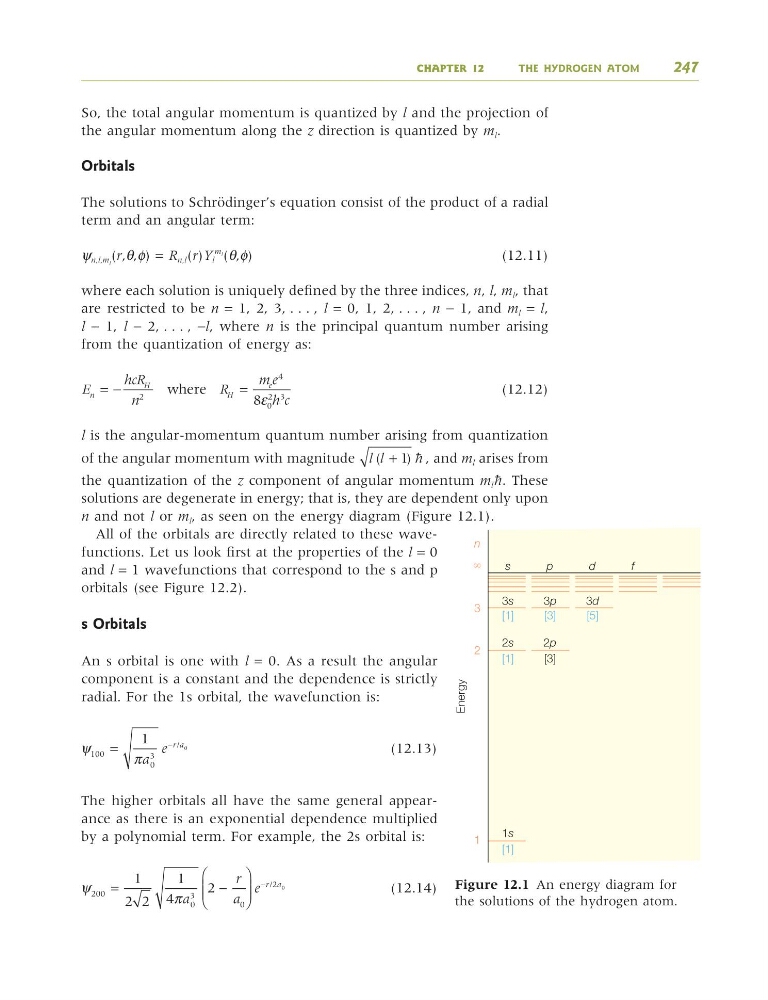
solutions are degenerate in energy; that is, they are dependent only upon
n and not l or m l , as seen on the energy diagram (Figure 12.1).
All of the orbitals are directly related to these wavefunctions. Let us look first at the properties of the l = 0
and l = 1 wavefunctions that correspond to the s and p
orbitals (see Figure 12.2).
s Orbitals
An s orbital is one with l = 0. As a result the angular
component is a constant and the dependence is strictly
radial. For the 1s orbital, the wavefunction is:
(12.13)
The higher orbitals all have the same general appearance as there is an exponential dependence multiplied
by a polynomial term. For example, the 2s orbital is:
(12.14)
ψ
π
200
0
3
0
2
1
2 2
1
4
2
0
/
=
−
⎛
⎝
⎜ ⎜
⎞
⎠
⎟ ⎟
−
a
r
a
e
r a
ψ
π
100
0
3
1
0
/
=
−
a
e
r a
l l
(
)
+ 1 Z
E
hcR
n
R
m e
h c
n
H
H
e
= −
=
2
4
0
2 3
8
where
ε
CHAPTER 12
THE HYDROGEN ATOM
247
s
ϱ
3
2
1
n
p
d
f
3s
3p
2s
2p
[1]
[1]
1s
[1]
[3]
[3]
[5]
3d
Energy
Figure 12.1 An energy diagram for
the solutions of the hydrogen atom.
9781405124362_4_012.qxd 4/29/08 9:11 Page 247
the angular momentum along the z direction is quantized by m l .
Orbitals
The solutions to Schrödinger’s equation consist of the product of a radial
term and an angular term:
ψ n,l,m l (r,θ,φ) = R n,l (r)Y l
m l (θ,φ)
(12.11)
where each solution is uniquely defined by the three indices, n, l, m l , that
are restricted to be n = 1, 2, 3, . . . , l = 0, 1, 2, . . . , n − 1, and m l = l,
l − 1, l − 2, . . . , −l, where n is the principal quantum number arising
from the quantization of energy as:
(12.12)
l is the angular-momentum quantum number arising from quantization
of the angular momentum with magnitude
, and m l arises from
the quantization of the z component of angular momentum m l Z. These
solutions are degenerate in energy; that is, they are dependent only upon
n and not l or m l , as seen on the energy diagram (Figure 12.1).
All of the orbitals are directly related to these wavefunctions. Let us look first at the properties of the l = 0
and l = 1 wavefunctions that correspond to the s and p
orbitals (see Figure 12.2).
s Orbitals
An s orbital is one with l = 0. As a result the angular
component is a constant and the dependence is strictly
radial. For the 1s orbital, the wavefunction is:
(12.13)
The higher orbitals all have the same general appearance as there is an exponential dependence multiplied
by a polynomial term. For example, the 2s orbital is:
(12.14)
ψ
π
200
0
3
0
2
1
2 2
1
4
2
0
/
=
−
⎛
⎝
⎜ ⎜
⎞
⎠
⎟ ⎟
−
a
r
a
e
r a
ψ
π
100
0
3
1
0
/
=
−
a
e
r a
l l
(
)
+ 1 Z
E
hcR
n
R
m e
h c
n
H
H
e
= −
=
2
4
0
2 3
8
where
ε
CHAPTER 12
THE HYDROGEN ATOM
247
s
ϱ
3
2
1
n
p
d
f
3s
3p
2s
2p
[1]
[1]
1s
[1]
[3]
[3]
[5]
3d
Energy
Figure 12.1 An energy diagram for
the solutions of the hydrogen atom.
9781405124362_4_012.qxd 4/29/08 9:11 Page 247