

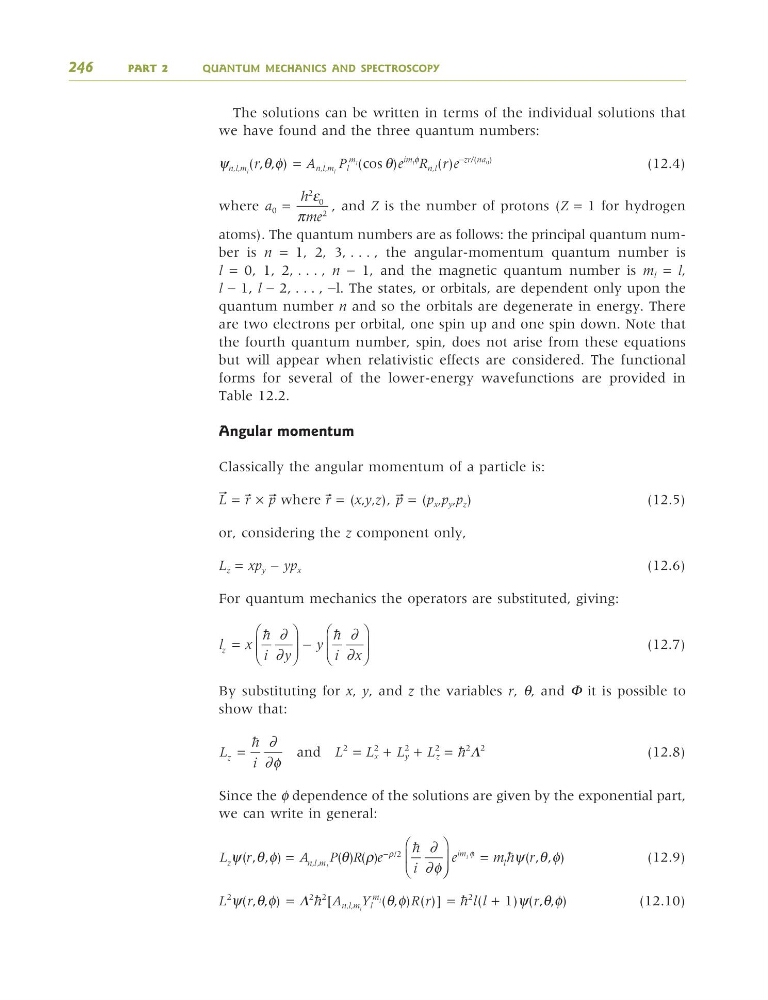
The solutions can be written in terms of the individual solutions that
we have found and the three quantum numbers:
ψ n,l,m l (r,θ,φ) = A n,l,m l P l
m l (cos θ)e
im l φ R n,l (r)e
−zr/(na 0 )
(12.4)
where a 0 =
, and Z is the number of protons (Z = 1 for hydrogen
atoms). The quantum numbers are as follows: the principal quantum number is n = 1, 2, 3, . . . , the angular-momentum quantum number is
l = 0, 1, 2, . . . , n − 1, and the magnetic quantum number is m l = l,
l − 1, l − 2, . . . , −l. The states, or orbitals, are dependent only upon the
quantum number n and so the orbitals are degenerate in energy. There
are two electrons per orbital, one spin up and one spin down. Note that
the fourth quantum number, spin, does not arise from these equations
but will appear when relativistic effects are considered. The functional
forms for several of the lower-energy wavefunctions are provided in
Table 12.2.
Angular momentum
Classically the angular momentum of a particle is:
O = J × I where J = (x,y,z), I = (p x ,p y ,p z )
(12.5)
or, considering the z component only,
L z = xp y − yp x
(12.6)
For quantum mechanics the operators are substituted, giving:
(12.7)
By substituting for x, y, and z the variables r, θ, and Φ it is possible to
show that:
and L
2
= L
2
x + L
2
y + L
2
z = Z
2
Λ
2
(12.8)
Since the φ dependence of the solutions are given by the exponential part,
we can write in general:
(12.9)
L
2
ψ(r,θ,φ) = Λ
2
Z
2
[A n,l,m l Y l
m l (θ,φ)R(r)] = Z
2
l(l + 1)ψ(r,θ,φ)
(12.10)
L r
A P R e
i
z
n l m l
ψ θ φ
θ ρ
∂
∂φ
ρ
( , , )
( ) ( )
, ,
/
=
⎛
⎝
⎜ ⎜
⎞
− 2
Z
⎠ ⎠
⎟ ⎟
=
e
m
r
im
l
l φ
ψ θ φ
( , , )
Z
L
i
z =
Z ∂
∂φ
l
x
i y
y
i x
z =
⎛
⎝
⎜ ⎜
⎞
⎠
⎟ ⎟ −
⎛
⎝
⎜ ⎜
⎞
⎠
⎟ ⎟
Z
Z
∂
∂
∂
∂
h
me
2
0
2
ε
π
246
PART 2
QUANTUM MECHANICS AND SPECTROSCOPY
9781405124362_4_012.qxd 4/29/08 9:11 Page 246
we have found and the three quantum numbers:
ψ n,l,m l (r,θ,φ) = A n,l,m l P l
m l (cos θ)e
im l φ R n,l (r)e
−zr/(na 0 )
(12.4)
where a 0 =
, and Z is the number of protons (Z = 1 for hydrogen
atoms). The quantum numbers are as follows: the principal quantum number is n = 1, 2, 3, . . . , the angular-momentum quantum number is
l = 0, 1, 2, . . . , n − 1, and the magnetic quantum number is m l = l,
l − 1, l − 2, . . . , −l. The states, or orbitals, are dependent only upon the
quantum number n and so the orbitals are degenerate in energy. There
are two electrons per orbital, one spin up and one spin down. Note that
the fourth quantum number, spin, does not arise from these equations
but will appear when relativistic effects are considered. The functional
forms for several of the lower-energy wavefunctions are provided in
Table 12.2.
Angular momentum
Classically the angular momentum of a particle is:
O = J × I where J = (x,y,z), I = (p x ,p y ,p z )
(12.5)
or, considering the z component only,
L z = xp y − yp x
(12.6)
For quantum mechanics the operators are substituted, giving:
(12.7)
By substituting for x, y, and z the variables r, θ, and Φ it is possible to
show that:
and L
2
= L
2
x + L
2
y + L
2
z = Z
2
Λ
2
(12.8)
Since the φ dependence of the solutions are given by the exponential part,
we can write in general:
(12.9)
L
2
ψ(r,θ,φ) = Λ
2
Z
2
[A n,l,m l Y l
m l (θ,φ)R(r)] = Z
2
l(l + 1)ψ(r,θ,φ)
(12.10)
L r
A P R e
i
z
n l m l
ψ θ φ
θ ρ
∂
∂φ
ρ
( , , )
( ) ( )
, ,
/
=
⎛
⎝
⎜ ⎜
⎞
− 2
Z
⎠ ⎠
⎟ ⎟
=
e
m
r
im
l
l φ
ψ θ φ
( , , )
Z
L
i
z =
Z ∂
∂φ
l
x
i y
y
i x
z =
⎛
⎝
⎜ ⎜
⎞
⎠
⎟ ⎟ −
⎛
⎝
⎜ ⎜
⎞
⎠
⎟ ⎟
Z
Z
∂
∂
∂
∂
h
me
2
0
2
ε
π
246
PART 2
QUANTUM MECHANICS AND SPECTROSCOPY
9781405124362_4_012.qxd 4/29/08 9:11 Page 246