

CHAPTER 12
THE HYDROGEN ATOM
243
This will be true if l = 0 and m l = 0. Another possible solution is:
Θ(θ) = B cos θ
(db12.28)
Substitution gives:
sin θ(−2B sin θ cos θ) + [l(l + 1)sin
2
θ − m l
2 ]Θ(θ) = 0
(db12.29)
This is true if l = 1 and m l = 0. In general the solutions are polynomials of trigonometric
functions.
Radial solution
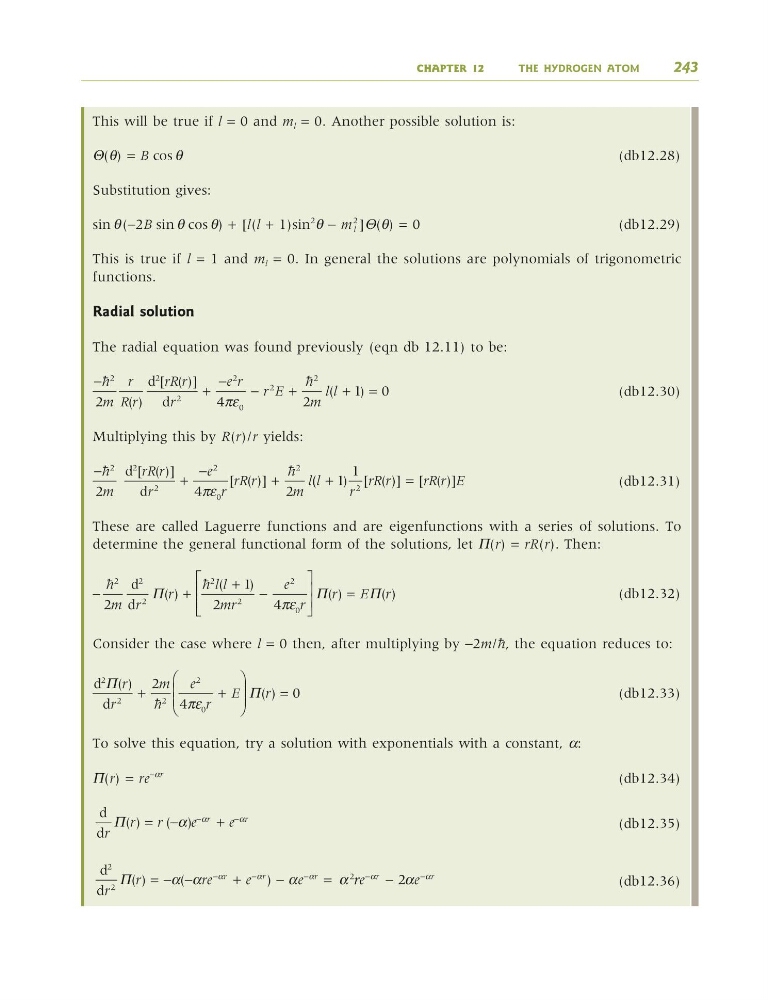
The radial equation was found previously (eqn db 12.11) to be:
(db12.30)
Multiplying this by R(r)/r yields:
(db12.31)
These are called Laguerre functions and are eigenfunctions with a series of solutions. To
determine the general functional form of the solutions, let Π(r) = rR(r). Then:
(db12.32)
Consider the case where l = 0 then, after multiplying by −2m/Z, the equation reduces to:
(db12.33)
To solve this equation, try a solution with exponentials with a constant, α:
Π(r) = re
−αr
(db12.34)
(db12.35)
(db12.36)
d
d
2
2
2
2
0
2
4
0
Π
Π
( )
( )
r
r
m e
r
E
r
+
+
⎛
⎝
⎜
⎜
⎞
⎠
⎟
⎟
=
Z
πε
−
+
+ −
⎡
⎣
Z
Z
2
2
2
2
2
2
0
2
1
2
4
m r
r
l l
mr
e
r
d
d
Π( )
(
)
πε
⎢ ⎢
⎢
⎤
⎦
⎥
⎥
=
Π
Π
( )
( )
r
E r
−
+
−
+
Z
2
2
2
2
0
2
2
4
2
m
rR r
r
e
r
rR r
m
l
d
d
[ ( )]
[ ( )]
πε
( (
) [ ( )] [ ( )]
l
r
rR r
rR r E
+
=
1
1
2
Z
−
+
−
−
+
Z
2
2
Z
2
2
0
2
2
4
m
r
R r
rR r
r
e r r E
( )
[ ( )]
d
d
πε
2
2
1 0
m
l l
(
)
+ =
d
d
2
2
2
r
r
r e
e
e
r
r
r
Π( )
(
)
= − −
+
−
=
−
−
−
α α
α
α
α
α
α
r re
e
r
r
−
−
−
α
α
α
2
d
dr
r
r
e
e
r
r
Π( )
( )
= −
+
−
−
α
α
α
9781405124362_4_012.qxd 4/30/08 20:25 Page 243
THE HYDROGEN ATOM
243
This will be true if l = 0 and m l = 0. Another possible solution is:
Θ(θ) = B cos θ
(db12.28)
Substitution gives:
sin θ(−2B sin θ cos θ) + [l(l + 1)sin
2
θ − m l
2 ]Θ(θ) = 0
(db12.29)
This is true if l = 1 and m l = 0. In general the solutions are polynomials of trigonometric
functions.
Radial solution
The radial equation was found previously (eqn db 12.11) to be:
(db12.30)
Multiplying this by R(r)/r yields:
(db12.31)
These are called Laguerre functions and are eigenfunctions with a series of solutions. To
determine the general functional form of the solutions, let Π(r) = rR(r). Then:
(db12.32)
Consider the case where l = 0 then, after multiplying by −2m/Z, the equation reduces to:
(db12.33)
To solve this equation, try a solution with exponentials with a constant, α:
Π(r) = re
−αr
(db12.34)
(db12.35)
(db12.36)
d
d
2
2
2
2
0
2
4
0
Π
Π
( )
( )
r
r
m e
r
E
r
+
+
⎛
⎝
⎜
⎜
⎞
⎠
⎟
⎟
=
Z
πε
−
+
+ −
⎡
⎣
Z
Z
2
2
2
2
2
2
0
2
1
2
4
m r
r
l l
mr
e
r
d
d
Π( )
(
)
πε
⎢ ⎢
⎢
⎤
⎦
⎥
⎥
=
Π
Π
( )
( )
r
E r
−
+
−
+
Z
2
2
2
2
0
2
2
4
2
m
rR r
r
e
r
rR r
m
l
d
d
[ ( )]
[ ( )]
πε
( (
) [ ( )] [ ( )]
l
r
rR r
rR r E
+
=
1
1
2
Z
−
+
−
−
+
Z
2
2
Z
2
2
0
2
2
4
m
r
R r
rR r
r
e r r E
( )
[ ( )]
d
d
πε
2
2
1 0
m
l l
(
)
+ =
d
d
2
2
2
r
r
r e
e
e
r
r
r
Π( )
(
)
= − −
+
−
=
−
−
−
α α
α
α
α
α
α
r re
e
r
r
−
−
−
α
α
α
2
d
dr
r
r
e
e
r
r
Π( )
( )
= −
+
−
−
α
α
α
9781405124362_4_012.qxd 4/30/08 20:25 Page 243