

242
PART 2
QUANTUM MECHANICS AND SPECTROSCOPY
The values of the constant m l are fixed by the physical constraint that, if the object is fully
rotated by 2π, then the solution must be the same. This gives:
Φ(φ + 2π) = Φ(φ)
(db12.22)
Ae
im l φ
= Ae
im l (φ +2π)
= Ae
im l φ
e
im l 2π
(db12.23)
For this to be true then:
1 = e
im l 2π
= cos(2πm l ) + i sin(2πm l )
(db12.24)
with m l = 0, ±1, ±2, ±3, . . . .
The Θ term is called the Legendre equation and it has a series of solutions of the form
commonly denoted as P l (cos Θ) for which there are restrictions on the separation constants:
(db12.25)
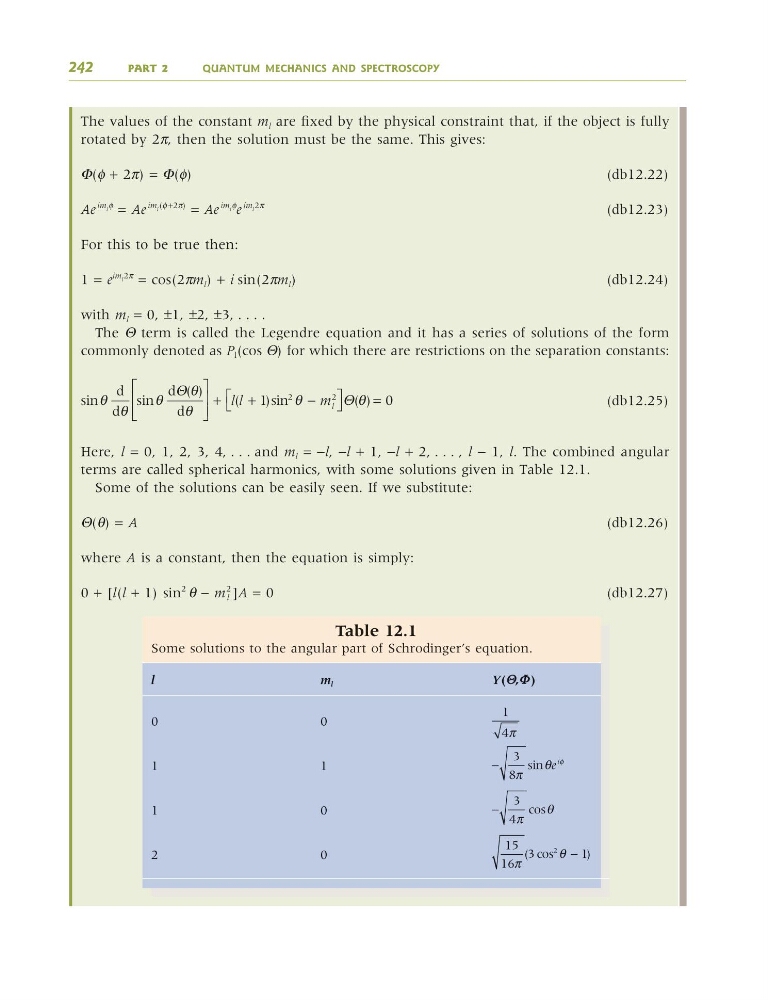
Here, l = 0, 1, 2, 3, 4, . . . and m l = −l, −l + 1, −l + 2, . . . , l − 1, l. The combined angular
terms are called spherical harmonics, with some solutions given in Table 12.1.
Some of the solutions can be easily seen. If we substitute:
Θ(θ) = A
(db12.26)
where A is a constant, then the equation is simply:
0 + [l(l + 1) sin
2
θ − m l
2 ]A = 0
(db12.27)
sin
sin
( )
(
)sin
θ θ
θ
θ
θ
θ
d
d
d
d
Θ
⎡
⎣
⎢
⎢
⎤
⎦
⎥
⎥
+
+
l l 1
2
− −
⎡
⎣
⎤
⎦
=
( )
m l
2
0
Θ θ
Table 12.1
Some solutions to the angular part of Schrodinger’s equation.
l
m l
Y(Θ Θ,Φ Φ )
0
0
1
1
1
0
2
0
15
16
3
1
2
π
θ
( cos
)
−
−
3
4π
θ
cos
−
3
8π
θ
φ
sin e
i
1
4π
9781405124362_4_012.qxd 4/30/08 20:24 Page 242
PART 2
QUANTUM MECHANICS AND SPECTROSCOPY
The values of the constant m l are fixed by the physical constraint that, if the object is fully
rotated by 2π, then the solution must be the same. This gives:
Φ(φ + 2π) = Φ(φ)
(db12.22)
Ae
im l φ
= Ae
im l (φ +2π)
= Ae
im l φ
e
im l 2π
(db12.23)
For this to be true then:
1 = e
im l 2π
= cos(2πm l ) + i sin(2πm l )
(db12.24)
with m l = 0, ±1, ±2, ±3, . . . .
The Θ term is called the Legendre equation and it has a series of solutions of the form
commonly denoted as P l (cos Θ) for which there are restrictions on the separation constants:
(db12.25)
Here, l = 0, 1, 2, 3, 4, . . . and m l = −l, −l + 1, −l + 2, . . . , l − 1, l. The combined angular
terms are called spherical harmonics, with some solutions given in Table 12.1.
Some of the solutions can be easily seen. If we substitute:
Θ(θ) = A
(db12.26)
where A is a constant, then the equation is simply:
0 + [l(l + 1) sin
2
θ − m l
2 ]A = 0
(db12.27)
sin
sin
( )
(
)sin
θ θ
θ
θ
θ
θ
d
d
d
d
Θ
⎡
⎣
⎢
⎢
⎤
⎦
⎥
⎥
+
+
l l 1
2
− −
⎡
⎣
⎤
⎦
=
( )
m l
2
0
Θ θ
Table 12.1
Some solutions to the angular part of Schrodinger’s equation.
l
m l
Y(Θ Θ,Φ Φ )
0
0
1
1
1
0
2
0
15
16
3
1
2
π
θ
( cos
)
−
−
3
4π
θ
cos
−
3
8π
θ
φ
sin e
i
1
4π
9781405124362_4_012.qxd 4/30/08 20:24 Page 242