

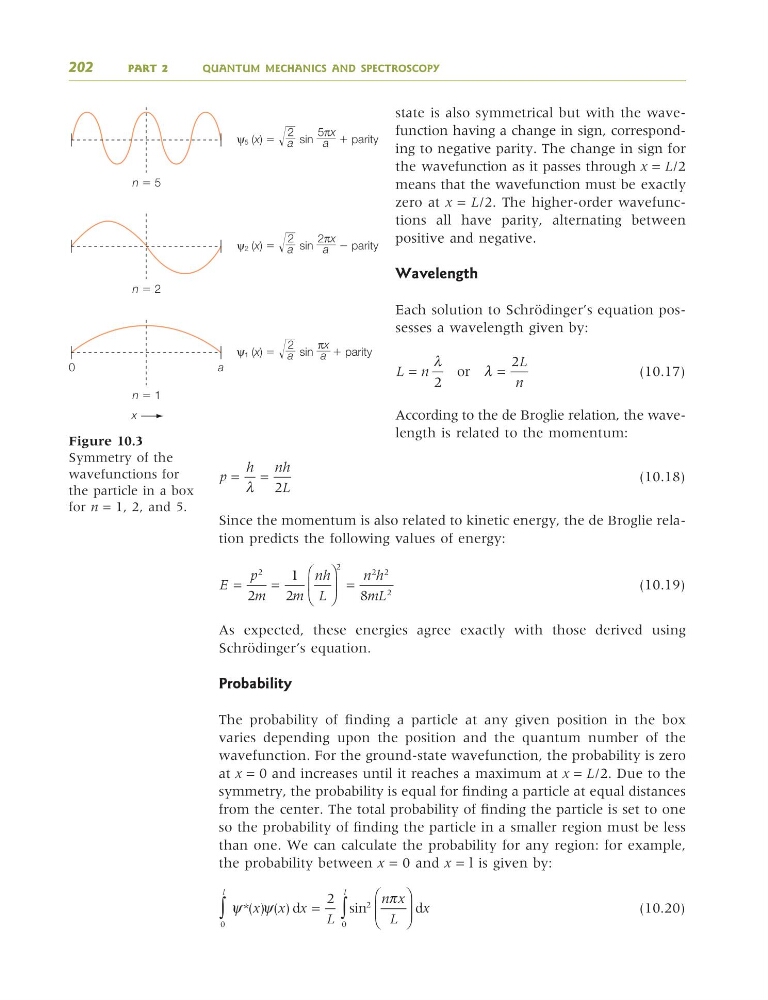
state is also symmetrical but with the wavefunction having a change in sign, corresponding to negative parity. The change in sign for
the wavefunction as it passes through x = L/2
means that the wavefunction must be exactly
zero at x = L/2. The higher-order wavefunctions all have parity, alternating between
positive and negative.
Wavelength
Each solution to Schrödinger’s equation possesses a wavelength given by:
(10.17)
According to the de Broglie relation, the wavelength is related to the momentum:
(10.18)
Since the momentum is also related to kinetic energy, the de Broglie relation predicts the following values of energy:
(10.19)
As expected, these energies agree exactly with those derived using
Schrödinger’s equation.
Probability
The probability of finding a particle at any given position in the box
varies depending upon the position and the quantum number of the
wavefunction. For the ground-state wavefunction, the probability is zero
at x = 0 and increases until it reaches a maximum at x = L/2. Due to the
symmetry, the probability is equal for finding a particle at equal distances
from the center. The total probability of finding the particle is set to one
so the probability of finding the particle in a smaller region must be less
than one. We can calculate the probability for any region: for example,
the probability between x = 0 and x = l is given by:
(10.20)
ψ ψ
π
*
d
d
( ) ( )
sin
x x x
L
n x
L
x
l
l
0
2
0
2
∫
∫
=
⎛
⎝
⎜ ⎜
⎞
⎠
⎟ ⎟
E
p
m
m
nh
L
n h
mL
=
=
⎛
⎝
⎜ ⎜
⎞
⎠
⎟ ⎟ =
2
2
2 2
2
2
1
2
8
p
h nh
L
= =
λ 2
L n
L
n
=
=
λ
λ
2
2
or
202
PART 2
QUANTUM MECHANICS AND SPECTROSCOPY
ψ5 (x) ϭ Ί
2 sin
5πx ϩ parity
n ϭ 5
a
a
ψ 2 (x) ϭ Ί
2 sin
2πx Ϫ parity
n ϭ 2
a
a
ψ1 (x) ϭ Ί
2 sin
πx ϩ parity
n ϭ 1
0
a
a
a
x
Figure 10.3
Symmetry of the
wavefunctions for
the particle in a box
for n = 1, 2, and 5.
9781405124362_4_010.qxd 4/29/08 13:09 Page 202
the wavefunction as it passes through x = L/2
means that the wavefunction must be exactly
zero at x = L/2. The higher-order wavefunctions all have parity, alternating between
positive and negative.
Wavelength
Each solution to Schrödinger’s equation possesses a wavelength given by:
(10.17)
According to the de Broglie relation, the wavelength is related to the momentum:
(10.18)
Since the momentum is also related to kinetic energy, the de Broglie relation predicts the following values of energy:
(10.19)
As expected, these energies agree exactly with those derived using
Schrödinger’s equation.
Probability
The probability of finding a particle at any given position in the box
varies depending upon the position and the quantum number of the
wavefunction. For the ground-state wavefunction, the probability is zero
at x = 0 and increases until it reaches a maximum at x = L/2. Due to the
symmetry, the probability is equal for finding a particle at equal distances
from the center. The total probability of finding the particle is set to one
so the probability of finding the particle in a smaller region must be less
than one. We can calculate the probability for any region: for example,
the probability between x = 0 and x = l is given by:
(10.20)
ψ ψ
π
*
d
d
( ) ( )
sin
x x x
L
n x
L
x
l
l
0
2
0
2
∫
∫
=
⎛
⎝
⎜ ⎜
⎞
⎠
⎟ ⎟
E
p
m
m
nh
L
n h
mL
=
=
⎛
⎝
⎜ ⎜
⎞
⎠
⎟ ⎟ =
2
2
2 2
2
2
1
2
8
p
h nh
L
= =
λ 2
L n
L
n
=
=
λ
λ
2
2
or
202
PART 2
QUANTUM MECHANICS AND SPECTROSCOPY
ψ5 (x) ϭ Ί
2 sin
5πx ϩ parity
n ϭ 5
a
a
ψ 2 (x) ϭ Ί
2 sin
2πx Ϫ parity
n ϭ 2
a
a
ψ1 (x) ϭ Ί
2 sin
πx ϩ parity
n ϭ 1
0
a
a
a
x
Figure 10.3
Symmetry of the
wavefunctions for
the particle in a box
for n = 1, 2, and 5.
9781405124362_4_010.qxd 4/29/08 13:09 Page 202