

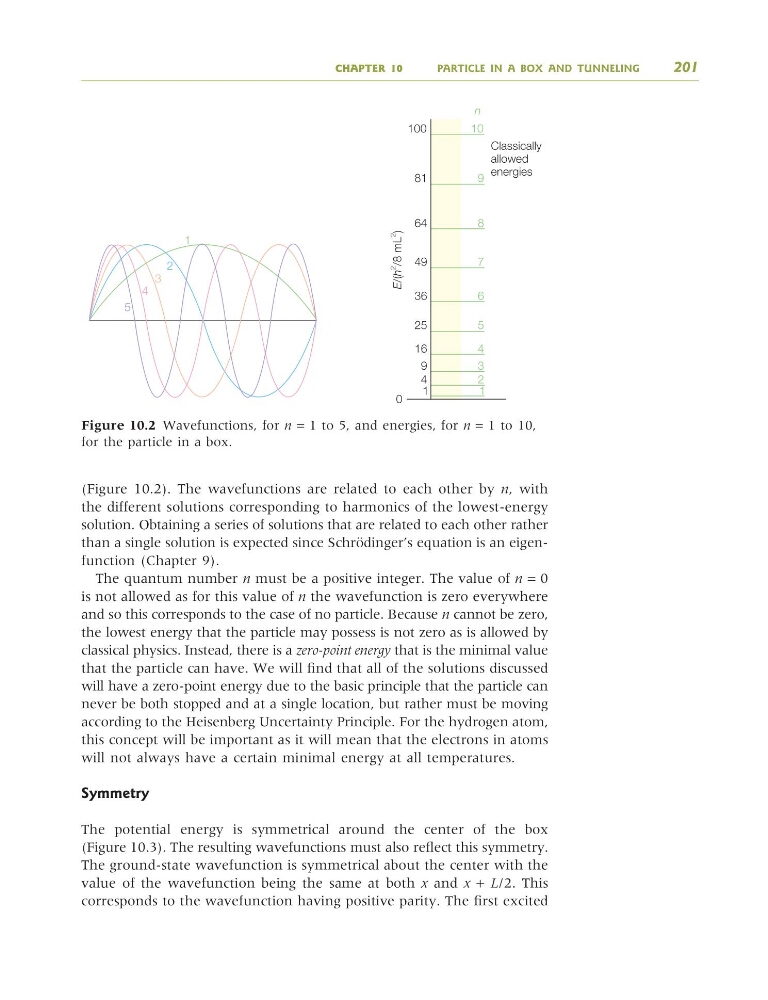
(Figure 10.2). The wavefunctions are related to each other by n, with
the different solutions corresponding to harmonics of the lowest-energy
solution. Obtaining a series of solutions that are related to each other rather
than a single solution is expected since Schrödinger’s equation is an eigenfunction (Chapter 9).
The quantum number n must be a positive integer. The value of n = 0
is not allowed as for this value of n the wavefunction is zero everywhere
and so this corresponds to the case of no particle. Because n cannot be zero,
the lowest energy that the particle may possess is not zero as is allowed by
classical physics. Instead, there is a zero-point energy that is the minimal value
that the particle can have. We will find that all of the solutions discussed
will have a zero-point energy due to the basic principle that the particle can
never be both stopped and at a single location, but rather must be moving
according to the Heisenberg Uncertainty Principle. For the hydrogen atom,
this concept will be important as it will mean that the electrons in atoms
will not always have a certain minimal energy at all temperatures.
Symmetry
The potential energy is symmetrical around the center of the box
(Figure 10.3). The resulting wavefunctions must also reflect this symmetry.
The ground-state wavefunction is symmetrical about the center with the
value of the wavefunction being the same at both x and x + L/2. This
corresponds to the wavefunction having positive parity. The first excited
Figure 10.2 Wavefunctions, for n = 1 to 5, and energies, for n = 1 to 10,
for the particle in a box.
CHAPTER 10
PARTICLE IN A BOX AND TUNNELING
201
1
2
3
4
5
6
7
8
9
10
n
1
1
2
3
4
5
0
4
9
16
25
36
49
64
81
E/(h
2
/8 mL
2
)
Classically
allowed
energies
100
9781405124362_4_010.qxd 4/29/08 13:09 Page 201
the different solutions corresponding to harmonics of the lowest-energy
solution. Obtaining a series of solutions that are related to each other rather
than a single solution is expected since Schrödinger’s equation is an eigenfunction (Chapter 9).
The quantum number n must be a positive integer. The value of n = 0
is not allowed as for this value of n the wavefunction is zero everywhere
and so this corresponds to the case of no particle. Because n cannot be zero,
the lowest energy that the particle may possess is not zero as is allowed by
classical physics. Instead, there is a zero-point energy that is the minimal value
that the particle can have. We will find that all of the solutions discussed
will have a zero-point energy due to the basic principle that the particle can
never be both stopped and at a single location, but rather must be moving
according to the Heisenberg Uncertainty Principle. For the hydrogen atom,
this concept will be important as it will mean that the electrons in atoms
will not always have a certain minimal energy at all temperatures.
Symmetry
The potential energy is symmetrical around the center of the box
(Figure 10.3). The resulting wavefunctions must also reflect this symmetry.
The ground-state wavefunction is symmetrical about the center with the
value of the wavefunction being the same at both x and x + L/2. This
corresponds to the wavefunction having positive parity. The first excited
Figure 10.2 Wavefunctions, for n = 1 to 5, and energies, for n = 1 to 10,
for the particle in a box.
CHAPTER 10
PARTICLE IN A BOX AND TUNNELING
201
1
2
3
4
5
6
7
8
9
10
n
1
1
2
3
4
5
0
4
9
16
25
36
49
64
81
E/(h
2
/8 mL
2
)
Classically
allowed
energies
100
9781405124362_4_010.qxd 4/29/08 13:09 Page 201