

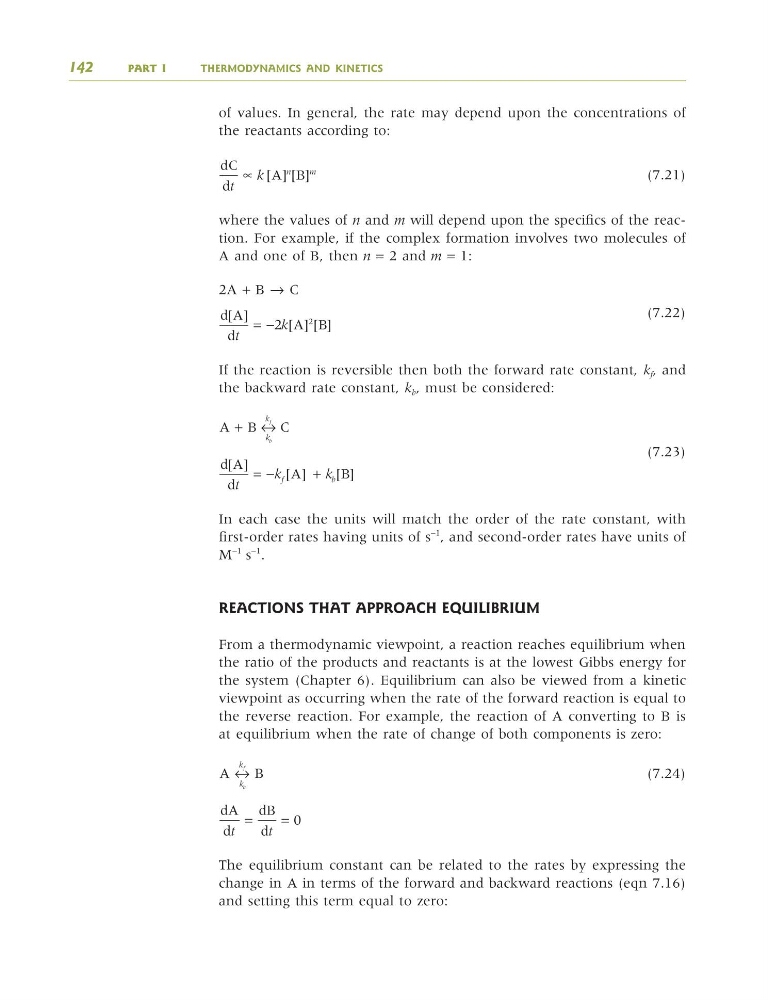
of values. In general, the rate may depend upon the concentrations of
the reactants according to:
(7.21)
where the values of n and m will depend upon the specifics of the reaction. For example, if the complex formation involves two molecules of
A and one of B, then n = 2 and m = 1:
2A + B → C
(7.22)
If the reaction is reversible then both the forward rate constant, k f , and
the backward rate constant, k b , must be considered:
(7.23)
In each case the units will match the order of the rate constant, with
first-order rates having units of s
−1
, and second-order rates have units of
M
−1 s
−1
.
REACTIONS THAT APPROACH EQUILIBRIUM
From a thermodynamic viewpoint, a reaction reaches equilibrium when
the ratio of the products and reactants is at the lowest Gibbs energy for
the system (Chapter 6). Equilibrium can also be viewed from a kinetic
viewpoint as occurring when the rate of the forward reaction is equal to
the reverse reaction. For example, the reaction of A converting to B is
at equilibrium when the rate of change of both components is zero:
(7.24)
The equilibrium constant can be related to the rates by expressing the
change in A in terms of the forward and backward reactions (eqn 7.16)
and setting this term equal to zero:
dA
d
dB
d
t
t
=
= 0
A
B
↔
k
k
b
f
d A
d
A
B
[ ]
[ ]
[ ]
t
k
k
f
b
= −
+
A B
C
+ ↔
k
k
b
f
d A
d
A B
[ ]
[ ] [ ]
t
k
= −2
2
dC
d
A B
t
k
n
m
[ ] [ ]
∝
142
PART I
THERMODYNAMICS AND KINETICS
9781405124362_4_007.qxd 4/29/08 10:41 Page 142
the reactants according to:
(7.21)
where the values of n and m will depend upon the specifics of the reaction. For example, if the complex formation involves two molecules of
A and one of B, then n = 2 and m = 1:
2A + B → C
(7.22)
If the reaction is reversible then both the forward rate constant, k f , and
the backward rate constant, k b , must be considered:
(7.23)
In each case the units will match the order of the rate constant, with
first-order rates having units of s
−1
, and second-order rates have units of
M
−1 s
−1
.
REACTIONS THAT APPROACH EQUILIBRIUM
From a thermodynamic viewpoint, a reaction reaches equilibrium when
the ratio of the products and reactants is at the lowest Gibbs energy for
the system (Chapter 6). Equilibrium can also be viewed from a kinetic
viewpoint as occurring when the rate of the forward reaction is equal to
the reverse reaction. For example, the reaction of A converting to B is
at equilibrium when the rate of change of both components is zero:
(7.24)
The equilibrium constant can be related to the rates by expressing the
change in A in terms of the forward and backward reactions (eqn 7.16)
and setting this term equal to zero:
dA
d
dB
d
t
t
=
= 0
A
B
↔
k
k
b
f
d A
d
A
B
[ ]
[ ]
[ ]
t
k
k
f
b
= −
+
A B
C
+ ↔
k
k
b
f
d A
d
A B
[ ]
[ ] [ ]
t
k
= −2
2
dC
d
A B
t
k
n
m
[ ] [ ]
∝
142
PART I
THERMODYNAMICS AND KINETICS
9781405124362_4_007.qxd 4/29/08 10:41 Page 142