

The second step of the process is a first-order reaction with some instantaneous probability. However, to consider the overall process, this probability must be multiplied by the probability that the complex forms
during an inter9al of time, dt. From the standpoint of molecule B, if any
molecule A enters an interaction volume around B, then the complex
may be formed. For simplicity, molecule A is assumed to enter the interaction volume and either form the complex or leave rapidly compared
to the time required for the second process to occur. In this case, the
distribution of A will always be random, and the number of A molecules
within the interaction volume is equal to the product of the concentration of A and the interaction 9olume around B, V B . The formation of the
product, C, is given by the first-order rate expression:
(7.19)
The concentration of the complex is given by the product of the concentration of B and the number of molecules of A within V B , yielding:
(7.20)
the term kV B is usually referred to as the second-order rate constant for
the reaction.
THE ORDER OF A REACTION
Although the reaction order may be considered from a molecular standpoint, in practice the order is an empirical quantity and may have a range
dC
d
AB
A B
B
t
k
k V
[ ]
[ ][ ]
=
=
dC
d
AB
t
k[ ]
=
CHAPTER 7
KINETICS AND ENZYMES
141
B
C
A
B
C
A
Concentration
Time
Concentration
Time
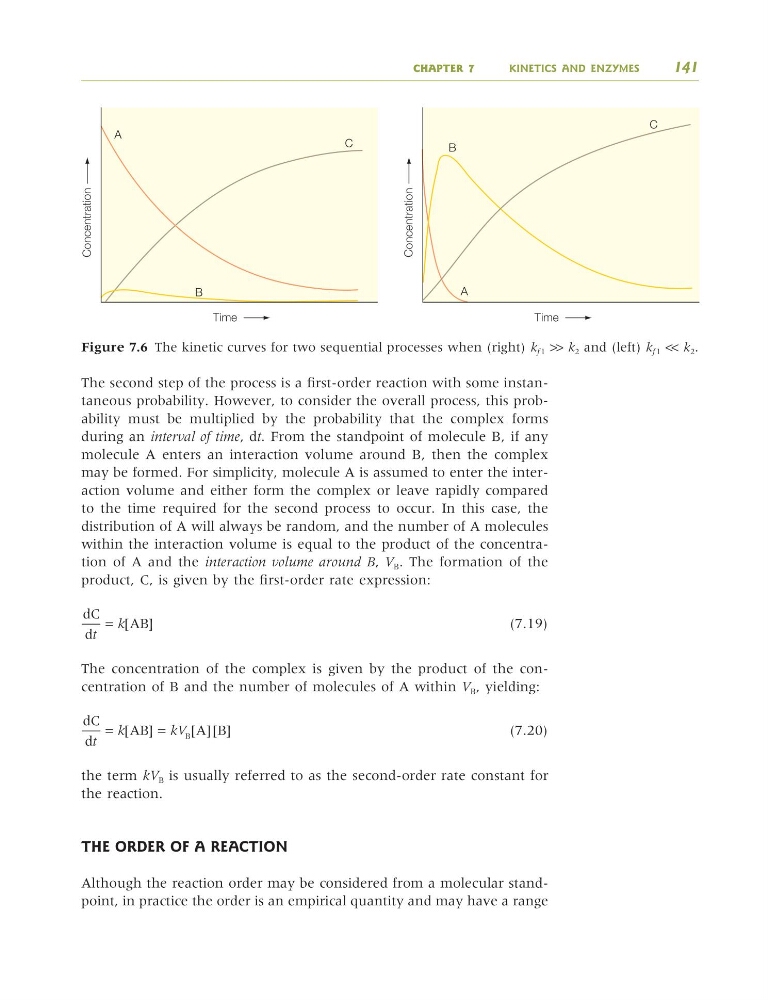
Figure 7.6 The kinetic curves for two sequential processes when (right) k f 1 >> k 2 and (left) k f 1 << k 2 .
9781405124362_4_007.qxd 4/29/08 10:41 Page 141
during an inter9al of time, dt. From the standpoint of molecule B, if any
molecule A enters an interaction volume around B, then the complex
may be formed. For simplicity, molecule A is assumed to enter the interaction volume and either form the complex or leave rapidly compared
to the time required for the second process to occur. In this case, the
distribution of A will always be random, and the number of A molecules
within the interaction volume is equal to the product of the concentration of A and the interaction 9olume around B, V B . The formation of the
product, C, is given by the first-order rate expression:
(7.19)
The concentration of the complex is given by the product of the concentration of B and the number of molecules of A within V B , yielding:
(7.20)
the term kV B is usually referred to as the second-order rate constant for
the reaction.
THE ORDER OF A REACTION
Although the reaction order may be considered from a molecular standpoint, in practice the order is an empirical quantity and may have a range
dC
d
AB
A B
B
t
k
k V
[ ]
[ ][ ]
=
=
dC
d
AB
t
k[ ]
=
CHAPTER 7
KINETICS AND ENZYMES
141
B
C
A
B
C
A
Concentration
Time
Concentration
Time
Figure 7.6 The kinetic curves for two sequential processes when (right) k f 1 >> k 2 and (left) k f 1 << k 2 .
9781405124362_4_007.qxd 4/29/08 10:41 Page 141