

PROTONATION STATES OF AMINO ACID RESIDUES
When an amino acid is dissolved in water, it can exchange a
proton with water, acting as either a weak base or a weak
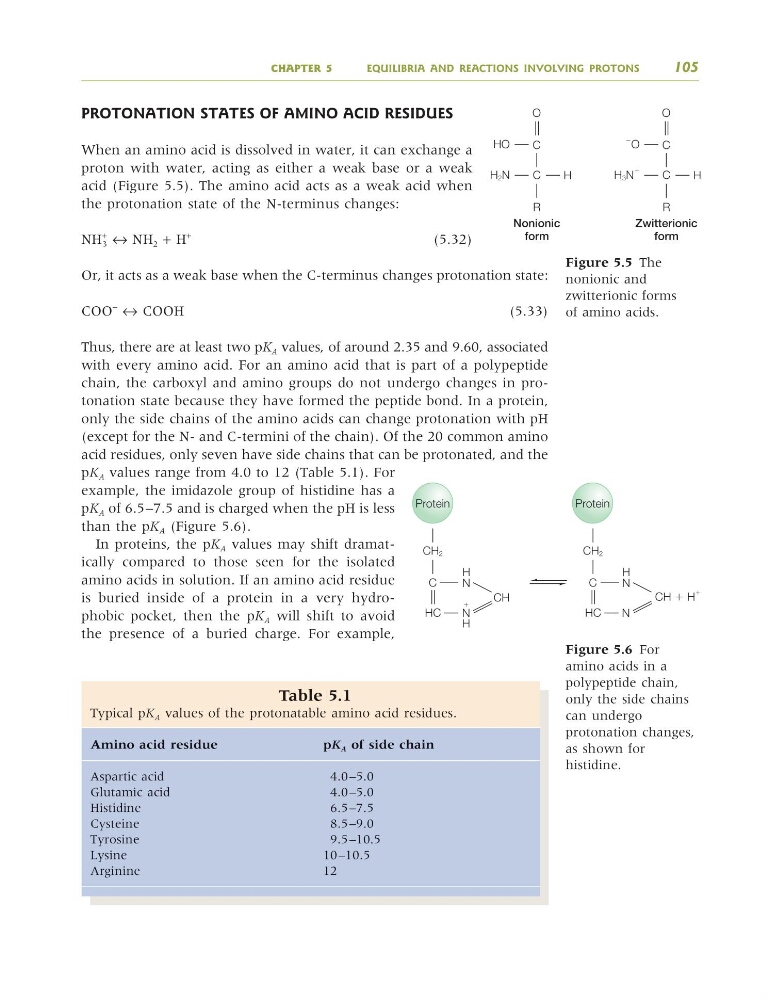
acid (Figure 5.5). The amino acid acts as a weak acid when
the protonation state of the N-terminus changes:
NH
+
3 ↔ NH 2 + H
+
(5.32)
Or, it acts as a weak base when the C-terminus changes protonation state:
COO
−
↔ COOH
(5.33)
Thus, there are at least two pK A values, of around 2.35 and 9.60, associated
with every amino acid. For an amino acid that is part of a polypeptide
chain, the carboxyl and amino groups do not undergo changes in protonation state because they have formed the peptide bond. In a protein,
only the side chains of the amino acids can change protonation with pH
(except for the N- and C-termini of the chain). Of the 20 common amino
acid residues, only seven have side chains that can be protonated, and the
pK A values range from 4.0 to 12 (Table 5.1). For
example, the imidazole group of histidine has a
pK A of 6.5–7.5 and is charged when the pH is less
than the pK A (Figure 5.6).
In proteins, the pK A values may shift dramatically compared to those seen for the isolated
amino acids in solution. If an amino acid residue
is buried inside of a protein in a very hydrophobic pocket, then the pK A will shift to avoid
the presence of a buried charge. For example,
CHAPTER 5
EQUILIBRIA AND REACTIONS INVOLVING PROTONS
105
C
O
H2N
C
R
H
HO
Nonionic
form
C
O
H3N
ϩ
C
R
H
Ϫ O
Zwitterionic
form
Figure 5.5 The
nonionic and
zwitterionic forms
of amino acids.
Table 5.1
Typical pK A values of the protonatable amino acid residues.
Amino acid residue
pK A of side chain
Aspartic acid
4.0–5.0
Glutamic acid
4.0–5.0
Histidine
6.5–7.5
Cysteine
8.5–9.0
Tyrosine
9.5–10.5
Lysine
10–10.5
Arginine
12
C
CH2
HC
N
H
H
N
CH
Protein
Protein
C
CH2
HC
CH ϩ H
ϩ
ϩ
N
H
N
Figure 5.6 For
amino acids in a
polypeptide chain,
only the side chains
can undergo
protonation changes,
as shown for
histidine.
9781405124362_4_005.qxd 4/29/08 9:08 Page 105
When an amino acid is dissolved in water, it can exchange a
proton with water, acting as either a weak base or a weak
acid (Figure 5.5). The amino acid acts as a weak acid when
the protonation state of the N-terminus changes:
NH
+
3 ↔ NH 2 + H
+
(5.32)
Or, it acts as a weak base when the C-terminus changes protonation state:
COO
−
↔ COOH
(5.33)
Thus, there are at least two pK A values, of around 2.35 and 9.60, associated
with every amino acid. For an amino acid that is part of a polypeptide
chain, the carboxyl and amino groups do not undergo changes in protonation state because they have formed the peptide bond. In a protein,
only the side chains of the amino acids can change protonation with pH
(except for the N- and C-termini of the chain). Of the 20 common amino
acid residues, only seven have side chains that can be protonated, and the
pK A values range from 4.0 to 12 (Table 5.1). For
example, the imidazole group of histidine has a
pK A of 6.5–7.5 and is charged when the pH is less
than the pK A (Figure 5.6).
In proteins, the pK A values may shift dramatically compared to those seen for the isolated
amino acids in solution. If an amino acid residue
is buried inside of a protein in a very hydrophobic pocket, then the pK A will shift to avoid
the presence of a buried charge. For example,
CHAPTER 5
EQUILIBRIA AND REACTIONS INVOLVING PROTONS
105
C
O
H2N
C
R
H
HO
Nonionic
form
C
O
H3N
ϩ
C
R
H
Ϫ O
Zwitterionic
form
Figure 5.5 The
nonionic and
zwitterionic forms
of amino acids.
Table 5.1
Typical pK A values of the protonatable amino acid residues.
Amino acid residue
pK A of side chain
Aspartic acid
4.0–5.0
Glutamic acid
4.0–5.0
Histidine
6.5–7.5
Cysteine
8.5–9.0
Tyrosine
9.5–10.5
Lysine
10–10.5
Arginine
12
C
CH2
HC
N
H
H
N
CH
Protein
Protein
C
CH2
HC
CH ϩ H
ϩ
ϩ
N
H
N
Figure 5.6 For
amino acids in a
polypeptide chain,
only the side chains
can undergo
protonation changes,
as shown for
histidine.
9781405124362_4_005.qxd 4/29/08 9:08 Page 105