

4—14.
THE PHOTO-VOLTAIC EFFECT
87
‘
image of a photographie film is due to the combination of photo'
electrons with silver ions to form silver atoms. It has been found
that one silver atom, approximately,is set free for each quantum
of light absorbed. Upon dev€ldpment, each separate silver atom
'
becomes the nucleus around which more silver atoms collect to
form the black area of the visible image.
4—14.
The Photo—voltaic Eect.5—Electromotive forces of the
order of magnitude of tenths of a volt maybe produced by the
unsymmetriçal illumination of two similar electrodes separated by
]
an appropriate electroly‘ce. For example, an e.m.f. of 0.25 volts
was produced by intense illumination of one of two similar plati—
num electrodes in a uorescent solution.
Potential differences of
10 to 20 microvolts were similarly generated When platinum, copper, mercury, silver or gold electrodes were used in non-uorescent
'
electrolytes such as copper sulphate. The kind of electrolyte used
has no eHect on the electromotive force._
,
.
The barrier—layer, dry-disc, or photo—voltaic cells produce an
electromotive force of their own when exposed to light and can be
used to drive a current through a résistance without the use of an
external battery.
In one type,* a lm of properly annealed
selenium\is formed on a thick- base of iron. Light which passes“
through the thin layer of selenium
,
causes electrons tomove from.the
"
_
iron to the selenium; in the con.
'
-
ï ' ven‘tional sense, ïthe iron forms
,"
C
…
positive and the selenium
the
negative
5000
‘
…
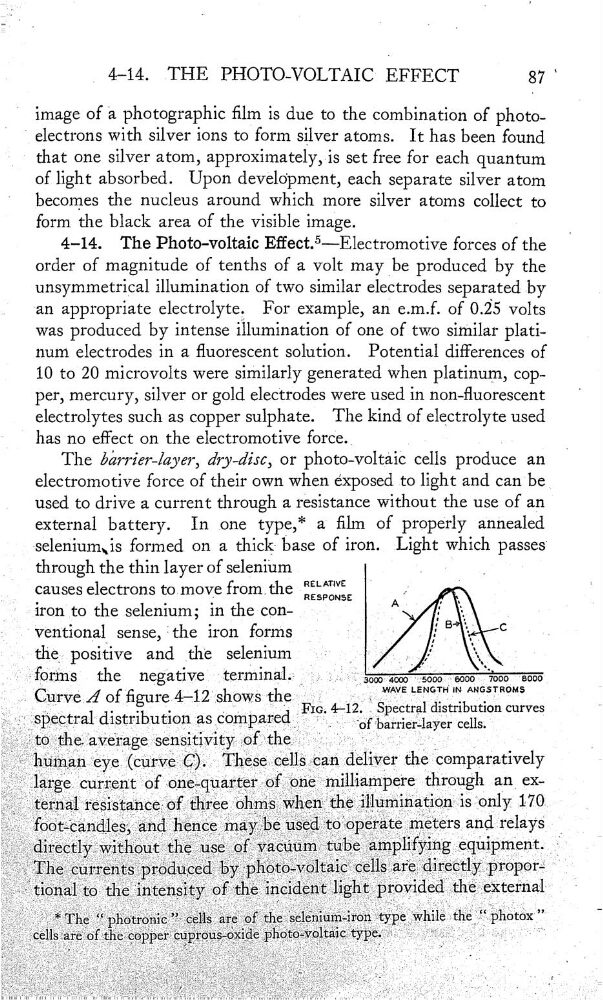
Curve/f of gure 4—12‘shoWs
”Î ANG.S‘TR°MS
'
'
-
.
.
.
“.
…
'
FIG. 4—12.
curves
sPeCtral dÇ13-‘Cflbutlün-Ças compared
"ofbai‘rielaÿér cells.
humneye
comparatively
largecurrentofonequartemfonemhampere
an. CX—
ThecurretsprœluœbyPhc>mV®h“—alcCô“Säî‘êdlfeCtlYPl”°£°or Ï ;
THE PHOTO-VOLTAIC EFFECT
87
‘
image of a photographie film is due to the combination of photo'
electrons with silver ions to form silver atoms. It has been found
that one silver atom, approximately,is set free for each quantum
of light absorbed. Upon dev€ldpment, each separate silver atom
'
becomes the nucleus around which more silver atoms collect to
form the black area of the visible image.
4—14.
The Photo—voltaic Eect.5—Electromotive forces of the
order of magnitude of tenths of a volt maybe produced by the
unsymmetriçal illumination of two similar electrodes separated by
]
an appropriate electroly‘ce. For example, an e.m.f. of 0.25 volts
was produced by intense illumination of one of two similar plati—
num electrodes in a uorescent solution.
Potential differences of
10 to 20 microvolts were similarly generated When platinum, copper, mercury, silver or gold electrodes were used in non-uorescent
'
electrolytes such as copper sulphate. The kind of electrolyte used
has no eHect on the electromotive force._
,
.
The barrier—layer, dry-disc, or photo—voltaic cells produce an
electromotive force of their own when exposed to light and can be
used to drive a current through a résistance without the use of an
external battery.
In one type,* a lm of properly annealed
selenium\is formed on a thick- base of iron. Light which passes“
through the thin layer of selenium
,
causes electrons tomove from.the
"
_
iron to the selenium; in the con.
'
-
ï ' ven‘tional sense, ïthe iron forms
,"
C
…
positive and the selenium
the
negative
5000
‘
…
Curve/f of gure 4—12‘shoWs
”Î ANG.S‘TR°MS
'
'
-
.
.
.
“.
…
'
FIG. 4—12.
curves
sPeCtral dÇ13-‘Cflbutlün-Ças compared
"ofbai‘rielaÿér cells.
humneye
comparatively
largecurrentofonequartemfonemhampere
an. CX—
ThecurretsprœluœbyPhc>mV®h“—alcCô“Säî‘êdlfeCtlYPl”°£°or Ï ;