

4—13.
PHOTO-CONDUCTÏVITŸ
85
increased current and that all the light absorbed could be accounted
,
»
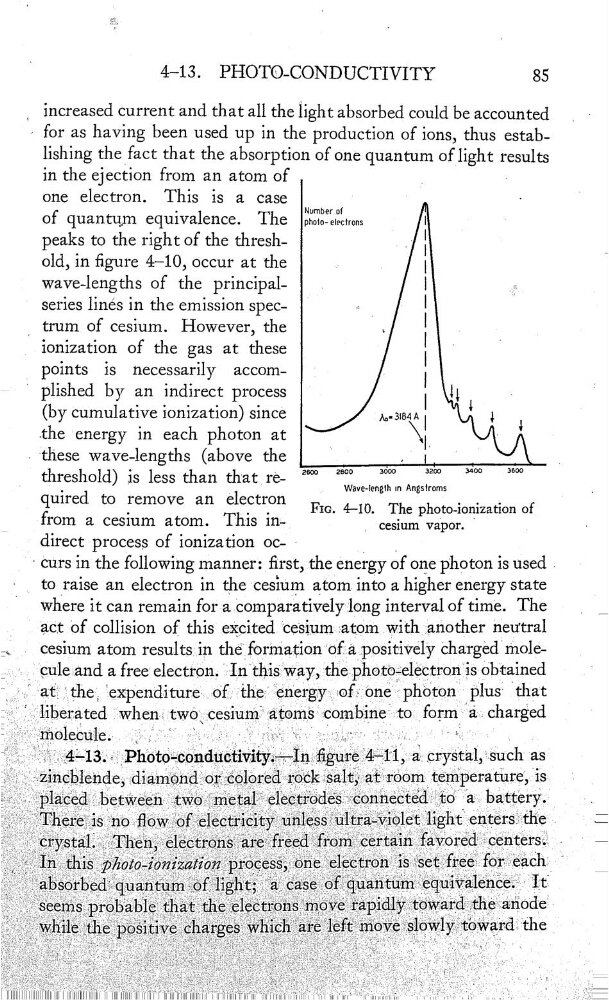
for as having been used up in the production of ions, thus establishing thefact that the absorption of one quantum of light results
in the ejection from an atom of
,
one
electron.
This is a case
'
'
'
of quantum equivalence. The ËËÂÎÏÏÊÊ«…nS
!
peaks to the right of the thresh.
,:
old, in gure 4—10, occur at the
|
wave-lengths of the principal.
l
series lines in the emission spec|
,
trum of cesium. However, the
,
l
ionization of the gas
at these
:
'
_
points is necessarily accom_
.
l
'
plished by an indirect process
'
|
l;
(by cumulative ionization) since
}…-3l84A |
l
;
the energy in each photon at
\]
-
i
.
these wave-lengths (above the
J
'
_
threshold) is less than that re”°°
”°°
”°°
‘
’
.
,
Wave-Ienglh un Angslroms
,
qu1red to remove
an
ele_Ctr_on FIG. 4—10. The photo-ionization of
_
from a ces1um atom. This m…
cesium VàP0r_
‘
_
.
direct process of ionization oc- -
_
-
ours in the following manner: rst, the energy of one photon is used
.
—
to raise an electron in the cesium atom into a higher energy
state
where it can remain for a comparatively'long interval of time. The
_
act Of collision of this eïçcited
another neutral
…
cesium atom
_
n
“__cÇule and a free electron.—
the
obtained
'
that
Îliberated [when
atoms combine
to
,
Chaïz‘-Ë€d
mOIËCUI€
'
4—13 Photoconducüvxty—Ingure4—lla crystalsuch
b?‘îtètèfŸ
—
TherelSnoevvofelectrlatyunlessultra—Violet11ghfenœfsthe
:
seemSpmbablethattheelectœnsmovefap1dlyt0wardïean0de ‘
_
; .Ë;t:iàË'
PHOTO-CONDUCTÏVITŸ
85
increased current and that all the light absorbed could be accounted
,
»
for as having been used up in the production of ions, thus establishing thefact that the absorption of one quantum of light results
in the ejection from an atom of
,
one
electron.
This is a case
'
'
'
of quantum equivalence. The ËËÂÎÏÏÊÊ«…nS
!
peaks to the right of the thresh.
,:
old, in gure 4—10, occur at the
|
wave-lengths of the principal.
l
series lines in the emission spec|
,
trum of cesium. However, the
,
l
ionization of the gas
at these
:
'
_
points is necessarily accom_
.
l
'
plished by an indirect process
'
|
l;
(by cumulative ionization) since
}…-3l84A |
l
;
the energy in each photon at
\]
-
i
.
these wave-lengths (above the
J
'
_
threshold) is less than that re”°°
”°°
”°°
‘
’
.
,
Wave-Ienglh un Angslroms
,
qu1red to remove
an
ele_Ctr_on FIG. 4—10. The photo-ionization of
_
from a ces1um atom. This m…
cesium VàP0r_
‘
_
.
direct process of ionization oc- -
_
-
ours in the following manner: rst, the energy of one photon is used
.
—
to raise an electron in the cesium atom into a higher energy
state
where it can remain for a comparatively'long interval of time. The
_
act Of collision of this eïçcited
another neutral
…
cesium atom
_
n
“__cÇule and a free electron.—
the
obtained
'
that
Îliberated [when
atoms combine
to
,
Chaïz‘-Ë€d
mOIËCUI€
'
4—13 Photoconducüvxty—Ingure4—lla crystalsuch
b?‘îtètèfŸ
—
TherelSnoevvofelectrlatyunlessultra—Violet11ghfenœfsthe
:
seemSpmbablethattheelectœnsmovefap1dlyt0wardïean0de ‘
_
; .Ë;t:iàË'