

\
\
4—2.
_
NUMBER OF
°
ELECTRONS EMITTED
69
.
cerning the changes in electrical conductivity when various sub—
stances are illuminated.
This is the photb-conductz've effect.
A related phenomenon, known asthe photo—voltaic effect, was
discovered by Becquerel in 1899. He found that an electromotive
force is produced between two similar electrodes in— a' suitable
electrolyte when one of them is illuminated with light.
'
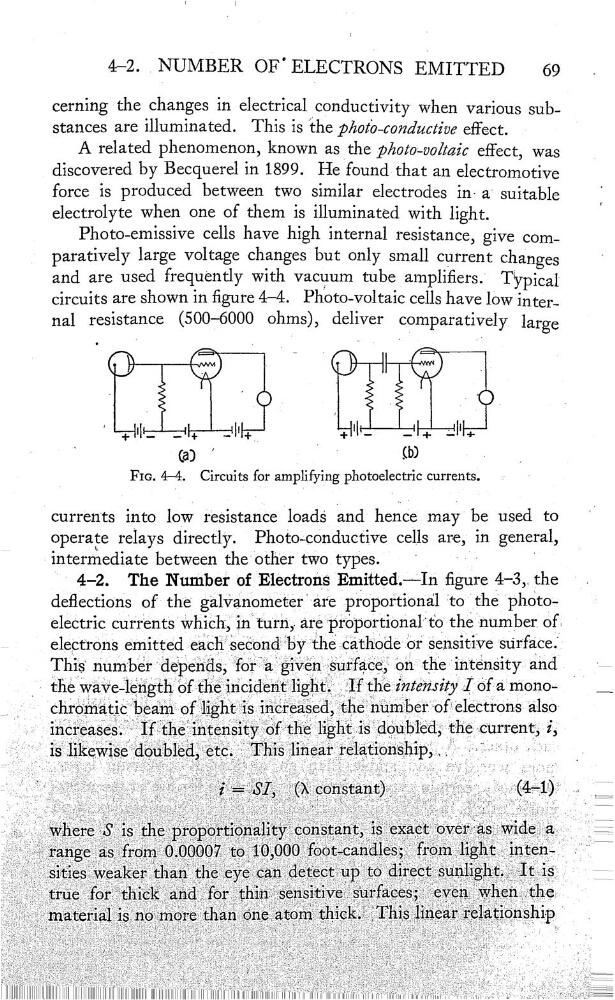
Photo-emissive cells have high internal resistance, give comparatively large voltage changes but only small current changes
'
and are used frequently With vacuum tube_ampliers.' Typical‘
circuits are shown in gure 4—4. Photo-voltaic cells have low internal resistance
(500—6000 ohms), deliver
large
ÎÊ
'
(a)
'
'
.(b)
.
_
FIG. 4—4.
Circuits for amplifying photoelectric currents.
'
curren‘ts
into low resistance loads‘ and henCe maybe used to
operate relays directly. Photo—cdnductive cells are, in general,
intermediate between theother two types.
'
;
'
4—2.
The Number of Electrons Emitted.——I
4—3, the
.
deections of the galvànometer‘aœ proportional
photoelectric
intu‘r—n, are proporti0nal“to thèhumber Of?
electrons emitt€d eachsecondby thécathodeor Sensitive surface.“
This number depends,forafg1vensurface, on the intensity. and
thewave—lengthofthe1nc1denthght If thè‘ritéñJitÿ
] of
_
_
-_ chromat1cbeam ofhght151ncreasedthenumberofelectrons aiso
SltœsweakerthantheeyeCândeœ°tuPt©d1feCtsunhâht1t13 f.
trueforthlckandforthmsen51twesuaœsevenwhenthe Ü
\
4—2.
_
NUMBER OF
°
ELECTRONS EMITTED
69
.
cerning the changes in electrical conductivity when various sub—
stances are illuminated.
This is the photb-conductz've effect.
A related phenomenon, known asthe photo—voltaic effect, was
discovered by Becquerel in 1899. He found that an electromotive
force is produced between two similar electrodes in— a' suitable
electrolyte when one of them is illuminated with light.
'
Photo-emissive cells have high internal resistance, give comparatively large voltage changes but only small current changes
'
and are used frequently With vacuum tube_ampliers.' Typical‘
circuits are shown in gure 4—4. Photo-voltaic cells have low internal resistance
(500—6000 ohms), deliver
large
ÎÊ
'
(a)
'
'
.(b)
.
_
FIG. 4—4.
Circuits for amplifying photoelectric currents.
'
curren‘ts
into low resistance loads‘ and henCe maybe used to
operate relays directly. Photo—cdnductive cells are, in general,
intermediate between theother two types.
'
;
'
4—2.
The Number of Electrons Emitted.——I
4—3, the
.
deections of the galvànometer‘aœ proportional
photoelectric
intu‘r—n, are proporti0nal“to thèhumber Of?
electrons emitt€d eachsecondby thécathodeor Sensitive surface.“
This number depends,forafg1vensurface, on the intensity. and
thewave—lengthofthe1nc1denthght If thè‘ritéñJitÿ
] of
_
_
-_ chromat1cbeam ofhght151ncreasedthenumberofelectrons aiso
SltœsweakerthantheeyeCândeœ°tuPt©d1feCtsunhâht1t13 f.
trueforthlckandforthmsen51twesuaœsevenwhenthe Ü