

68
4.
PHOTOELECTRÏC EMISSION
_
the plate.
As a consequence
of this work, the photoelectric
effect is sometimes referred to as the Hallwacks eHect.
.
'
;
If a positively charged metal plate is placed near the illuminated
‘
surface, the negative electricity will be attracted to it and will
-_
“
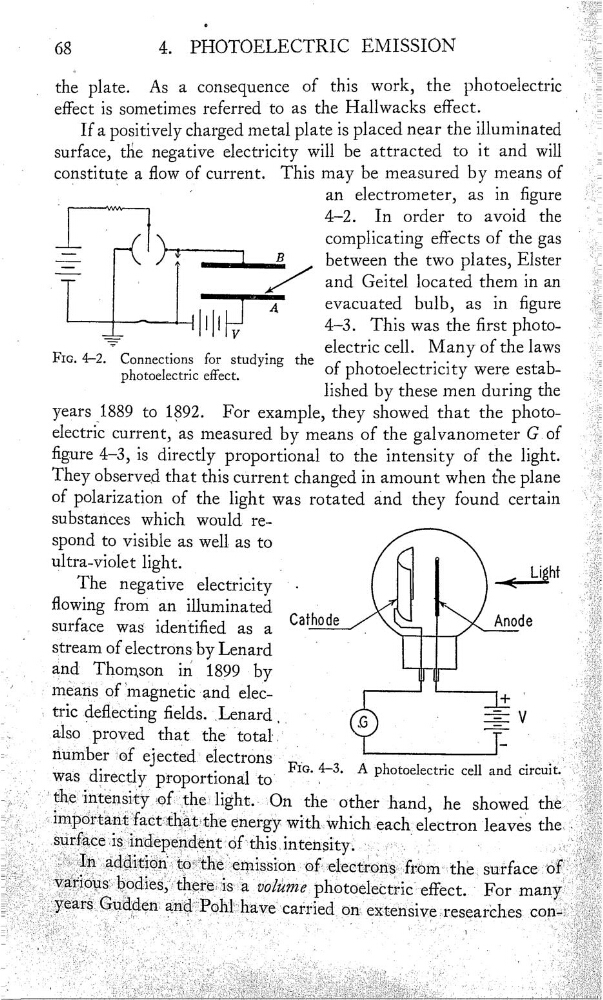
constitute a ow of current. This may be measured by means of
_
’
an
electrometer, as in gure
4—2.
In order to avoid the
complicating effects of the gas
'
—}
>_T:_B_
between the two plates, Elster
,_
=
/ and Geitel located them in an
'
A
evacuated bulb, as in gure
]… DV
4—3.
This was the rst photo'
F
?
_
_
electric cell. Many of the laws
IG. 4—2.
Connections for study1ng the
.
.
photoelectric effect.
of photoelectr1c1ty were estab—
lished by these men during the
years _1889 to 1892. For example, they showed that the photo—
electric current, as measured by means of the galvanometer Gof
gure 4—3, is directly proportional to the intensity of the light.
They observed that this current changed in amount when the plane
of polarization of the light was rotated and they found certain
substances which would re—
spond to visible as well as to
ultra-violet light.
_
'
-
The negative electricity
‘
.
i
-<ѣԮhi
owing from an illuminated
'
,
surface was identied as a
Cathode
.
Anode
stream
of electr0ns by Lenard
l .
and Thomson iri 1899 by
|| |]
’
magnetic and elec—
+
7 ‘
=
“Tic deecng elds— Lenard
..
@
-
:=: v
also
that the total]
”:_“ -
F1‘ç.
A photoelectric
cell and
light.- ‘On the other hand, he showed the;
ImportantfaCtthatth9 ‘?nefgÿ
each electron leaves the:
surfacelsindependentof*t‘hiaintehsity4 _;
}
Inaddltmnmthe
Surface of
_Var10us bodies, there
phbtoele‘ctriceect. For
yearsGudden andP0hlhavecariied
con-
4.
PHOTOELECTRÏC EMISSION
_
the plate.
As a consequence
of this work, the photoelectric
effect is sometimes referred to as the Hallwacks eHect.
.
'
;
If a positively charged metal plate is placed near the illuminated
‘
surface, the negative electricity will be attracted to it and will
-_
“
constitute a ow of current. This may be measured by means of
_
’
an
electrometer, as in gure
4—2.
In order to avoid the
complicating effects of the gas
'
—}
>_T:_B_
between the two plates, Elster
,_
=
/ and Geitel located them in an
'
A
evacuated bulb, as in gure
]… DV
4—3.
This was the rst photo'
F
?
_
_
electric cell. Many of the laws
IG. 4—2.
Connections for study1ng the
.
.
photoelectric effect.
of photoelectr1c1ty were estab—
lished by these men during the
years _1889 to 1892. For example, they showed that the photo—
electric current, as measured by means of the galvanometer Gof
gure 4—3, is directly proportional to the intensity of the light.
They observed that this current changed in amount when the plane
of polarization of the light was rotated and they found certain
substances which would re—
spond to visible as well as to
ultra-violet light.
_
'
-
The negative electricity
‘
.
i
-<ѣԮhi
owing from an illuminated
'
,
surface was identied as a
Cathode
.
Anode
stream
of electr0ns by Lenard
l .
and Thomson iri 1899 by
|| |]
’
magnetic and elec—
+
7 ‘
=
“Tic deecng elds— Lenard
..
@
-
:=: v
also
that the total]
”:_“ -
F1‘ç.
A photoelectric
cell and
light.- ‘On the other hand, he showed the;
ImportantfaCtthatth9 ‘?nefgÿ
each electron leaves the:
surfacelsindependentof*t‘hiaintehsity4 _;
}
Inaddltmnmthe
Surface of
_Var10us bodies, there
phbtoele‘ctriceect. For
yearsGudden andP0hlhavecariied
con-