

3—10.
THE UNCERTAINTY PRINCIPLE —
61
serve as a guide for the electron particle. The individual or phase
waves travel at an average velocity w and have an average wavelength )\ = h/mv. Their resultant travels at the group velocity 1).
The probability (per unit length) of observing an electron particle
along the path of the electron waves is proportional to the square
of the amplitude of the resultant wave, Since this amplitude is
practically zero except in the wave—packet, it is here that one may
expect
to nd the electron particle at a given*instant. In other
words, the likelihood that the particle is somewhere on the x-axis
_
_
is greatest at the center of the packet and recedes rapidly on
side.
Thus the particle travels at the group velocity 0.
3—10.
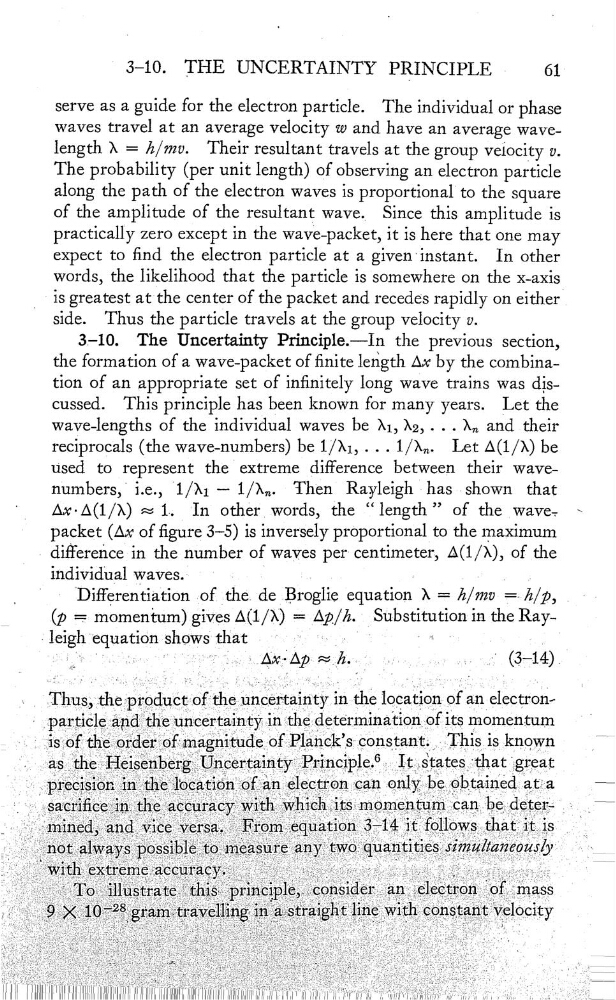
The Uncertainty Pnciple.—In the previous section,
the formation of a wave-packet of nite length Ax by the combination of an appropriate set of innitely long wave trains was dis—
cussed.
This principle has been known for many years. Let the
wave-lengths of the individual waves be >\1, )\2, . . . )… and their
reciprocals (the wave-numbers) be 1 /)\1, . . . 1/)…. Let A(1/)æ) be
used to represent
difference between their wavei.e.,
—1/)x…
Then Rayleigh has shown that
'
Ax-A(1/À) % 1…. In other words, the
“
length
”
of the
\
'
packet (Ax of gure 3—5) is inversely proportional to the maximum
-
difference in the number of waves per centimeter, A(1/À), of the
individual waves.Ï
‘
.
.
…
.
.
Differentiation «of
de Broglie equation )» = iz/mv = iz/p,
_
»
(p =. momentum) gives A(1/}x) = Ap/iz. ‘ Substitution in the Ray—
—
leigh‘equati0n shows that
_
‘
“
»
ï
‘
' _
'
,
'
.
Thusdmeproductofthe
particleandtheunœrtamty
its. momentum
'
f
'
astheHelsenbelgUnœrtathPnŒP1€°Itstatesthat'fgë«e@t
". premswrmthel@catwnofaneleetr0ncanonlÿbeobtamedata
——
mmedandwceversaFromequatl°n3—14lthHOWSthat1t13‘
notalwaysp0881blemmeasureanYtWOquantltles“”Wl‘awu—‘Ô’
"
f
-
ll lil ill… l HΑ
f
,
:
»
THE UNCERTAINTY PRINCIPLE —
61
serve as a guide for the electron particle. The individual or phase
waves travel at an average velocity w and have an average wavelength )\ = h/mv. Their resultant travels at the group velocity 1).
The probability (per unit length) of observing an electron particle
along the path of the electron waves is proportional to the square
of the amplitude of the resultant wave, Since this amplitude is
practically zero except in the wave—packet, it is here that one may
expect
to nd the electron particle at a given*instant. In other
words, the likelihood that the particle is somewhere on the x-axis
_
_
is greatest at the center of the packet and recedes rapidly on
side.
Thus the particle travels at the group velocity 0.
3—10.
The Uncertainty Pnciple.—In the previous section,
the formation of a wave-packet of nite length Ax by the combination of an appropriate set of innitely long wave trains was dis—
cussed.
This principle has been known for many years. Let the
wave-lengths of the individual waves be >\1, )\2, . . . )… and their
reciprocals (the wave-numbers) be 1 /)\1, . . . 1/)…. Let A(1/)æ) be
used to represent
difference between their wavei.e.,
—1/)x…
Then Rayleigh has shown that
'
Ax-A(1/À) % 1…. In other words, the
“
length
”
of the
\
'
packet (Ax of gure 3—5) is inversely proportional to the maximum
-
difference in the number of waves per centimeter, A(1/À), of the
individual waves.Ï
‘
.
.
…
.
.
Differentiation «of
de Broglie equation )» = iz/mv = iz/p,
_
»
(p =. momentum) gives A(1/}x) = Ap/iz. ‘ Substitution in the Ray—
—
leigh‘equati0n shows that
_
‘
“
»
ï
‘
' _
'
,
'
.
Thusdmeproductofthe
particleandtheunœrtamty
its. momentum
'
f
'
astheHelsenbelgUnœrtathPnŒP1€°Itstatesthat'fgë«e@t
". premswrmthel@catwnofaneleetr0ncanonlÿbeobtamedata
——
mmedandwceversaFromequatl°n3—14lthHOWSthat1t13‘
notalwaysp0881blemmeasureanYtWOquantltles“”Wl‘awu—‘Ô’
"
f
-
ll lil ill… l HΑ
f
,
:
»