

60
WAVE-LENGTH OF THE ELECTRON
'
maxima and minima no longer travel with the same velocity (the -
average velocity, 20) of the individual wave trains, but at some
other velocity 0 which is greater or less than w, according to the
nature of the dispersive medium.
"
Finally, consider a large number of wave trains, each of innite
length, but differing slightly from one another in wave-length and
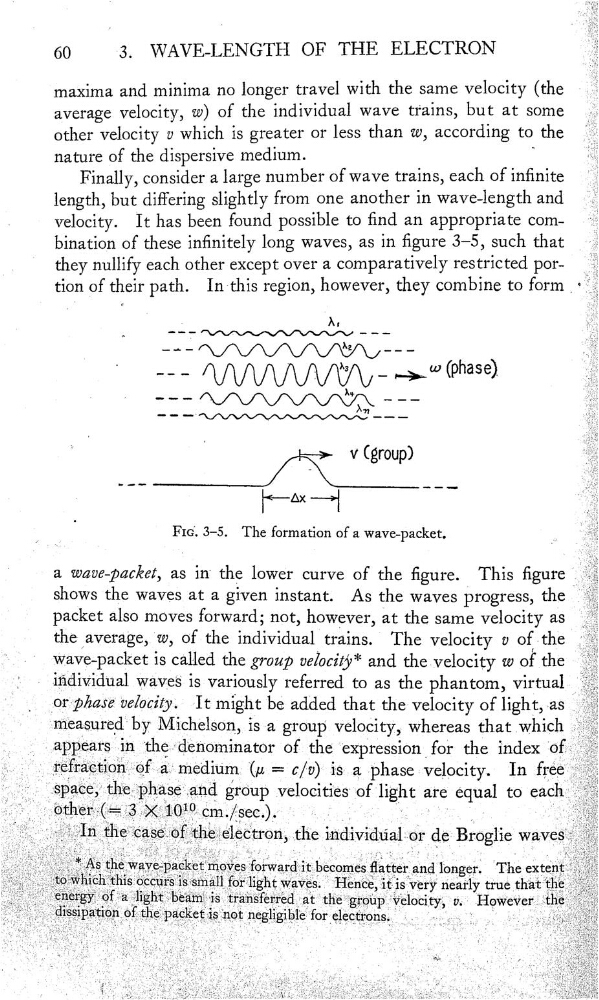
velocity. It has been found possible to nd an appropriate combination of these innitely long waves, as in gure 3—5, such that
_
,
they nullify each other except over a comparatively restricted portion of their path. In-this region, however, they combine to form
'
-
À«
'
-—
—
WWW/W — ——»°° (Phase)
-
———…———
-°—'\MWM——_
t—Ax——l
FIG'. 3—5.
The formation of a wave—packet.
'
a
wave—packet, as in‘ the lower curve of the gure. This gure
shows the waves at a given instant. As the waves progress, the
packet also m0ves forward; not, however, at the same velocity as
“10, of the individualtrains.
The velocity v of the
-
'
Wave-packet
is called the group velocitÿ* and thevelocity w of the
individual waves is variously referred to as the phantom, virtual
or*plzasê velocity. It might be added that thevelocity of light, as >
_
Mi‘chelSon, is a group
whereas
;_ {appears in
of the expression_for the index of
mediUm (# = 6/27) is a phase velocity. In free
Space,thephaseand group ,velociti€s of light are equal to each
? Other(=3><101°Cm/S€C)
—
,
«
“
‘
‘de Broglie waves
1=°""hlchthlsoccurswsmallforhght Waves Hence1t15very nearly true thatth6
energy °fa llghtbeam È1_S transferred af
vi.
Howeverthe
WAVE-LENGTH OF THE ELECTRON
'
maxima and minima no longer travel with the same velocity (the -
average velocity, 20) of the individual wave trains, but at some
other velocity 0 which is greater or less than w, according to the
nature of the dispersive medium.
"
Finally, consider a large number of wave trains, each of innite
length, but differing slightly from one another in wave-length and
velocity. It has been found possible to nd an appropriate combination of these innitely long waves, as in gure 3—5, such that
_
,
they nullify each other except over a comparatively restricted portion of their path. In-this region, however, they combine to form
'
-
À«
'
-—
—
WWW/W — ——»°° (Phase)
-
———…———
-°—'\MWM——_
t—Ax——l
FIG'. 3—5.
The formation of a wave—packet.
'
a
wave—packet, as in‘ the lower curve of the gure. This gure
shows the waves at a given instant. As the waves progress, the
packet also m0ves forward; not, however, at the same velocity as
“10, of the individualtrains.
The velocity v of the
-
'
Wave-packet
is called the group velocitÿ* and thevelocity w of the
individual waves is variously referred to as the phantom, virtual
or*plzasê velocity. It might be added that thevelocity of light, as >
_
Mi‘chelSon, is a group
whereas
;_ {appears in
of the expression_for the index of
mediUm (# = 6/27) is a phase velocity. In free
Space,thephaseand group ,velociti€s of light are equal to each
? Other(=3><101°Cm/S€C)
—
,
«
“
‘
‘de Broglie waves
1=°""hlchthlsoccurswsmallforhght Waves Hence1t15very nearly true thatth6
energy °fa llghtbeam È1_S transferred af
vi.
Howeverthe