

2—11.
THE MASS OF THE ELECTRON —
37
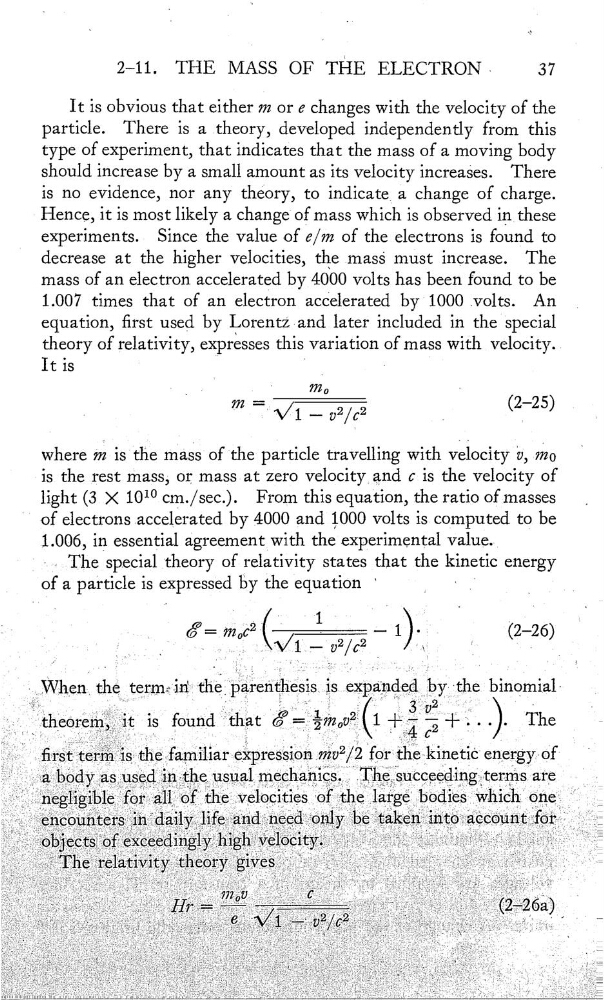
It is obvious that either m or 6 changes With the velocity of the
particle. There is a theory, developed independently from this
type of experiment, that indicates that the mass of a moving body
should increase by a small amount as its velocity increaSes. There
‘
is no evidence, nor any theory, to indicate a change of charge.
Hence, it is most likely a change of mass which is observed in these
experiments. Since the value of 5/ m of the electrons is found to
decrease at the higher velocities, the mass must increase. The
mass of an electron accelerated by 4000 volts has been found to be
1.007 times that of an electron accelerated by 1000 volts. An
equation, rst used by Lorentz‘and later included in the special
theory of relativity, exprèsses this variation of mass With velocity.
It is
‘
'
_
-
_
.
_
'
ma
.
.
m —.\/1_—…2
.
<2,
25)
.
Where 772 is the mass of the particle travelling With velocity b, mo
is the rest mass, or mass at zero velocityand 6 is the velocity of
light (3 X 1010 cm. / sec.). From this equation, the ratio of masses
,
'
of electrons accelerated by 4000 and 1000 volts is computed to be
1.006, in essential agreementwith the experimental value…
'
-
The special [theory of relativity states that the kinetic energy
_
of a particle is expressed by the equation
‘
—
_'
_
_
-
Ë=m062'__-——:——1 -.
(2—26)
_
.'
_….
…
\î
'
_
When the
binomial
hm
found h € =m(1+î—+ .)
The
energybf
'
abodyasused1ntheusualmechamcsThesucceemgtermsare ; -
@bJeCtsOfexœedmglÿhlghvdCl'CY
THE MASS OF THE ELECTRON —
37
It is obvious that either m or 6 changes With the velocity of the
particle. There is a theory, developed independently from this
type of experiment, that indicates that the mass of a moving body
should increase by a small amount as its velocity increaSes. There
‘
is no evidence, nor any theory, to indicate a change of charge.
Hence, it is most likely a change of mass which is observed in these
experiments. Since the value of 5/ m of the electrons is found to
decrease at the higher velocities, the mass must increase. The
mass of an electron accelerated by 4000 volts has been found to be
1.007 times that of an electron accelerated by 1000 volts. An
equation, rst used by Lorentz‘and later included in the special
theory of relativity, exprèsses this variation of mass With velocity.
It is
‘
'
_
-
_
.
_
'
ma
.
.
m —.\/1_—…2
.
<2,
25)
.
Where 772 is the mass of the particle travelling With velocity b, mo
is the rest mass, or mass at zero velocityand 6 is the velocity of
light (3 X 1010 cm. / sec.). From this equation, the ratio of masses
,
'
of electrons accelerated by 4000 and 1000 volts is computed to be
1.006, in essential agreementwith the experimental value…
'
-
The special [theory of relativity states that the kinetic energy
_
of a particle is expressed by the equation
‘
—
_'
_
_
-
Ë=m062'__-——:——1 -.
(2—26)
_
.'
_….
…
\î
'
_
When the
binomial
hm
found h € =m(1+î—+ .)
The
energybf
'
abodyasused1ntheusualmechamcsThesucceemgtermsare ; -
@bJeCtsOfexœedmglÿhlghvdCl'CY