

36
2.
THE MASS OF THE ELECTRON
'
"
silver, each of mass M, then e/M = 89.45.
In the case of hydrogen,
the lightest known element, electrolysis has shown that the
ratio of charge to mass of the atom is 95745 e.m.u./g. The
“
lighter the particle, the larger is its charge-to-mass ratio. The
charge 6 is that of the electron, as originally dened by Stoney.
Inasmuch as the ratio of charge—to—mass of the electron is greater
than that for the hydrogen atom and the charge is the Same, the
electron must have a mass less than that of the lightest atom.
The hydrogen atom is thus found to have a mass 1839 times that of
the electron or 1.6618 X 10—24 grams.
If the mass of one electron is subtracted from this, it is seen that the mass of the proton
or nucleus Of the hydrogen atom is 1.6609 X 10
”24
grams.
Several experimenters
17
Who
worked during the years from 1902
to
1916, measured the ratio of
charge—to—mass of the negatively
_
'
charged or beta particles e‘mitl+
ted by radioactive. substances.
Ï
Ra
(:
P
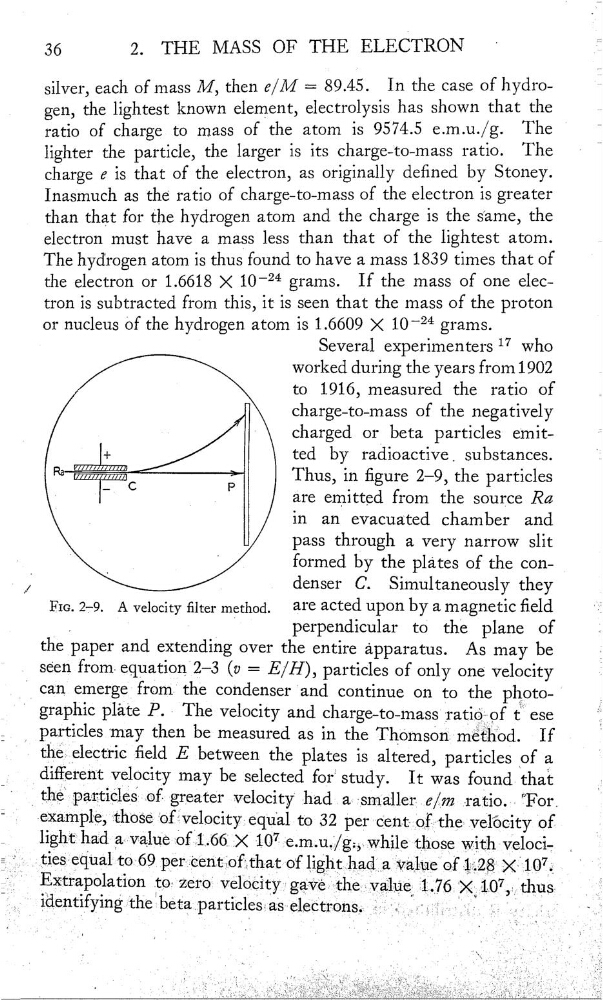
Thus, in gure 2—9, the particles
_
"
_
.
are
emitted from the source Ra
_
in
an
evacuated chamber
and
_
pass through a very marrow slit
-
'
_
'
formed by the plates of the con/'
denser C'.
Simultaneously they
Fm. 2-9.
A velocity lter method.
are acted upon by a magnetic eld
“-‘î
,
perpendicular to the plane of
thepaper and extending over the entire apparatus. As may be
'
.
se‘en from equationZ—3 (v = E/H), particles of only one velocity
' _
emerge from the cohdenser ‘and continue on to the photo,
'
graphic plate P. - The velocity and charge—to—mass ;ratidepf t ese
:
_
particles may then be measured as in the
If
eld E between the plates is altered, particles of a
different velocity may be selected
study.
It was found that
'
_
greater velocity
e/m
l’For_
=
example,ëthose
to 32 per cent— of»-the velôcity of
_
light had avalue of 1.66] >< 107e.m.u,1/g;, While those
a
_
… tiesée‘qual to:69 per.centéof;that of
ÿa_1ue of128'
zero
?
_ “
_
2.
THE MASS OF THE ELECTRON
'
"
silver, each of mass M, then e/M = 89.45.
In the case of hydrogen,
the lightest known element, electrolysis has shown that the
ratio of charge to mass of the atom is 95745 e.m.u./g. The
“
lighter the particle, the larger is its charge-to-mass ratio. The
charge 6 is that of the electron, as originally dened by Stoney.
Inasmuch as the ratio of charge—to—mass of the electron is greater
than that for the hydrogen atom and the charge is the Same, the
electron must have a mass less than that of the lightest atom.
The hydrogen atom is thus found to have a mass 1839 times that of
the electron or 1.6618 X 10—24 grams.
If the mass of one electron is subtracted from this, it is seen that the mass of the proton
or nucleus Of the hydrogen atom is 1.6609 X 10
”24
grams.
Several experimenters
17
Who
worked during the years from 1902
to
1916, measured the ratio of
charge—to—mass of the negatively
_
'
charged or beta particles e‘mitl+
ted by radioactive. substances.
Ï
Ra
(:
P
Thus, in gure 2—9, the particles
_
"
_
.
are
emitted from the source Ra
_
in
an
evacuated chamber
and
_
pass through a very marrow slit
-
'
_
'
formed by the plates of the con/'
denser C'.
Simultaneously they
Fm. 2-9.
A velocity lter method.
are acted upon by a magnetic eld
“-‘î
,
perpendicular to the plane of
thepaper and extending over the entire apparatus. As may be
'
.
se‘en from equationZ—3 (v = E/H), particles of only one velocity
' _
emerge from the cohdenser ‘and continue on to the photo,
'
graphic plate P. - The velocity and charge—to—mass ;ratidepf t ese
:
_
particles may then be measured as in the
If
eld E between the plates is altered, particles of a
different velocity may be selected
study.
It was found that
'
_
greater velocity
e/m
l’For_
=
example,ëthose
to 32 per cent— of»-the velôcity of
_
light had avalue of 1.66] >< 107e.m.u,1/g;, While those
a
_
… tiesée‘qual to:69 per.centéof;that of
ÿa_1ue of128'
zero
?
_ “
_