

19—2.
HIGH RESISTANCE
4—43
clean, dry, rubber tubes, making a total of 20 strings of 40units
each.
The rubber tubing (R) is wound around inSulating spacers
between metal discs (D). The latter are used as corona shields
and must have smooth, rounded edges. Corona can be reduced
by placing the entire. unit in a sealed glass or t€xtolite cylinder to—
'
gether with an open dish of carbon tetrachloride (CCl4). The
discs may be about one foot in diameter, spaced one—half foot apart.
A microammeter is used in series with the resistors and can be cali—
brated to read volts directly, by means of Ohm’s law.
Resistance ribbon consists of a ne wire woven back and forth
at right angles to the supporting cotton threads; the latter running lengthwise of the ribbon. The currents in adjacent wires
are in opposite directions so that the inductive effects are at least
partially neutralized.
'
Tubes of various liquids may also be used as high resistances.
Alcohol (any form) may be added to xylol to lower 'its' resistance to the desired value, say 100,000 ohms per cubic centimeter.
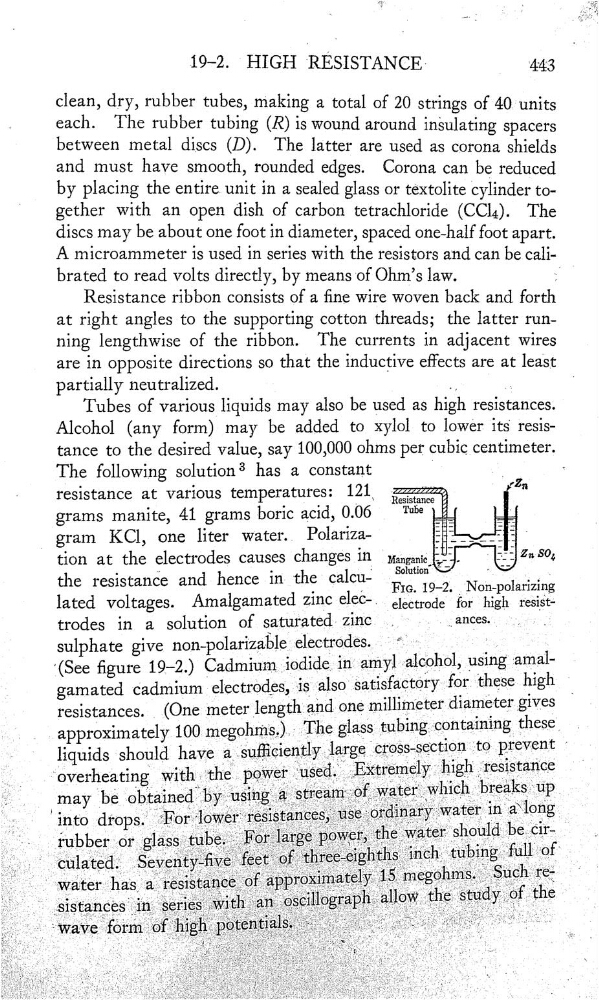
The following solution3 has a constant
_
z
«
,
resistance at various temperatures:
'
“
grams manite, 4—1 grams
boric acid, 0.06
Tube
==Ë_
_
grain KCl, one liter water., Polariza—
i
—
tion at the electrodes causes changesin
!
_
»
Zn so,,
the resistance and. hence in the calcué
Non—polarizing
lated voltages. Amalgamated Zinc €1€C-—
for high
trodes in a solution of satuf,ated zinc
»
…anc_es_‘
sulphate give non—polarizable electrodes.
‘
_
,
'(See gure 19—2.) Cadmium
in
.‘l51ng :amal—
‘
gamated Cadmium el‘ectrÔd_es,
.saus_‘factory .forçthese }}1gh
_
resistances.
_
(One ineter lengthahd 0116
diameter gives
'
_
approximately 100
glass
..
'
liquide should have ilvlgP
…
waveform@fh1ghtentlals
-
HIGH RESISTANCE
4—43
clean, dry, rubber tubes, making a total of 20 strings of 40units
each.
The rubber tubing (R) is wound around inSulating spacers
between metal discs (D). The latter are used as corona shields
and must have smooth, rounded edges. Corona can be reduced
by placing the entire. unit in a sealed glass or t€xtolite cylinder to—
'
gether with an open dish of carbon tetrachloride (CCl4). The
discs may be about one foot in diameter, spaced one—half foot apart.
A microammeter is used in series with the resistors and can be cali—
brated to read volts directly, by means of Ohm’s law.
Resistance ribbon consists of a ne wire woven back and forth
at right angles to the supporting cotton threads; the latter running lengthwise of the ribbon. The currents in adjacent wires
are in opposite directions so that the inductive effects are at least
partially neutralized.
'
Tubes of various liquids may also be used as high resistances.
Alcohol (any form) may be added to xylol to lower 'its' resistance to the desired value, say 100,000 ohms per cubic centimeter.
The following solution3 has a constant
_
z
«
,
resistance at various temperatures:
'
“
grams manite, 4—1 grams
boric acid, 0.06
Tube
==Ë_
_
grain KCl, one liter water., Polariza—
i
—
tion at the electrodes causes changesin
!
_
»
Zn so,,
the resistance and. hence in the calcué
Non—polarizing
lated voltages. Amalgamated Zinc €1€C-—
for high
trodes in a solution of satuf,ated zinc
»
…anc_es_‘
sulphate give non—polarizable electrodes.
‘
_
,
'(See gure 19—2.) Cadmium
in
.‘l51ng :amal—
‘
gamated Cadmium el‘ectrÔd_es,
.saus_‘factory .forçthese }}1gh
_
resistances.
_
(One ineter lengthahd 0116
diameter gives
'
_
approximately 100
glass
..
'
liquide should have ilvlgP
…
waveform@fh1ghtentlals
-