

_
_
2—9;
THE HELICAL METHOD
.
33
velocity along the axis. The latter may be expressed in terms of
the accelerating voltage V by equation 2—12. Then
l
_
.
Z‘ = _; sec.
(2—20)
\/(2Ve/m)lO8
An alternating potential is applied across the condenser plates C
and serves to
the electron beam back and forth.
A line
instead of a spot is then observed on the uorescent screen.
The
electrons travel in parabolic paths, with increasing transverse
velocity, as they pass through the condenser, after Which they
travel in a straight line to the screen. Finally, a magnetic eld
of strength H, oersteds, is applied
_
_
in such a manner that the lines
%
_
of force are parallel to the axis
:
_
_
of the tube.
This eld does not
:
,
affect the forward motion of the
_
,Ï\
—
electrons but does act upon the
'
.
transverse motion.
.
From the ele'
mentary
motor rule, one may see
_
!
that the electrons Will be de—
{
ected
into circular
in
_
l
planes at right angles to the tube
FIG' 2—8“
Paths
axis at the same time that they
'
'
move
down the tube.
The resultant of the combined uniform
.
circular and uniform linear motions is such that the electrons
_
travel in helical paths down the tube.
_
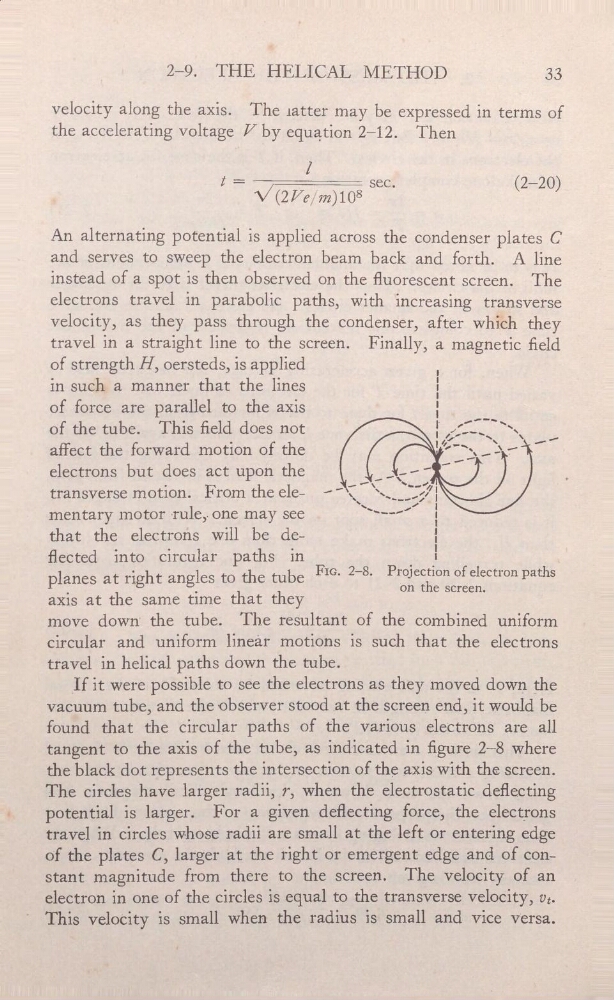
_If it were possible to seethe electrons as they moved down the
vacuumtube, and the observer stood at the screen end, it would be
found that the circular paths of the various electrons areall
tangent to the axis of the tube, as ind-icàttedin gure 2—8 where
the black dot represents
the intersection of the axis With the screen. _
The circles have larger radii, r, when the electrostatic deecting
‘.
potential islarger. For a given deecting force,
electrons
travel in circles_whose radii are small at- the left or en_tering edge
of the plates C, larger at the right or emergent edge and of con’
staht magnitude from there to the screen. The Velocity of an -
.
electron in one of the circles is equal to the transverse velocity, vt.
'
velocity is small when the radius is small
vice versa;
_
2—9;
THE HELICAL METHOD
.
33
velocity along the axis. The latter may be expressed in terms of
the accelerating voltage V by equation 2—12. Then
l
_
.
Z‘ = _; sec.
(2—20)
\/(2Ve/m)lO8
An alternating potential is applied across the condenser plates C
and serves to
the electron beam back and forth.
A line
instead of a spot is then observed on the uorescent screen.
The
electrons travel in parabolic paths, with increasing transverse
velocity, as they pass through the condenser, after Which they
travel in a straight line to the screen. Finally, a magnetic eld
of strength H, oersteds, is applied
_
_
in such a manner that the lines
%
_
of force are parallel to the axis
:
_
_
of the tube.
This eld does not
:
,
affect the forward motion of the
_
,Ï\
—
electrons but does act upon the
'
.
transverse motion.
.
From the ele'
mentary
motor rule, one may see
_
!
that the electrons Will be de—
{
ected
into circular
in
_
l
planes at right angles to the tube
FIG' 2—8“
Paths
axis at the same time that they
'
'
move
down the tube.
The resultant of the combined uniform
.
circular and uniform linear motions is such that the electrons
_
travel in helical paths down the tube.
_
_If it were possible to seethe electrons as they moved down the
vacuumtube, and the observer stood at the screen end, it would be
found that the circular paths of the various electrons areall
tangent to the axis of the tube, as ind-icàttedin gure 2—8 where
the black dot represents
the intersection of the axis With the screen. _
The circles have larger radii, r, when the electrostatic deecting
‘.
potential islarger. For a given deecting force,
electrons
travel in circles_whose radii are small at- the left or en_tering edge
of the plates C, larger at the right or emergent edge and of con’
staht magnitude from there to the screen. The Velocity of an -
.
electron in one of the circles is equal to the transverse velocity, vt.
'
velocity is small when the radius is small
vice versa;